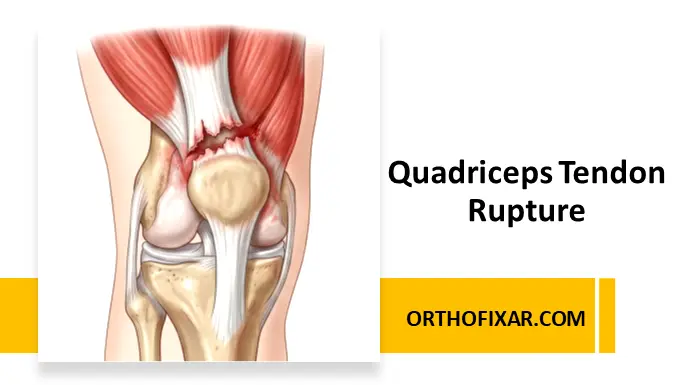
Quadriceps tendon rupture is an uncommon but disabling cause of acute knee pain that disrupts the extensor mechanism. Although less frequently discussed than other knee injuries, it is more common than patellar tendon rupture and requires prompt diagnosis and treatment to prevent long-term dysfunction.
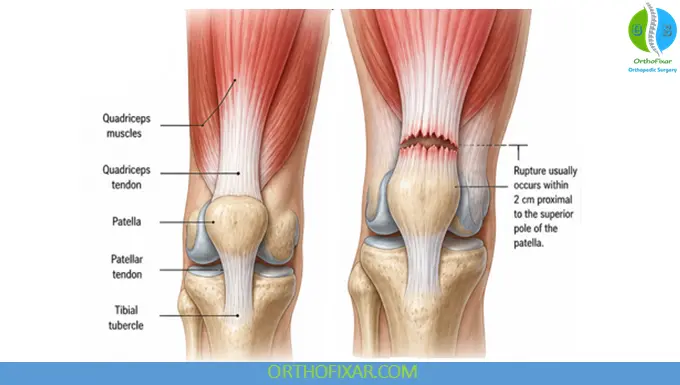
The rupture typically occurs within 2 cm proximal to the superior pole of the patella, most often at the bone–tendon junction in patients over 40 years old.
Epidemiology
Quadriceps tendon tear most commonly:
- Occurs in patients older than 40 years
- Results from sudden eccentric contraction of the quadriceps
- Is more frequent in males than females
In younger patients (<40 years), tears are more likely mid-substance, whereas in older individuals they occur near the patellar insertion.
Mechanism of Injury
The knee extensor mechanism includes:
- Quadriceps muscle group
- Quadriceps tendon
- Patella
- Patellar tendon
- Tibial tubercle insertion
Injury occurs due to:
- Forceful eccentric contraction of the quadriceps
- Typically with:
- Foot planted
- Knee flexed
This leads to failure of the tendon, especially if underlying degeneration exists.
Risk Factors for Quadriceps Tendon Rupture
Predisposing factors weaken tendon integrity and increase rupture risk:
- Diabetes mellitus
- Chronic renal failure
- Rheumatoid arthritis / inflammatory arthropathy
- Hyperparathyroidism
- Connective tissue disorders
- Tendinitis
- Anabolic steroid use
- Local corticosteroid injections
- Systemic steroid therapy
See Also: Patellar Fractures | Broken Kneecap

Clinical Evaluation
History
Patients typically report:
- A sudden “pop” sensation
- Acute knee pain
- Difficulty or inability to bear weight
Physical Examination
Key findings include:
- Knee joint effusion
- Tenderness at the superior pole of the patella
- Palpable defect proximal to the patella
- Loss of active knee extension (hallmark)
Important distinctions:
- Complete Quadriceps Tendon Rupture→ no active extension
- Partial Quad tear → preserved extension but with lag
- If extension is possible despite a defect → extensor retinaculum may be intact
Quadriceps Tendon Rupture Symptoms
Common symptoms include:
- Sudden onset knee pain
- Audible or felt “pop”
- Swelling and tenderness
- Inability to perform straight leg raise (complete tear)
- Weak or delayed extension (partial tear)
See Also: Patellar Dislocation
Radiology
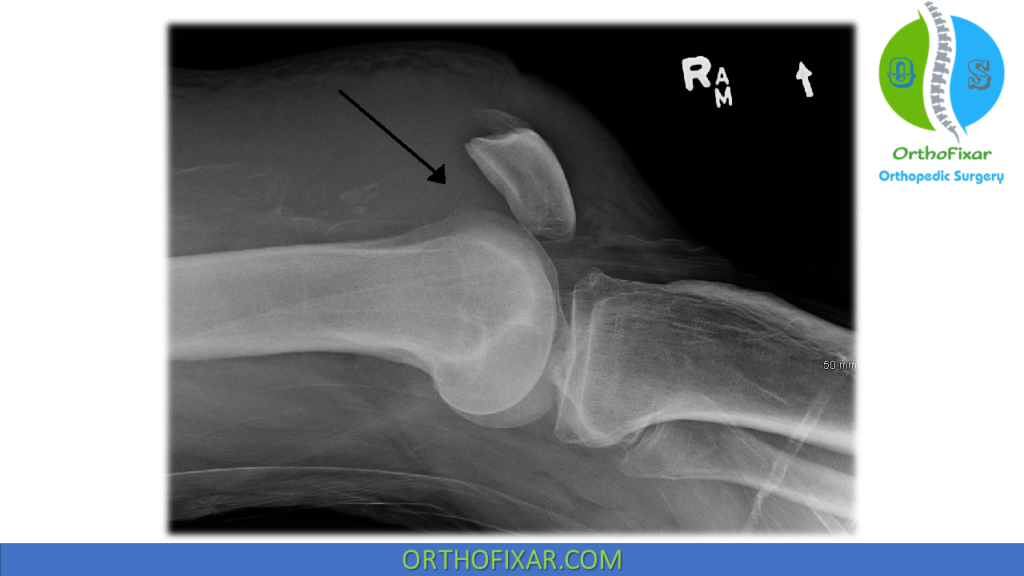
X-rays (AP and Lateral)
- Perform with knee in ~30° flexion
- Findings may include:
- Patella baja (inferior displacement of patella)
- Altered patellofemoral alignment
Blumensaat Line Assessment
On lateral radiograph:
- The inferior pole of the patella should align with the projected Blumensaat line
- Deviations suggest extensor mechanism injury:
- Patella baja → quadriceps tendon rupture
- Patella alta → patellar tendon rupture
Advanced Imaging
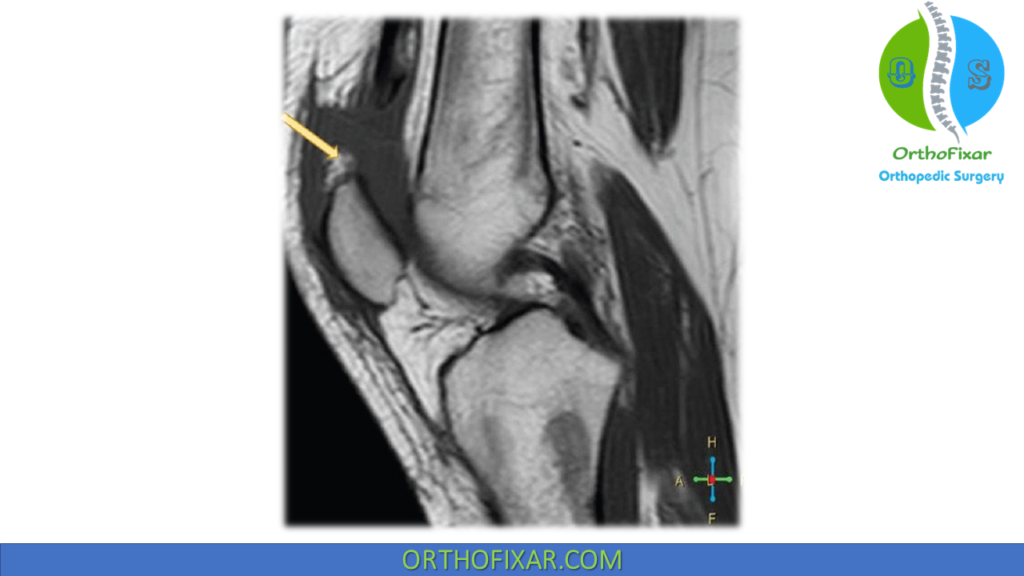
Used when diagnosis is unclear:
- MRI – gold standard for soft tissue evaluation
- Ultrasound – useful, rapid, and cost-effective
Quadricep Tendon Rupture Repair Treatment
Nonoperative Management
Indicated for partial quad tears with preserved extension:
- Knee immobilization in full extension for 4–6 weeks
- Followed by progressive physiotherapy
- Restore range of motion
- Strengthen quadriceps
Operative Management
Indicated for complete ruptures
Surgical techniques:
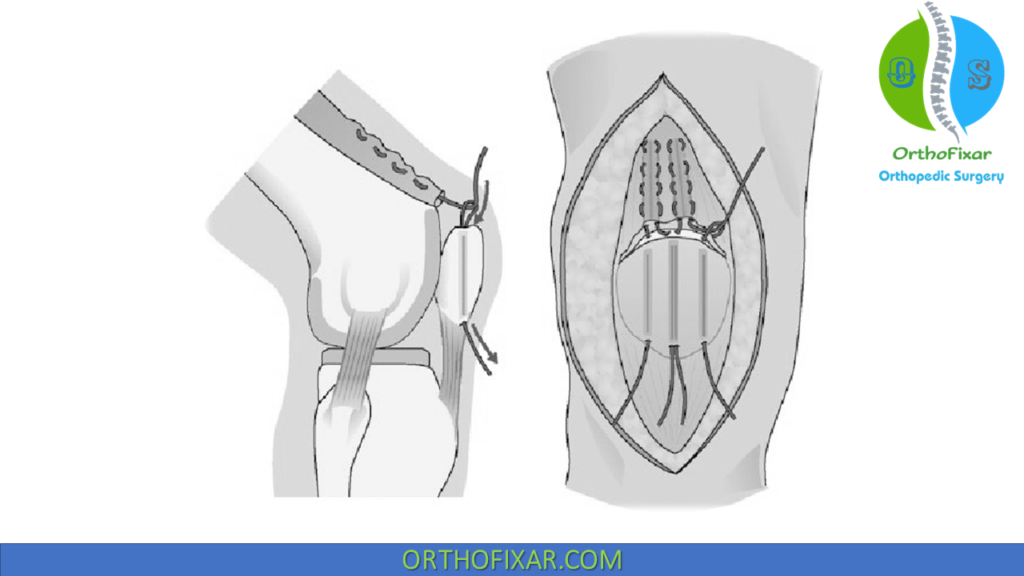
- Reapproximation of tendon to bone
- Using non-absorbable sutures through bone tunnels
- Or suture anchors
- Repair should be performed:
- Close to articular surface
- To avoid patellar tilting
Specific approaches:
- Mid-substance tears → end-to-end repair
- Reinforcement techniques:
- Codivilla turn-down flap
- Allograft augmentation
- Chronic ruptures:
- Require V–Y advancement (Codivilla V–Y plasty)
Postoperative Management
- Immobilization with:
- Knee immobilizer or cylinder cast for 5–6 weeks
- Weight-bearing allowed in extension as tolerated
- Gradual rehabilitation program
- Hinged knee braces are not typically indicated

Complications
Potential complications include:
- Rerupture
- Persistent quadriceps weakness or atrophy
- Reduced knee flexion
- Infection
Key Clinical Pearls
- Loss of active knee extension = red flag
- Always compare with contralateral knee
- Early surgical repair leads to better functional outcomes
- Missed diagnosis significantly worsens prognosis
References & More
- Siwek CW, Rao JP. Ruptures of the extensor mechanism of the knee joint. J Bone Joint Surg Am. 1981 Jul;63(6):932-7. PMID: 6985557. Pubmed
- Pope JD, El Bitar Y, Mabrouk A, et al. Quadriceps Tendon Rupture. [Updated 2023 Apr 22]. In: StatPearls [Internet]. Treasure Island (FL): StatPearls Publishing; 2026 Jan-. Available from: Pubmed
- Mercer’s Textbook of Orthopaedics and Trauma, Tenth edition.
- Millers Review of Orthopaedics -7th Edition Book.
- Egol KA. Handbook of fractures. 6th ed. Philadelphia: Lippincott Williams & Wilkins; 2019.