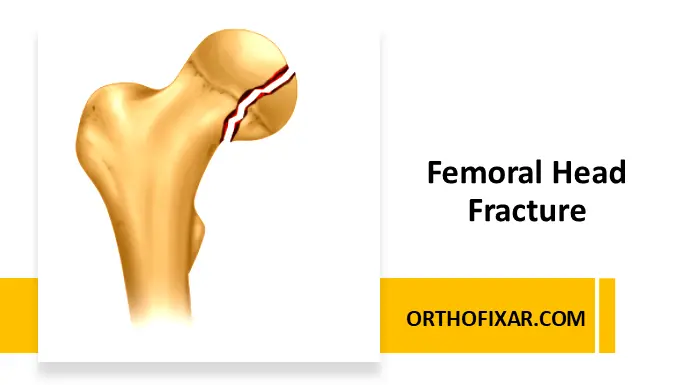
A femoral head fracture is a rare but severe orthopedic injury involving the articular surface of the femoral head. It typically occurs in association with traumatic hip dislocation, most commonly posterior dislocation following high-energy trauma.
Although uncommon, this injury demands urgent diagnosis and management to prevent long-term complications such as avascular necrosis and post-traumatic arthritis.
Epidemiology
- Incidence: ~2 cases per million people annually
- Common in young adults (high-energy trauma group)
- Frequently associated with motor vehicle accidents (~80% cases)
- Occurs in 4–17% of hip dislocations
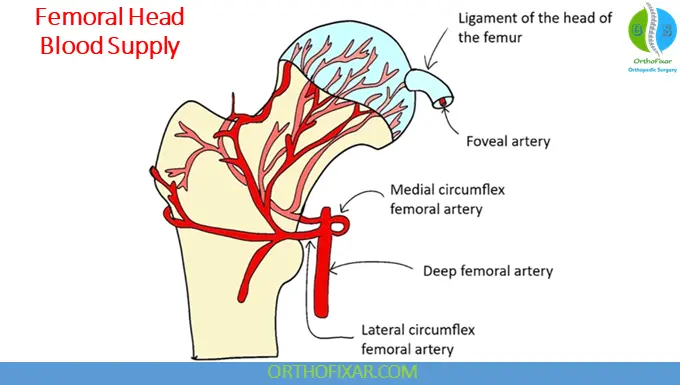
Mechanism of Injury
Femoral head fractures usually result from axial loading of the femur when the hip is flexed, such as:
- Dashboard injury in road traffic accidents
- Falls from height
- High-energy sports trauma
The force drives the femoral head against the acetabulum, leading to fracture and often dislocation.
See Also: Hip Joint Anatomy
Associated Injuries
These fractures rarely occur in isolation and may include:
- Posterior hip dislocation (most common)
- Acetabular fractures
- Femoral neck fractures
- Sciatic nerve injury
See Also: Adult Hip Dislocations
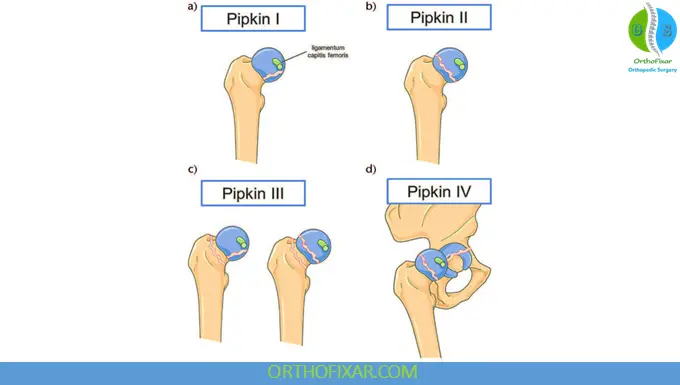
Classification: Pipkin Classification
The Pipkin classification is the most widely used system for femoral head fractures.
Types:
- Type I:
Fracture inferior to the fovea capitis (non-weight-bearing surface) - Type II:
Fracture superior to the fovea capitis (weight-bearing surface) - Type III:
Type I or II + femoral neck fracture - Type IV:
Type I or II + acetabular fracture
Clinical relevance:
- Types I & II → better prognosis
- Types III & IV → worse outcomes and higher complication rates
Clinical Presentation
Patients typically present with:
- Severe hip pain
- Inability to bear weight
- Limb deformity (often flexed, adducted, internally rotated in posterior dislocation)
- Restricted hip movement
Neurological examination is essential due to risk of sciatic nerve injury.
Diagnosis
1. Imaging
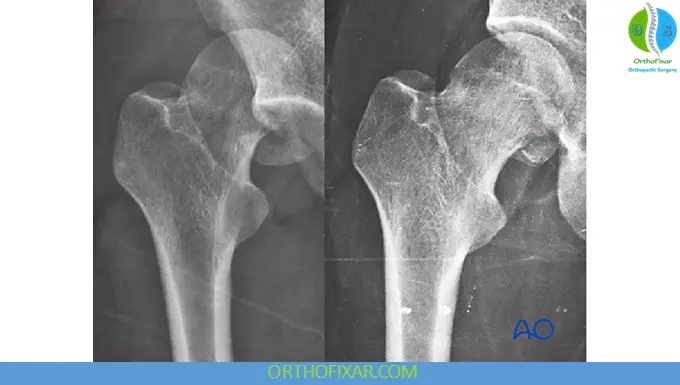
- X-ray (AP pelvis): Initial assessment
- CT scan (essential):
- Defines fracture fragment size
- Detects loose bodies
- Evaluates joint congruity
CT is mandatory after reduction to guide treatment.
See Also: Hip Joint X-Ray Imaging
Emergency Management
Femoral head fracture with dislocation is an orthopedic emergency.
Immediate step:
- Urgent closed reduction of hip joint
Delay increases risk of:
- Avascular necrosis
- Cartilage damage
Definitive Treatment
Treatment depends on:
- Fracture type (Pipkin classification)
- Fragment size and displacement
- Joint congruity
- Associated injuries
Non-operative Treatment
Indications:
- Small fragments
- Minimal displacement (<1–2 mm)
- Stable, congruent hip joint
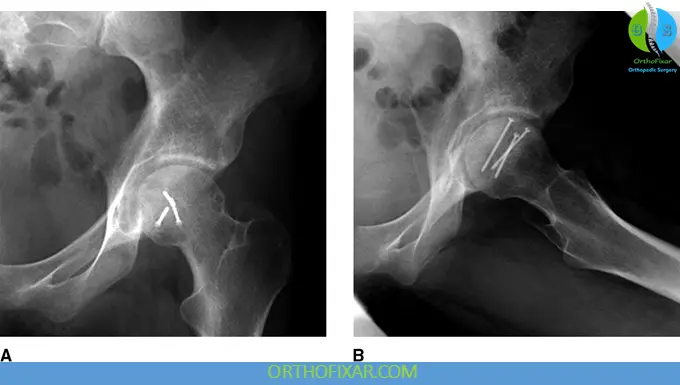
Surgical Treatment Options
- Fragment Excision
- Small, non-weight-bearing fragments (Type I)
- Open Reduction and Internal Fixation (ORIF)
- Larger fragments in weight-bearing zone (Type II)
- Total Hip Arthroplasty (THA)
- Severe fractures (Type III, elderly patients)
Surgical Approach
- Anterior approach: Better for anterior fragments
- Posterior approach: Used when associated with posterior dislocation
Choice depends on fracture anatomy and associated injuries.
See Also: Posterior Approach to Hip
Complications
Femoral head fractures carry a significant risk of long-term morbidity:
- Avascular necrosis (AVN)
- Post-traumatic osteoarthritis
- Heterotopic ossification
- Nonunion or malunion
Prognosis
- Better outcomes in Pipkin Type I and II
- Poorer outcomes in Type III and IV due to associated injuries
- Early reduction and appropriate management improve prognosis
Key Clinical Pearls
- Always suspect femoral head fracture in hip dislocation cases
- Urgent reduction is critical
- CT scan is mandatory for surgical planning
- Classification guides treatment and prognosis
Conclusion
Femoral head fractures are rare but complex injuries requiring rapid diagnosis, accurate classification, and tailored management. The Pipkin classification remains the cornerstone for guiding treatment decisions. Early intervention significantly reduces complications and improves functional outcomes.
References & More
- Ross JR, Gardner MJ. Femoral head fractures. Curr Rev Musculoskelet Med. 2012 Sep;5(3):199-205. doi: 10.1007/s12178-012-9129-8. PMID: 22628176; PMCID: PMC3535084. Pubmed
- Menger MM, Braun BJ, Herath SC, Küper MA, Rollmann MF, Histing T. Fractures of the femoral head: a narrative review. EFORT Open Rev. 2021 Nov 19;6(11):1122-1131. doi: 10.1302/2058-5241.6.210034. PMID: 34909230; PMCID: PMC8631236. Pubmed
- Dunseath OA, Al-Obaidi I, Ignatius L, Rudran B, Jordan C. Femoral head fractures: anatomy, diagnosis and management. EFORT Open Rev. 2026 Mar 2;11(3):175-182. doi: 10.1530/EOR-2025-0026. PMID: 41770054; PMCID: PMC12974760. Pubmed
- Egol KA. Handbook of fractures. 6th ed. Philadelphia: Lippincott Williams & Wilkins; 2019.