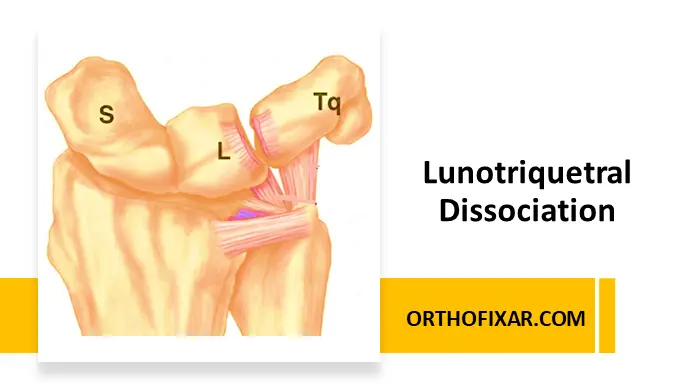
Lunotriquetral dissociation (LT dissociation) is a significant but often underdiagnosed cause of ulnar-sided wrist pain. As part of the spectrum of carpal instability, it typically involves disruption of key ligamentous structures stabilizing the proximal carpal row. This SEO-optimized guide is based on trusted orthopedic literature and PubMed-backed concepts, designed for clinicians, students, and medical educators.
What is Lunotriquetral Dissociation?
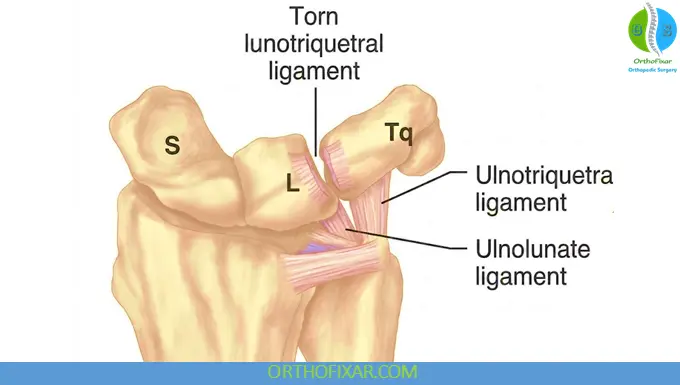
Lunotriquetral dissociation refers to instability between the lunate and triquetrum, resulting from injury to the lunotriquetral interosseous ligament and surrounding stabilizers.
These injuries commonly involve:
- Disruption of the distal limb of the volar radiolunotriquetral ligament
- Injury to the lunotriquetral interosseous ligament
- Damage to the dorsal radiolunotriquetral ligament
It may occur as:
- A Stage III lesser arc injury in perilunate instability
- A result of excessive radial deviation with intercarpal pronation
Etiology and Mechanism of Injury
Lunotriquetral ligament disruption can occur via:
1. Acute Trauma
- Fall on an outstretched hand (FOOSH)
- Forced radial deviation
- Intercarpal pronation forces
2. Degenerative or Inflammatory Conditions
- Chronic ligament attenuation
- Rheumatoid arthritis or other inflammatory arthropathies
See Also: Scapholunate Dissociation
Clinical Presentation
Acute Injury
- Swelling over the peritriquetral area
- Localized tenderness (typically one fingerbreadth distal to the ulnar head)
- Pain exacerbated by wrist motion
Chronic Injury
- Vague, persistent ulnar-sided wrist pain
- Mechanical symptoms (clicking, instability)
Physical Examination Tests
Ballottement Test (Shear/Shuck Test)
- Stabilize the lunate and translate the triquetrum dorsally and volarly
- Positive test: Increased excursion compared to the opposite side + painful crepitus
See Also: Lunotriquetral Ballottement Test
Ulnar Compression Test
- Apply axial load with wrist in ulnar deviation and pronation
- Positive test: Painful “snap” or click
Imaging and Radiographic Evaluation
Standard PA View
- Often normal
- May show subtle disruption of the proximal carpal arc
Radial Deviation View
- Triquetrum appears dorsiflexed
- Scapholunate complex appears palmar flexed
Lateral View
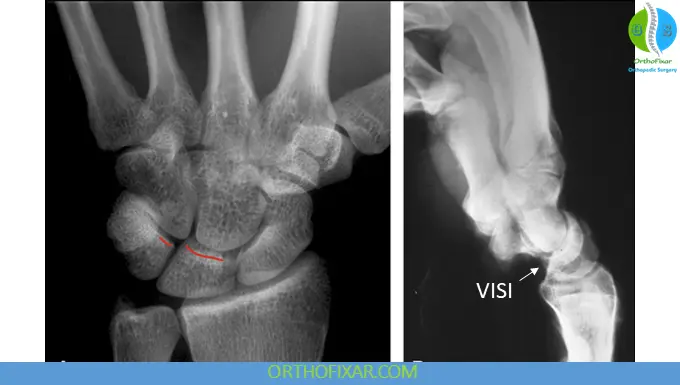
- May demonstrate VISI (Volar Intercalated Segment Instability) pattern
Stress Views
- Bilateral clenched-fist views in radial and ulnar deviation can reveal instability
Understanding VISI Deformity
VISI: Volar flexion of lunate due to LT instability
In LT dissociation, the lunate follows the scaphoid into volar flexion, producing a VISI deformity—opposite to the DISI pattern seen in scapholunate injuries.
Treatment of Lunotriquetral Dissociation
Nonoperative Management (Acute, Stable Injuries)
- Long arm cast for 4 weeks
- Followed by short arm cast or splint for another 4 weeks
Closed Reduction and Pinning
- Indicated if instability persists
- Temporary fixation between lunate and triquetrum
Surgical Management
Required when:
- Reduction is unacceptable
- Angular deformity is present
- Chronic instability
Procedures include:
- Open reduction and internal fixation (ORIF)
- Combined dorsal and volar approach
- Ligament repair or reconstruction
- Lunotriquetral fusion (in severe or chronic cases)
Complications
- Recurrent instability
- Persistent ulnar-sided wrist pain
- Degenerative arthritis
Advanced Surgical Options
- Ligament reconstruction with capsular augmentation
- Lunotriquetral fusion
- Ulnar shortening osteotomy (to improve ligament tension)
Key Takeaways
- Lunotriquetral dissociation is a subtle but clinically important wrist injury
- Diagnosis requires a combination of clinical suspicion + stress imaging
- Early treatment improves outcomes and prevents chronic instability
- Chronic cases may require surgical reconstruction or fusion
References & More
- Ranzenberger LR, Carter KR. Lunotriquetral Instability. [Updated 2023 Jun 26]. In: StatPearls [Internet]. Treasure Island (FL): StatPearls Publishing; 2026 Jan-. Available from: Pubmed
- Shin AY, Battaglia MJ, Bishop AT. Lunotriquetral instability: diagnosis and treatment. J Am Acad Orthop Surg. 2000 May-Jun;8(3):170-9. PubMed.
- Ritt MJ, Bishop AT, Berger RA, Linscheid RL, Berglund LJ, An KN. Lunotriquetral ligament properties: a comparison of three anatomic subregions. J Hand Surg Am. 1998 May;23(3):425-31. PubMed
- Egol KA. Handbook of fractures. 6th ed. Philadelphia: Lippincott Williams & Wilkins; 2019.