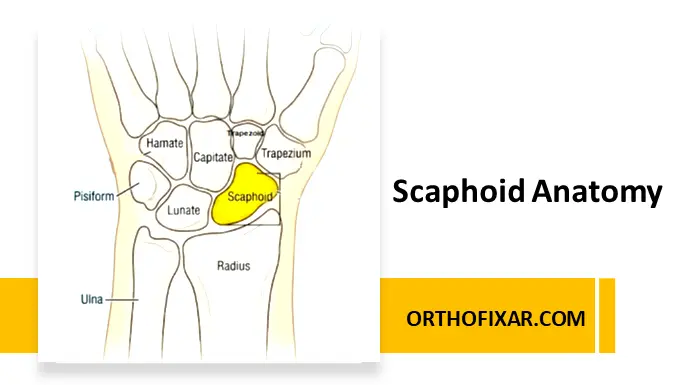
The scaphoid bone (os scaphoideum) is one of the most clinically significant carpal bones due to its unique anatomy, biomechanics, and susceptibility to injury. It plays a central role in wrist stability and motion, acting as a mechanical link between the proximal and distal carpal rows. Its anatomical features—particularly its vascular supply—are crucial in understanding fracture behavior and complications such as nonunion and avascular necrosis.
Location and Classification
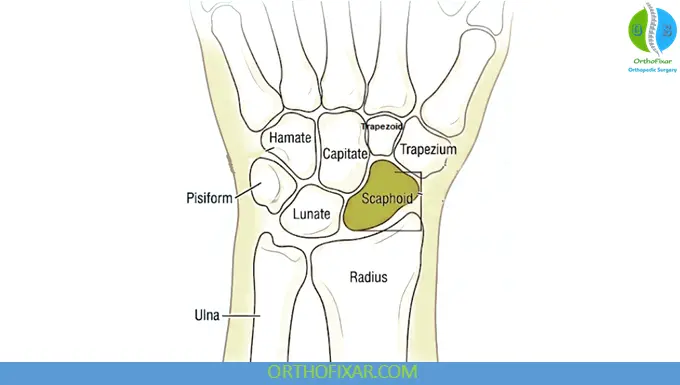
The scaphoid is a short carpal bone located on the radial (thumb) side of the wrist. It is the most lateral bone in the proximal carpal row and forms part of the radiocarpal joint.
It articulates with five bones:
- Radius (proximally)
- Lunate (medially)
- Capitate (distally)
- Trapezium and trapezoid (distolaterally)
This extensive articulation explains its key role in wrist kinematics.
See Also: Wrist Anatomy
Morphology and Surface Anatomy
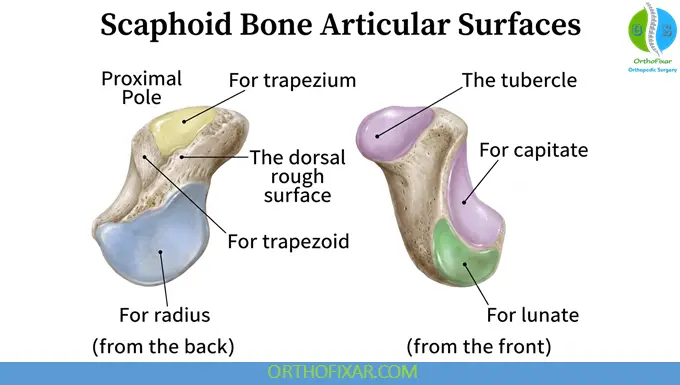
The scaphoid has a complex, boat-like shape, which contributes to its mechanical behavior under load. It consists of three main regions:
- Proximal pole – smooth, convex, articulates with the radius
- Waist – narrow central portion, most common fracture site
- Distal pole – broader, includes the tubercle
Key anatomical features include:
- Scaphoid tubercle (palmar surface): attachment for the flexor retinaculum and abductor pollicis brevis
- Palmar and dorsal surfaces
- Multiple articular facets for neighboring carpal bones
Biomechanics and Functional Role
The scaphoid serves as a critical link between the proximal and distal carpal rows, coordinating wrist motion.
- It tends to flex (palmar flexion) during axial loading
- Its unique orientation allows it to stabilize the carpus during movement
- It transmits forces from the hand to the forearm
Because of this bridging function, disruption of the scaphoid significantly alters wrist biomechanics.
Ligamentous Attachments
The scaphoid is strongly anchored by several ligaments, including:
- Scapholunate ligament
- Radial collateral ligament
- Radiocapitate ligament
These ligamentous attachments contribute to:
- Stability of the wrist
- Fracture displacement patterns
- Altered biomechanics when injured
Scaphoid Blood Supply
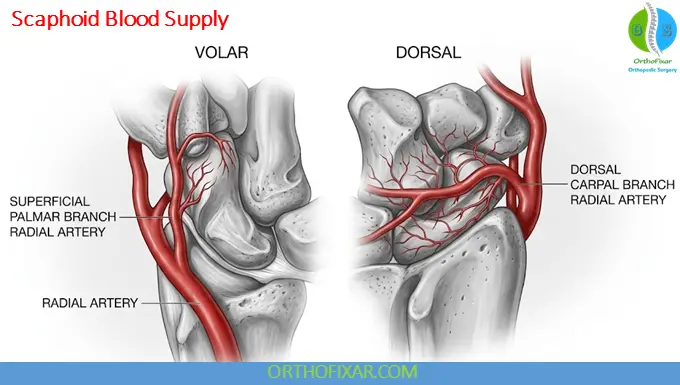
The vascular anatomy of the scaphoid is notoriously precarious, which is why surgeons respect it.
- Blood supply is mainly from branches of the radial artery
- Dorsal branches supply ~70–80%, entering distally
- Flow is retrograde, supplying the proximal pole last
👉 Clinical implication:
- Proximal pole fractures are at high risk of avascular necrosis (AVN)
Microanatomy and Nutrient Foramina
Recent anatomical studies show:
- Multiple nutrient foramina, predominantly on the dorsal surface
- Average 6 nutrient foramina per bone
- Uneven distribution affecting vascular penetration.
This microvascular pattern further explains variable healing potential.
Clinical Correlation
The scaphoid is the most frequently fractured carpal bone, accounting for up to 70% of carpal fractures.
Why is it prone to injury?
- Positioned along the line of force in a fall on an outstretched hand (FOOSH)
- Subjected to axial loading and extension forces.
Key clinical concerns:
- Occult fractures (may not appear initially on X-ray)
- Nonunion due to limited blood supply
- Avascular necrosis, especially in proximal fractures
- SNAC wrist (Scaphoid Nonunion Advanced Collapse)
Summary
The scaphoid is far more than just another carpal bone—it is a biomechanical cornerstone of the wrist. Its:
- Complex shape
- Extensive articulations
- Unique ligamentous support
- Retrograde blood supply
all combine to make it highly functional yet clinically vulnerable.
Key Takeaways
- Most important carpal bone in wrist stability
- Bridge between proximal and distal carpal rows
- Waist = most common fracture site
- Retrograde blood supply → risk of AVN
- Critical structure in wrist biomechanics and injury patterns
References & More
- Berger RA. The anatomy of the scaphoid. Hand Clin. 2001 Nov;17(4):525-32. PMID: 11775465. Pubmed
- Richard O. Scaphoïde [Scaphoid bone]. Ann Radiol (Paris). 1992;35(5):367-72. French. PMID: 1288402. Pubmed
- Egol KA. Handbook of fractures. 6th ed. Philadelphia: Lippincott Williams & Wilkins; 2019.