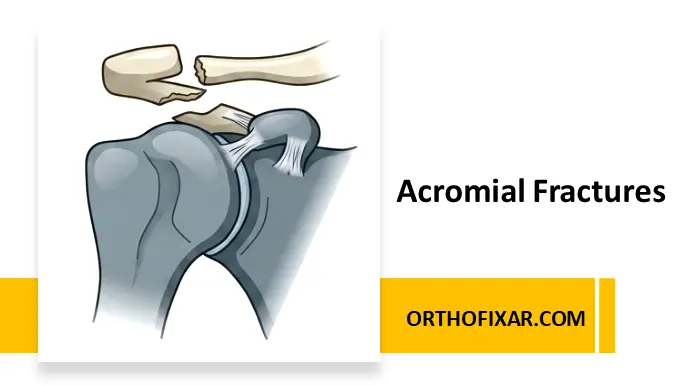
Acromial fractures are rare shoulder injuries involving the acromion process of the scapula. These fractures are commonly associated with high-energy trauma, shoulder girdle injuries, and rotator cuff dysfunction. Because acromial fractures can be easily missed on standard radiographs, early diagnosis and appropriate management are essential to prevent chronic pain, impingement, nonunion, and shoulder dysfunction.
This comprehensive medical education guide reviews the epidemiology, anatomy, classification systems, clinical presentation, imaging findings, treatment options, rehabilitation protocols, complications, and prognosis of acromial fractures using evidence-based orthopedic sources.
What is an Acromial Fracture?
An acromial fracture is a fracture involving the acromion, the lateral extension of the scapular spine that forms the superior aspect of the shoulder. The acromion articulates with the clavicle at the acromioclavicular (AC) joint and serves as an attachment site for the deltoid and trapezius muscles.
Acromial fractures are classified as scapular fractures and represent approximately 8% of all scapular fractures.
See Also: Scapula Fractures
Anatomy of the Acromion
The acromion is an important osseous structure that:
- Forms the roof of the subacromial space
- Protects the rotator cuff
- Contributes to shoulder stability
- Serves as an attachment for:
- Deltoid muscle
- Trapezius muscle
- Coracoacromial ligament
The relationship between the acromion and rotator cuff is clinically important because displaced fractures can narrow the subacromial space and produce impingement syndrome.
See Also: Scapula Anatomy
Epidemiology of Acromial Fractures
Acromial fractures are uncommon injuries.
Key epidemiologic findings include:
- Scapular fractures account for less than 1% of all fractures
- Approximately 3–5% of shoulder girdle fractures involve the scapula
- Acromial fractures represent roughly 8% of scapular fractures
- Most occur after high-energy trauma such as:
- Motor vehicle accidents
- Falls from height
- Direct shoulder trauma
- Sports injuries
Most patients are young adult males due to exposure to high-energy mechanisms.
Mechanism of Injury
Common injury mechanisms include:
Direct Trauma
A direct blow to the superior shoulder can fracture the acromion.
Examples:
- Contact sports injuries
- Falls onto the shoulder
- Crush injuries
Indirect Trauma
Force transmitted through the humeral head into the acromion during impact.
Stress Fractures
Rarely, repetitive overhead activity may produce stress fractures in:
- Athletes
- Throwing sports participants
- Manual laborers
Postoperative or Insufficiency Fractures
Can occur after:
- Reverse shoulder arthroplasty
- Rotator cuff surgery
- Osteoporotic bone weakening
Classification of Acromial Fractures
Several classification systems exist.
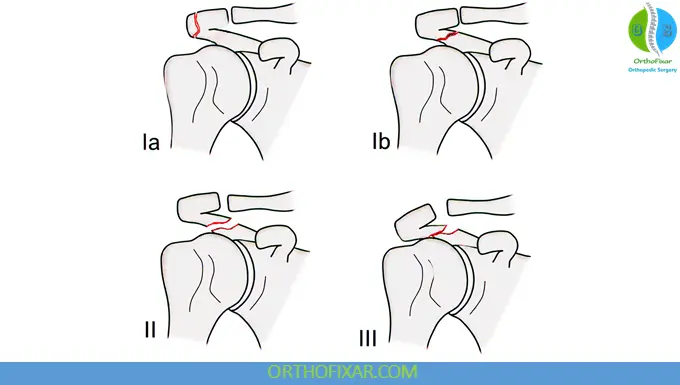
Kuhn Classification
The Kuhn classification is commonly used clinically.
Type I
- Nondisplaced
- Type IA: Avulsion
- Type IB: Direct trauma
Type II
- Displaced but without significant subacromial narrowing
Type III
- Inferior displacement causing reduction of subacromial space
- Associated with impingement
Type III fractures are more likely to require surgery.
Ogawa Classification
Based on location relative to the spinoglenoid notch.
Type I
- Fractures anterior to the spinoglenoid notch
Type II
- Fractures posterior to the notch
Clinical Presentation
Symptoms
Patients may present with:
- Severe shoulder pain
- Swelling over the superior shoulder
- Limited shoulder motion
- Pain with abduction
- Weakness
- Crepitus
- Difficulty lifting the arm
Physical Examination
Common findings include:
- Tenderness over the acromion
- Ecchymosis
- Painful ROM
- Deltoid dysfunction
- Shoulder asymmetry
- Signs of impingement
Associated injuries should always be assessed because scapular fractures frequently coexist with:
- Rib fractures
- Clavicle fractures
- Pulmonary injuries
- Brachial plexus injuries
Scapular fractures are associated with additional injuries in up to 80–95% of cases.
Diagnosis of Acromial Fractures
Plain Radiographs
Initial imaging includes:
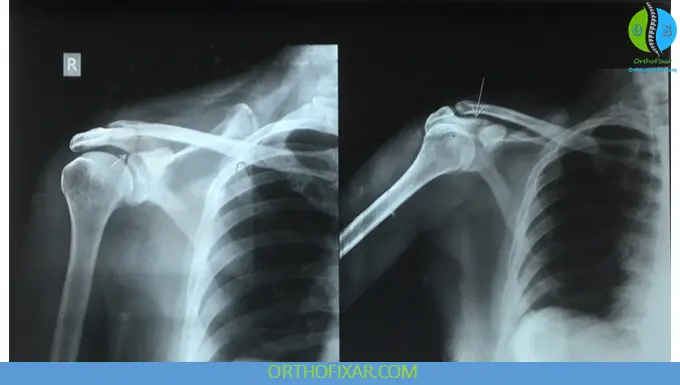
- AP shoulder view
- Scapular Y view
- Axillary lateral view
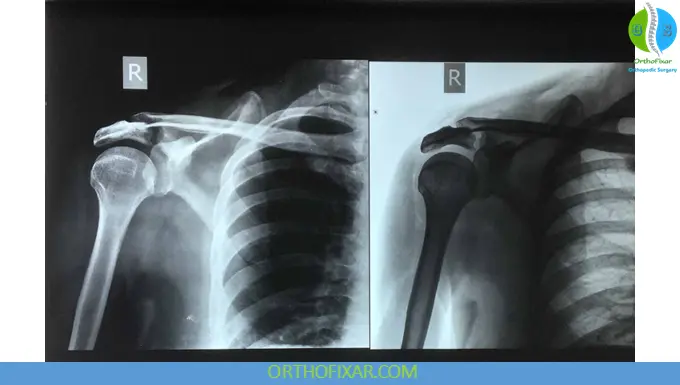
However, acromial fractures are frequently missed on routine X-rays.
CT Scan
CT imaging is considered the gold standard for evaluating:
- Fracture displacement
- Articular involvement
- Subacromial narrowing
- Surgical planning
Three-dimensional CT reconstruction is particularly useful.
MRI
MRI may help evaluate:
- Rotator cuff injuries
- Labral pathology
- Bone edema
- Occult stress fractures
Differential Diagnosis
Important differentials include:
- Os acromiale
- AC joint injury
- Rotator cuff tear
- Scapular spine fracture
- Subacromial impingement
- Shoulder contusion
Os Acromiale vs Acromial Fracture
Os acromiale is an unfused secondary ossification center that may mimic fracture radiographically. It usually has:
- Smooth corticated margins
- Bilateral occurrence
- Chronic appearance
Treatment of Acromial Fractures
Treatment depends on:
- Fracture displacement
- Subacromial space compromise
- Symptom severity
- Associated injuries
- Functional demand
Nonoperative Management
Most minimally displaced fractures are treated conservatively.
Indications
- Nondisplaced fractures
- Stable fractures
- No impingement
- No subacromial narrowing
Conservative Treatment Protocol
Immobilization
- Sling immobilization for 2–6 weeks
Pain Control
- NSAIDs
- Ice therapy
Physical Therapy
- Early pendulum exercises
- Gradual ROM progression
- Strengthening after union
Most nondisplaced fractures heal successfully with conservative treatment.
Surgical Management
Indications for Surgery
Operative fixation is considered for:
- Displaced fractures
- Subacromial impingement
- Symptomatic nonunion
- Open fractures
- Multiple shoulder suspensory complex injuries
- Deltoid dysfunction
Surgical Techniques
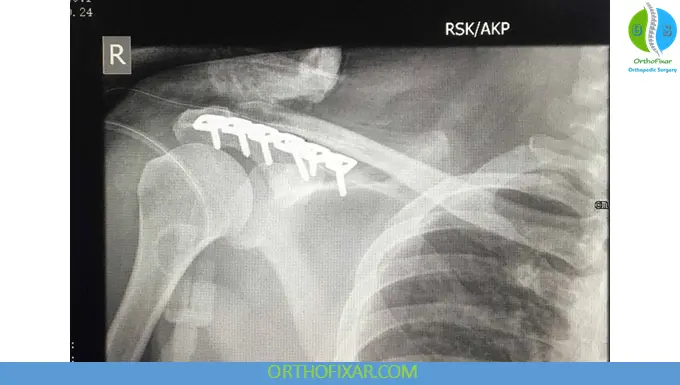
Open Reduction and Internal Fixation (ORIF)
Common fixation methods include:
- Plates and screws
- Tension band wiring
- Cannulated screws
Bone Grafting
Used in cases of nonunion.
Postoperative Rehabilitation
Typical rehabilitation includes:
Phase 1 (0–6 Weeks)
- Sling immobilization
- Passive ROM
Phase 2 (6–12 Weeks)
- Active ROM
- Gentle strengthening
Phase 3 (>12 Weeks)
- Advanced strengthening
- Return to sport/work activities
Complications of Acromial Fractures
- Potential complications include:
- Nonunion: More common in displaced fractures.
- Subacromial Impingement: Occurs when inferior displacement narrows the subacromial space.
- Chronic Shoulder Pain
- Deltoid Weakness
- Reduced ROM
- Post-Traumatic Arthritis
- Hardware Irritation: Possible after ORIF.
Prognosis
The prognosis is generally favorable when diagnosis and treatment are timely.
Better Outcomes Occur With:
- Early recognition
- Minimal displacement
- Appropriate rehabilitation
Poor Prognostic Factors
- Delayed diagnosis
- Nonunion
- Severe displacement
- Associated rotator cuff injury
Most patients regain good shoulder function after appropriate treatment.
Key Clinical Pearls
- Acromial fractures are rare but clinically important shoulder injuries.
- High-energy trauma is the most common cause.
- CT imaging is essential for accurate diagnosis.
- Most nondisplaced fractures heal with conservative management.
- Displaced fractures with impingement often require surgery.
- Os acromiale should be differentiated from acute fracture.
- Early rehabilitation helps prevent shoulder stiffness.
Conclusion
Acromial fractures are uncommon scapular injuries that require careful evaluation due to their potential impact on shoulder biomechanics and rotator cuff function. Although many fractures can be managed conservatively, displaced fractures causing subacromial narrowing may require surgical fixation to restore shoulder mechanics and prevent chronic disability.
Early diagnosis with CT imaging, appropriate classification, and individualized treatment planning are essential for achieving optimal outcomes in patients with acromial fractures.
Frequently Asked Questions (FAQ)
Are acromial fractures common?
No. They are rare injuries and account for a small percentage of scapular fractures.
Can acromial fractures heal without surgery?
Yes. Most nondisplaced fractures heal successfully with sling immobilization and rehabilitation.
What imaging is best for acromial fractures?
CT scan with 3D reconstruction is the best modality for evaluating fracture anatomy and displacement.
What is the main surgical indication?
Inferior displacement causing subacromial impingement is a major indication for surgery.
What complications can occur?
Complications include:
– Nonunion
– Impingement syndrome
– Chronic pain
– Shoulder stiffness
References & More
- Bhaduri I, Thakur R, Kumar S, Rajak MK. Isolated Fracture of the Acromion Process: A Case Report. Cureus. 2021 Mar 22;13(3):e14032. doi: 10.7759/cureus.14032. PMID: 33767940; PMCID: PMC7982874. Pubmed
- Lucasti CJ, Namdari S. Acromial Stress Fractures: A Systematic Review. Arch Bone Jt Surg. 2019 Sep;7(5):397-401. PMID: 31742214; PMCID: PMC6802552. Pubmed
- Kuhn JE, Blasier RB, Carpenter JE. Fractures of the acromion process: a proposed classification system. J Orthop Trauma. 1994;8(1):6-13. doi: 10.1097/00005131-199402000-00002. PMID: 8169698. Pubmed
- Egol KA. Handbook of fractures. 6th ed. Philadelphia: Lippincott Williams & Wilkins; 2019.