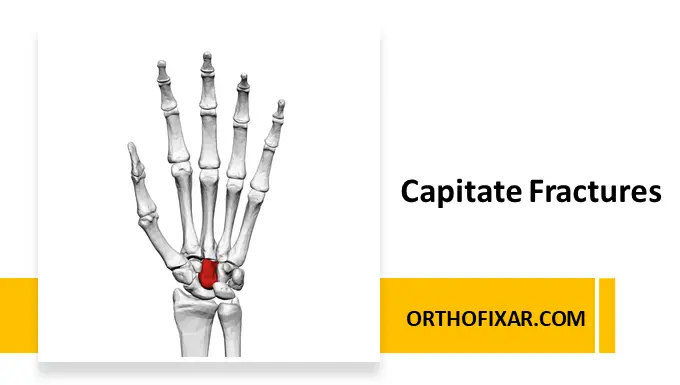
Capitate fractures are among the rarest injuries of the carpal bones, largely due to the capitate’s protected central position within the wrist. Despite their low incidence, these fractures carry important clinical implications, particularly when associated with complex carpal injury patterns. Early recognition and appropriate management are essential to prevent long-term complications such as osteonecrosis and midcarpal arthritis.
Anatomy and Epidemiology
The capitate is the largest carpal bone and serves as the central axis of wrist motion. Its strong ligamentous attachments and sheltered anatomical position contribute to the rarity of isolated fractures. Most capitate injuries occur in conjunction with other carpal disruptions rather than as standalone injuries.
See Also: Wrist Anatomy: Bones, Ligaments & Joints
Mechanism of Injury
Capitate fractures typically result from high-energy trauma. The most common mechanisms include:
- Axial loading through the middle finger ray
- Direct crushing forces to the wrist
These forces often produce associated injuries to adjacent carpal bones or metacarpals. A well-documented injury pattern is the greater arc injury, specifically the transscaphoid transcapitate perilunate fracture-dislocation.
A notable variant is naviculocapitate syndrome, where both the scaphoid and capitate are fractured without a frank dislocation. In such cases, the proximal fragment of the capitate may rotate up to 180 degrees, making diagnosis particularly challenging.
See Also: Scaphoid Fractures
Clinical Presentation
Patients with capitate fractures typically present with:
- Localized tenderness over the central dorsal wrist
- Pain exacerbated by wrist dorsiflexion
- Reduced range of motion depending on associated injuries
Pain during wrist extension occurs due to impingement of the fractured capitate against the dorsal rim of the distal radius.
Diagnosis
Diagnosis of capitate fractures can be difficult and is often delayed due to subtle radiographic findings. Recommended imaging includes:
- Standard wrist radiographs, including scaphoid views, which may reveal the fracture
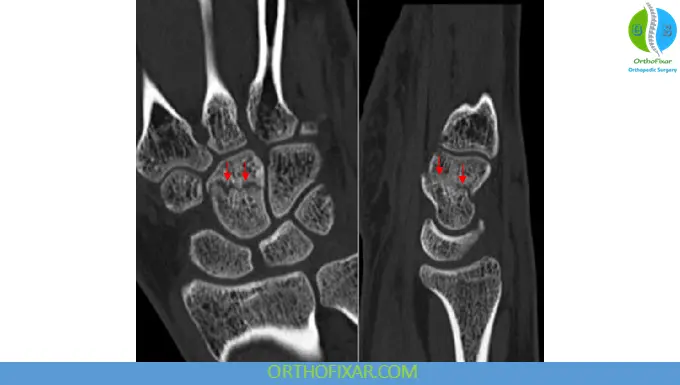
- Computed tomography (CT) for detailed assessment, especially when initial imaging is inconclusive
Advanced imaging is particularly important in detecting fragment displacement or rotational deformities.
Capitate Fractures Treatment
Non-Displaced Fractures
- Immobilization in a cast or splint
- Close radiographic follow-up
Displaced Fractures
Prompt anatomical reduction is critical to minimize the risk of complications. Treatment options include:
- Closed reduction, if achievable
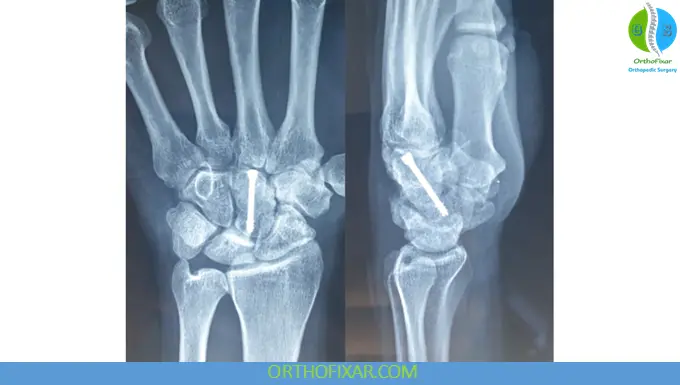
- Open reduction and internal fixation (ORIF) when closed methods fail
Internal fixation is typically performed using:
- Kirschner wires (K-wires)
- Lag screws
The primary goal is restoration of normal carpal alignment and vascular integrity.
Complications
Osteonecrosis
Although rare, osteonecrosis of the capitate can occur due to disruption of its blood supply. This complication may lead to chronic pain and functional impairment, highlighting the importance of early diagnosis and stable fixation.
Midcarpal Arthritis
Post-traumatic arthritis may develop secondary to collapse of the proximal capitate fragment, particularly in cases with delayed or inadequate treatment.
Prognosis
With timely diagnosis and appropriate management, outcomes are generally favorable. However, missed or improperly treated fractures can result in long-term disability, decreased wrist motion, and chronic pain.
Conclusion
Capitate fractures, though uncommon, require a high index of suspicion—especially in the context of high-energy wrist injuries. Advanced imaging, careful clinical evaluation, and prompt anatomical restoration are key to preventing serious complications. Clinicians should remain vigilant for associated injury patterns such as naviculocapitate syndrome, where diagnosis can easily be overlooked.
References & More
- Arabzadeh A, Salkhori O, Kalantar SH, Khabiri SS, Naghizadeh H. Capitate Fracture: Diagnostic Challenges, Treatment Strategies, and Long-Term Complications: A Narrative Review. JBJS Rev. 2025 Aug 22;13(8). doi: 10.2106/JBJS.RVW.25.00112. PMID: 40845185. Pubmed
- Dée W, Winckler S, Brug E. Die Fraktur und die Luxationsfraktur des Os capitatum. Literaturübersicht und Fallbericht [Fracture and dislocation fracture of the os capitatum. Review of the literature and case report]. Unfallchirurg. 1994 Sep;97(9):478-84. German. PMID: 7973753. Pubmed
- Ossowski D, Thomsen NOB, Clementson M, Besjakov J, Jörgsholm P, Björkman A. Long-term outcomes after capitate fractures: a median 16-year follow-up. Arch Orthop Trauma Surg. 2024 Aug;144(8):3885-3893. doi: 10.1007/s00402-024-05495-z. Epub 2024 Aug 23. PMID: 39174766; PMCID: PMC11417065. Pubmed
- Egol KA. Handbook of fractures. 6th ed. Philadelphia: Lippincott Williams & Wilkins; 2019.