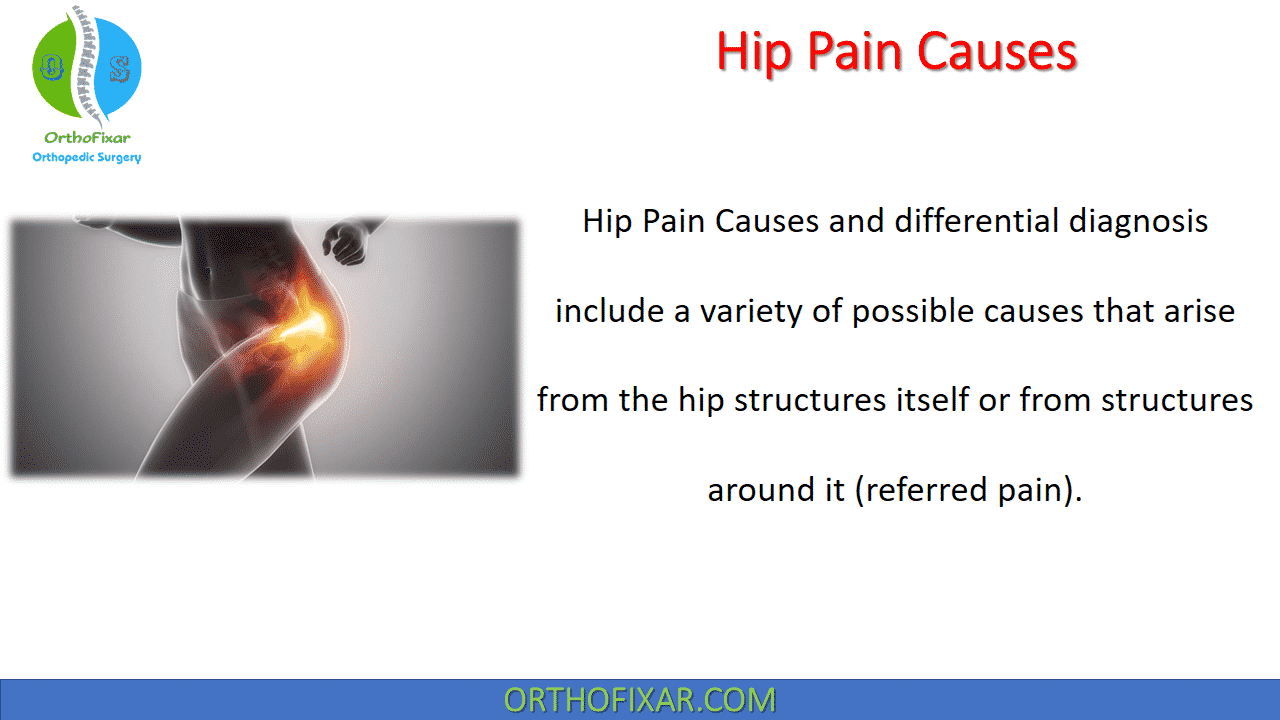
Hip Pain Causes and differential diagnosis include a variety of possible causes that arise from the hip structures itself or from structures around it (referred pain).
The location of the hip pain can provide the clinician with some useful information:
- Complaints of hip or groin pain, morning stiffness, stiffness after sitting, and hip pain with weight-bearing are suggestive of joint involvement, such as OA.
- Periarticular pain that is not reproduced by passive motion and direct joint palpation suggests an alternate etiology such as bursitis, tendinitis, or periostitis.
- Lateral and posterior hip (buttock) and thigh pain may be referred from the lumbar spine.
See Also: Hip Muscles Anatomy
[tele]
Physical Findings in More Common Thigh and Hip Pain Causes:
| Condition | Description of Findings |
|---|---|
| Osteoarthritis of the hip | Tenderness over the anterior hip capsule Pain reproduced by passive rotation of the hip Restricted range of motion (rotation is usually first affected) Pain reproduced by Stinchfield’s test. Abductor limp (more severe cases) Functional leg length discrepancy (if abduction contracture has developed) |
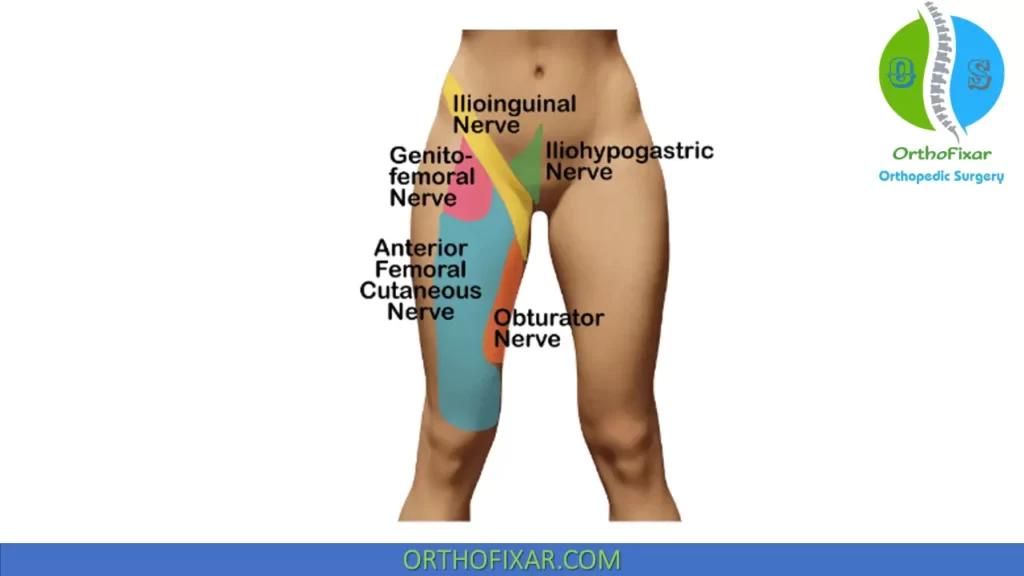
| Meralgia paresthetica | Altered sensation over the anterolateral thigh Symptoms reproduced by pressure or percussion just medial to the anterior–superior iliac spine |
| Piriformis tendinitis | Tenderness to deep palpation near the hook of the greater trochanter. Pain reproduced by piriformis stretch |
| Gluteus medius tendinitis | Tenderness just proximal to the greater trochanter Pain reproduced by resisted abduction of the hip |
| Trochanteric bursitis | Tenderness over the lateral aspect of the greater trochanter Popping or crepitation felt with flexion–extension of the hip (occasionally) Tight iliotibial tract revealed by Ober test (variable) |
| Quadriceps strain or contusion | Tenderness and swelling of the involved area of the quadriceps Weakness of quadriceps contraction Restriction of knee flexion, especially when the hip is extended Palpable divot in the quadriceps (more severe strains) Warmth and firmness in quadriceps (impending myositis ossificans) |
| Hamstring strain | Localized tenderness and swelling at the site of injury Ecchymosis (frequently) Restricted knee extension and straight-leg raising Palpable divot in the injured hamstring (more severe injuries) Abnormal tripod sign |
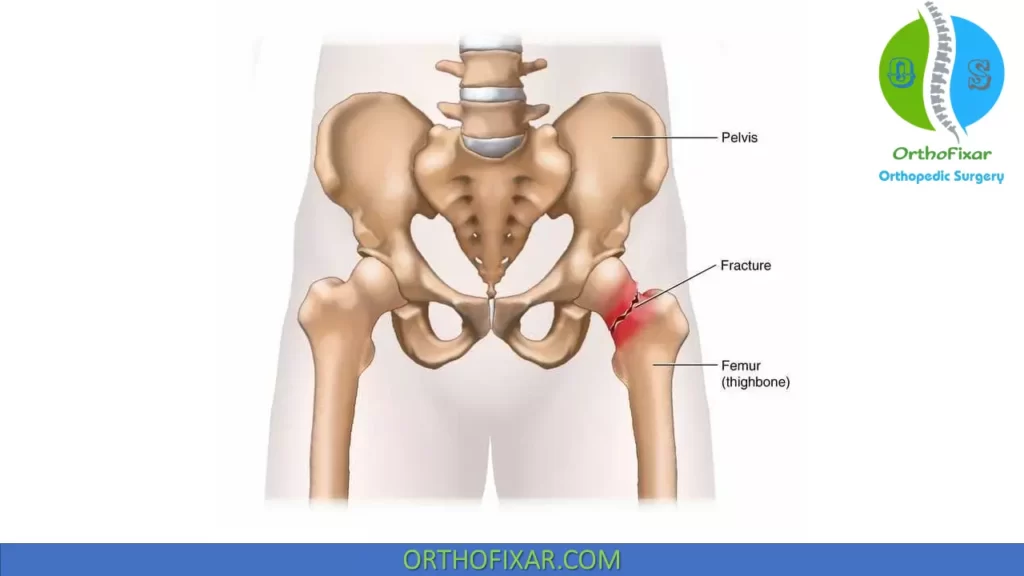
Potential Causes of Hip Pain
| Type of Pain/Structure Involved | Cause |
|---|---|
| Articular cartilage | Chondral lesion Osteoarthritis |
| Childhood disorders | Congenital dysplasia Legg–Calve–Perthes disease Slipped capital femoral epiphysis |
| Inflammation | Trochanteric bursitis Psoas bursitis Tendinitis Toxic synovitis |
| Infection | Septic arthritis Osteomyelitis |
| Labral tear | |
| Neoplasm | |
| Neurologic | Local nerve entrapment |
| Overuse | Stress fractures of the femur Muscle strains Inguinal hernia Femoral hernia |
| Referred | Lumbar disk pathology Lumbar spine-degenerative joint disease Athletic pubalgia Radiculopathy Piriformis syndrome Sacroiliac joint pathology Genitourinary tract pathology Abdominal wall pathology |
| Systemic | Rheumatoid arthritis Crohn’s disease Psoriasis Reiter’s syndrome Systemic lupus erythematosus |
| Trauma | Soft tissue contusion Fractures of the femoral head Dislocation of the femoral head Avulsion injury Myositis ossificans |
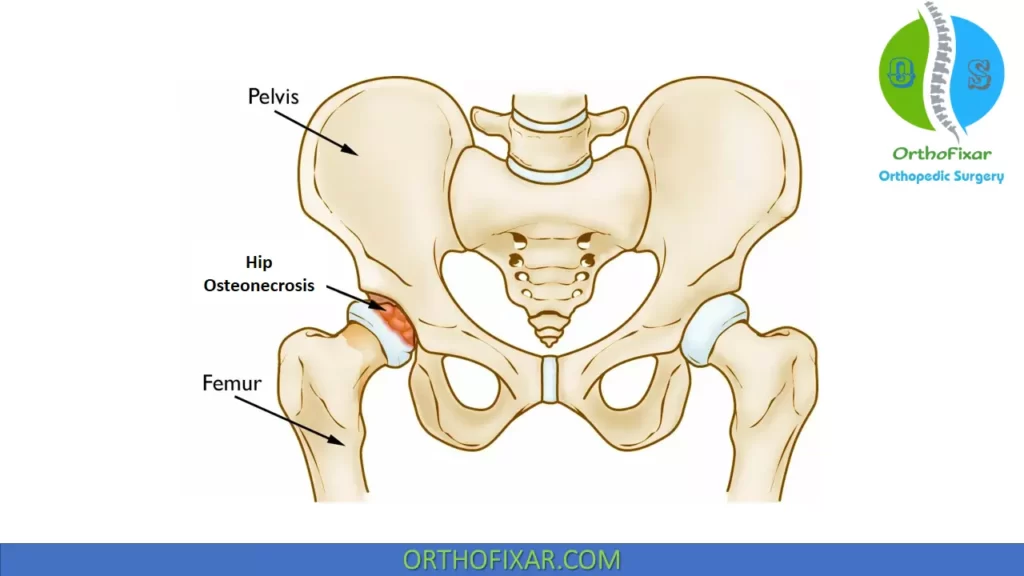
| Vascular | Avascular necrosis Osteonecrosis |
See Also:
Hip Pain Description & Possible Causes
| Hip Pain Description | Possible Diagnosis |
|---|---|
| Pain that is usually worse with sitting on hard surfaces, cycling, and prolonged standing | Ischiogluteal bursitis |
| Pain with squatting, lying on the involved side, climbing stairs, and walking | Subtrochanteric bursitis |
| A clicking or popping sound that occurs during running and dancing activities | Snapping hip syndrome |
| Pain with prolonged sitting, trunk flexion, and coughing/ sneezing | Lumbar disk herniation |
| Pain with activities that involve lumbar extension | Spinal stenosis, spondylolisthesis, or facet syndrome |
| Pain at night unrelated to movement | Malignancy |
| Pain with walking, which is relieved with cessation of the activity | Vascular claudication |
| Pain that appears to be affected by the weather | Arthritic condition or fibromyalgia syndrome |
| Progressive loss of or change in motor, bowel, bladder, or sexual function | Myelopathy, conus medullaris syndrome, or cauda equinus syndrome |
References
- Martell JM, Reider B: Pelvis, hip and thigh. In: Reider B, ed. The Orthopaedic Physical Examination. Philadelphia, PA: WB Saunders, 1999:159–199.
- Martin RL, Enseki KR, Draovitch P, Trapuzzano T, Philippon MJ. Acetabular labral tears of the hip: examination and diagnostic challenges. J Orthop Sports Phys Ther. 2006 Jul;36(7):503-15. doi: 10.2519/jospt.2006.2135. PMID: 16881467.
- Feinberg JH: Hip pain: Differential diagnosis. J Back Musculoskeletal Rehabil 4:154–173, 1994.
- Dutton’s Orthopaedic Examination, Evaluation, And Intervention 3rd Edition.
Closed.