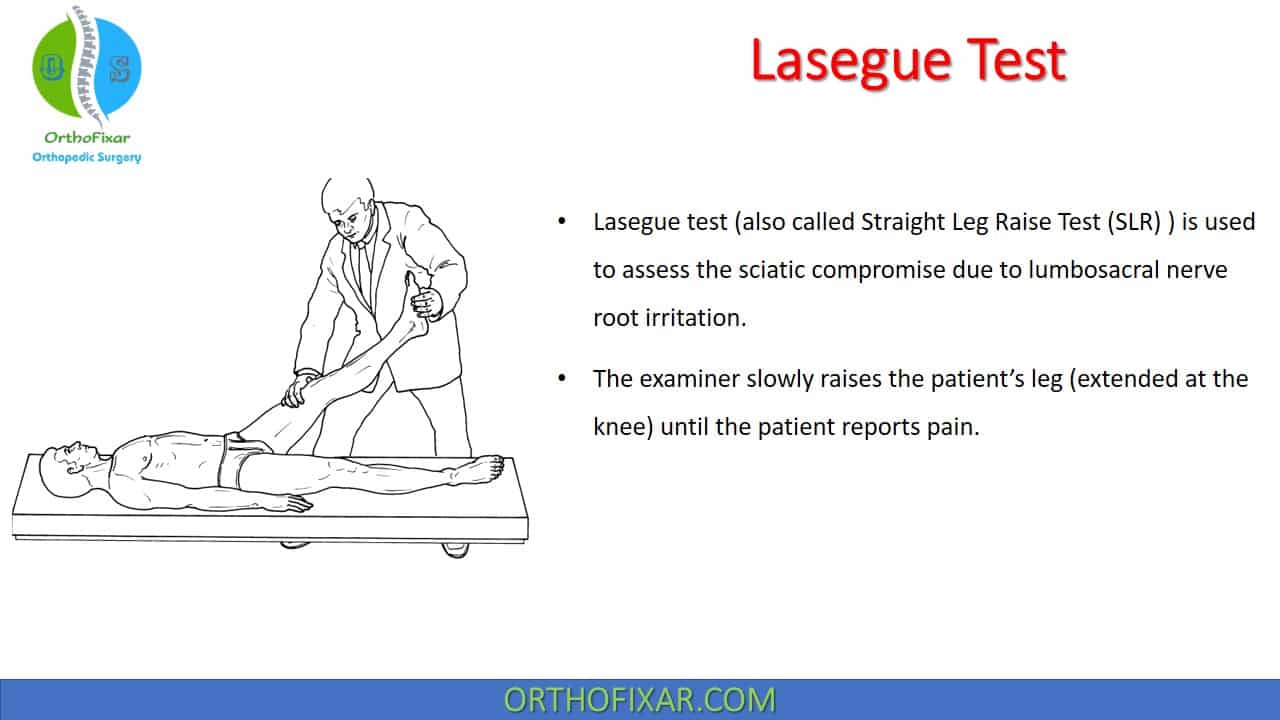
Lasegue test (also called Straight Leg Raise Test (SLR)) is used to assess the sciatic compromise due to lumbosacral nerve root irritation. It is recognized as the first neural tissue tension test to appear in the literature. It was first described by Charles Lasègue.
How do you do Lasegue test?
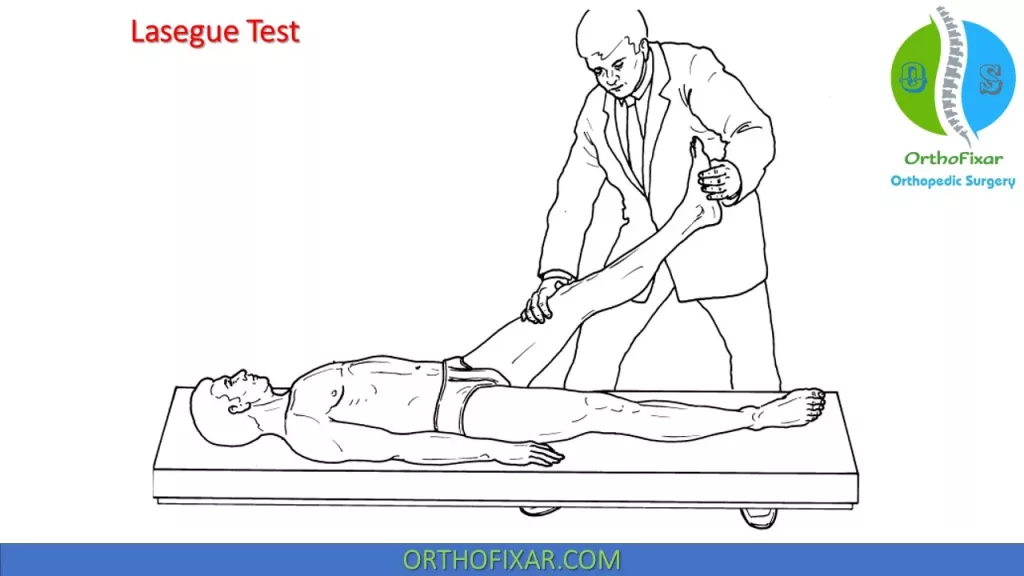
The straight leg raising test is done with the patient completely relaxed. It is one of the most common neurological tests of the lower limb. It is a passive test, and each leg is tested individually with the normal leg being tested first:
- The patient is positioned supine with no pillow under the head.
- The patient’s trunk and hip should remain neutral, avoiding internal or external rotation, and excessive adduction or abduction.
- Each leg is raised individually (uninvolved side first). To ensure that there is no undue stress on the dura, the tested leg is placed in slight internal rotation and adduction of the hip and extension of the knee.
- The clinician holds the patient’s heel, maintaining the extension and neutral dorsiflexion at the ankle, and raises the straight leg until complaints of pain or tightness in the posterior thigh are elicited.
- At this point, the range of motion is noted, and the clinician then slowly and carefully drops the leg back (extends it) slightly until the patient feels no pain or tightness.
- The patient is then asked to flex the neck so the chin is on the chest, or the examiner may dorsiflex the patient’s foot, or both actions may be done simultaneously. Most commonly, foot dorsiflexion is done first. Both of these maneuvers are considered to be provocative or sensitizing tests for neurological tissue
See Also: Thomas Test
What does a positive Lasegue Test mean?
The evaluation of the findings from the Lasegue Test (SLR) requires that the range of motion measured and the symptoms produced are compared with the contralateral side and with expected norms.
It is generally agreed that the first 30 degrees of the Lasegue Test serves to take up the slack or crimp in the sciatic nerve and its continuations. Using symptom reproduction below 40 degrees as a criterion for a positive Lasegue Test (SLR) result has been found to increase the sensitivity to 72%.
Pain in the 0- to 30-degree range may indicate the presence of:
- Acute spondylolisthesis
- Tumor of the buttock
- Gluteal abscess
- Very large disk protrusion or extrusion
- Acute inflammation of the dura
- Malingering patient
See Also: Spondylolisthesis: Causes, Symptoms & Treatment
Lasegue Test is positive if:
- The range is limited by spasm to less than 70 degrees, suggesting compression or irritation of the nerve roots. A positive test reproduces the symptoms of sciatica, with pain that radiates below the knee, not merely back or hamstring pain. When the Straight Leg Raise Test is severely limited, it is considered diagnostic for a disk herniation.
- The pain reproduced is neurologic in nature. This pain should be accompanied by other signs and symptoms such as pain with coughing, tying of shoe laces and so on but not necessarily by muscle weakness.
If the pain is primarily back pain, it is more likely a disc herniation from pressure on the anterior theca of the spinal cord, or the pathology causing the pressure is more central. “Back pain only” patients who have a disc prolapse have smaller, more central prolapses. If pain is primarily in the leg, it is more likely that the pathology causing the pressure on neurological tissues is more lateral. Disc herniations or pathology causing pressure between the two extremes are more likely to cause pain in both areas.
Pain that increases with neck flexion, ankle dorsiflexion, or both indicates stretching of the dura mater of the spinal cord or a lesion within the spinal cord (e.g., disc herniation, tumor, meningitis). Pain that does not increase with neck flexion may indicate a lesion in the hamstring area (tight hamstrings) or in the lumbosacral or sacroiliac joints.
Sensitivity & Specificity
The Lasegue Test has a high sensitivity for a low lumbar disc protrusion but has a low specificity 2:
- Sensitivity: 80 – 97 %
- Specificity: 40 %
Lasegue Test with the Patient Seated
This test is used to indicate the nerve root irritation.
The patient sits on the edge of the examining table and is asked to flex his or her hip with the leg extended at the knee.
This test corresponds to the Lasègue sign. When nerve root irritation is present, the patient will avoid the pain by leaning backward and using his or her arms for support. This test can also be used to identify simulated pain. If the patient can readily flex the hip without leaning backward, then a previous positive Lasègue sign must be questioned. The examiner can also perform this test in the same manner as the test for the Lasègue sign by passively flexing the hip with the knee extended.


Modified Straight Leg Raise Test
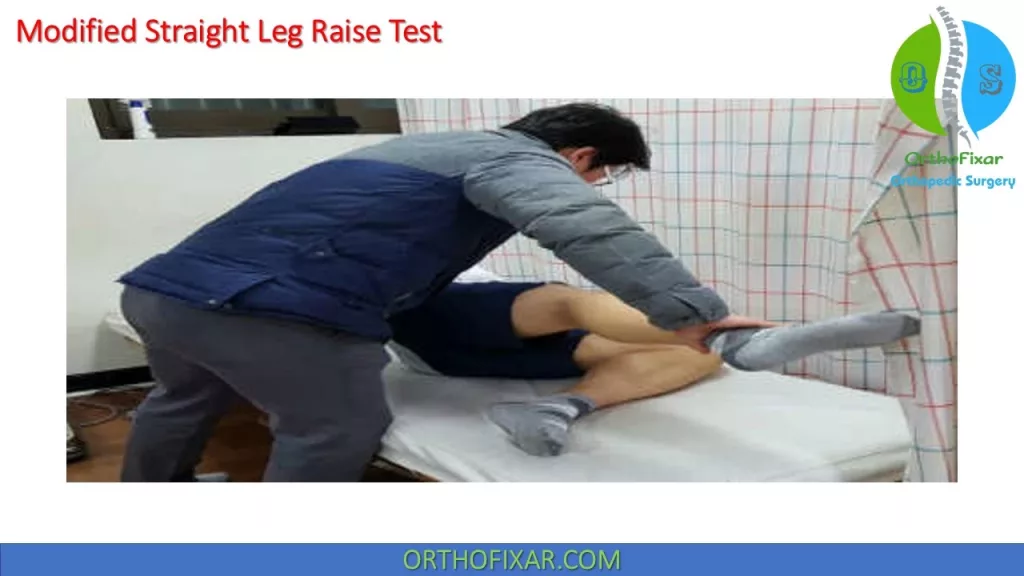
For patients who have difficulty lying supine, a modified straight leg raise test in the lateral position is possible:
- The patient lies with the tested leg uppermost with the hip and knee flexed to 90°.
- The lumbosacral spine is normally in a neutral position, but may be slightly flexed or extended as the patient’s condition allows.
- The examiner then slowly extends the patient’s knee passively on the affected side.
- The occurrence of pain or resistance to stretching the knee indicate a positive test.
Crossed Over Lasegue Test
Crossed Over Lasegue Test (or crossed SLR test) is used to test for central disc herniation in cases of severe nerve root irritation. The examiner passively flexes the patient’s uninvolved limb while maintaining the knee in extension.
A positive test is when the patient reports pain in the involved limb at 40 degrees of hip flexion with the uninvolved limb.
A study by Hakelius et al found that the Crossed Over Lasegue Test has a low sensitivity (28%) and a high specificity (88%).
Notes
Between 30 and 70 degrees, the spinal nerves, their dural sleeves, and the roots of the L4, L5, S1, and S2 segments are stretched with an excursion of 2–6 mm. After 70 degrees, although these structures undergo further tension, other structures also become involved. These additional structures include the hamstrings, gluteus maximus, hip, lumbar, and sacroiliac joints.
Confounding the results from the Straight Leg Raise Test test are the nonneural structures such as the sacroiliac joint, lumbar zygapophyseal joints, hip joint, muscles (hamstrings), and connective tissue. These structures may limit leg elevation and provoke patient discomfort during testing.
The Straight Leg Raise Test test places a tensile stress on the sciatic nerve and exerts a caudal traction on the lumbosacral nerve roots from L4 to S2. During the Straight Leg Raise Test, the L4–L5 and S1–S2 nerve roots are tracked inferiorly and anteriorly, pulling the dura mater caudally, laterally, and anteriorly.
Tension in the sciatic nerve, and its continuations, occurs in a sequential manner developing:
- first in the greater sciatic foramen,
- then over the ala of the sacrum,
- next in the area where the nerve crosses over the pedicle,
- and finally in the intervertebral foramen.
The inferior and anterior pull on the nerve root, and the relative fixation of the dural investment at the anterior wall, produces a displacement that pulls the root against the posterior-lateral aspect of the disk and vertebra. In addition, any space-occupying lesions situated at the anterior wall of the vertebral canal at the fourth and fifth lumbar and first and second sacral segments may interfere with the dura mater or nerve root structures.
The following caveats are important for accurate assessment of the Straight Leg Raise Test:
- The patient must have the necessary available range of hip flexion (30–70 degrees).
- The Straight Leg Raise Test produces a posterior shear and some degree of rotation in the lumbar spine (a region not well suited to shearing or rotational forces). Thus, back pain alone with the Straight Leg Raise Test is not a positive test.
The patient often attempts to avoid the pain by lifting the pelvis on the side being examined. The angle achieved when lifting the leg is estimated in degrees. This angle gives an indication of severity of the nerve root irritation present (genuine Lasegue test is at 60° or less).
Sciatica can also be provoked by adducting and internally rotating the leg with the knee flexed. This test is also described as a Bonnet or piriformis sign (adduction and internal rotation of the leg stretches the nerve as it passes through the piriformis).
Increases in sciatic pain on raising the head (Kernig sign) and/or passive dorsi-flexion of the great toes (Turyn sign) are further signs of significant sciatic nerve irritation (differential diagnosis should consider meningitis, subarachnoid hemorrhage, and carcinomatous meningitis).
Sacral or lumbar pain that increases only slowly as the leg is raised or pain radiating into the posterior thigh is usually attributable to degenerative joint disease (facet syndrome), irritation of the pelvic ligaments (tendinitis), or increased tension or shortening in the hamstrings (indicated by a soft end point, usually also found on the contralateral side). It is important to distinguish this “pseudo-radicular” pain (pseudo-Lasègue sign) from genuine sciatica (true Lasegue test).
If one leg is lifted and pain occurs on the opposite side, it suggests a herniated disk or a tumor. This may be called the Crossed Over Lasegue sign and usually indicates a rather large medial intervertebral disk protrusion.
The SLR may be helpful in differentiating between tarsal tunnel syndrome and plantar fasciitis. Beginning with the foot dorsiflexed and everted additionally stresses the tibial nerve. The SLR is then performed. An increase in symptoms points to tibial nerve entrapment because strain on the plantar fascia would not further increase.
Reference & More
- Sugar O. Charles Lasègue and his ‘Considerations on Sciatica’. JAMA. 1985 Mar 22-29;253(12):1767-8. PMID: 3883019. PubMed
- Kamath SU, Kamath SS. Lasègue’s Sign. J Clin Diagn Res. 2017 May;11(5):RG01-RG02. doi: 10.7860/JCDR/2017/24899.9794. Epub 2017 May 1. PMID: 28658865; PMCID: PMC5483767. PubMed
- Hakelius A, Hindmarsh J. The significance of neurological signs and myelographic findings in the diagnosis of lumbar root compression. Acta Orthop Scand. 1972;43:239-246.
- Coppieters, MW, et al: Strain and excursion of the sciatic, tibial, and plantar nerves during a modified straight leg raising test. J Orthop Res, 24:1883, 2006.
- Summers B, Malhan K, Cassar-Pullicino V. Low back pain on passive straight leg raising: the anterior theca as a source of pain. Spine. 2005;30: 342–345. PubMed
- Clinical Tests for the Musculoskeletal System 3rd Edition.
- Dutton’s Orthopaedic Examination, Evaluation, And Intervention 3rd Edition.