The bone remodeling process is a continuous physiological mechanism through which old or damaged bone is removed and replaced with new bone. This highly coordinated process is essential for maintaining skeletal strength, repairing microdamage, adapting bone architecture to mechanical stress, and regulating calcium and phosphate homeostasis.
Unlike many tissues, bone is not a static structure. Throughout life, specialized bone cells continuously reshape and renew the skeleton. Bone remodeling occurs through the coordinated actions of osteoclasts, which resorb bone, and osteoblasts, which form new bone. This dynamic process ensures the preservation of bone quality while responding to metabolic and mechanical demands.
What is Bone Remodeling?
Bone remodeling is the process by which previously formed bone is removed and subsequently replaced by newly formed bone at the same location. The process occurs throughout life and is essential for maintaining bone integrity and mineral homeostasis.
Bone remodeling serves several important functions:
- Replacement of aged or microdamaged bone
- Prevention of fatigue-related stress fractures
- Adaptation of bone architecture to mechanical loading
- Maintenance of calcium and phosphate balance
- Preservation of skeletal strength and structural integrity
In healthy adults, bone resorption and bone formation are tightly coupled, ensuring that the amount of bone removed is approximately equal to the amount of bone replaced.
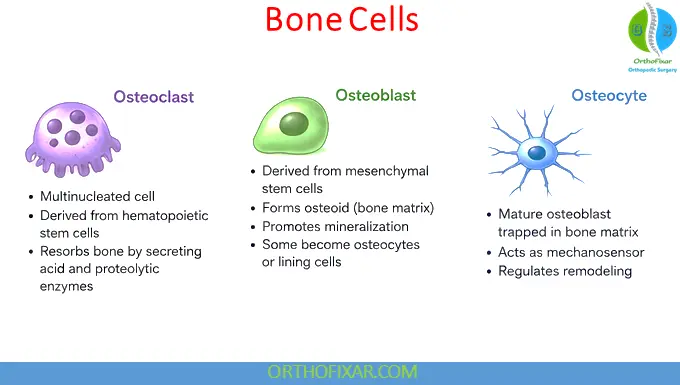
Bone Cells Involved in Bone Remodeling Process
Osteoblasts
Osteoblasts are bone-forming cells derived from mesenchymal stem cells.
Their functions include:
- Synthesis of osteoid (unmineralized bone matrix)
- Production of type I collagen
- Initiation of bone mineralization
- Regulation of osteoclast differentiation through signaling molecules such as RANKL and M-CSF
Some osteoblasts become embedded within the matrix and differentiate into osteocytes, while others become bone-lining cells.
Osteoclasts
Osteoclasts are large multinucleated cells derived from hematopoietic stem cells of the monocyte-macrophage lineage.
Their primary functions include:
- Bone resorption
- Removal of old or damaged bone
- Release of calcium and phosphate from bone matrix
Osteoclasts create an acidic microenvironment that dissolves mineralized bone and degrades organic matrix components.
Osteocytes
Osteocytes are mature osteoblasts trapped within mineralized bone.
They function as:
- Mechanosensors
- Regulators of bone remodeling
- Coordinators of communication between osteoblasts and osteoclasts
Current evidence suggests that osteocytes play a major role in initiating remodeling in response to mechanical strain and microdamage.
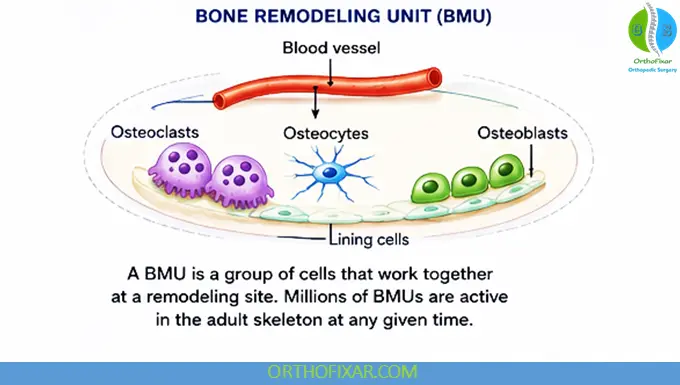
Bone Remodeling Unit (BMU)
The cellular machinery responsible for bone turnover is known as the Basic Multicellular Unit (BMU).
A BMU consists primarily of:
- Osteoclasts
- Osteoblasts
- Osteocytes
- Bone-lining cells
- Associated blood vessels and connective tissue
More than one million BMUs may be active throughout the adult skeleton at any given time. These units work in a coordinated manner to ensure proper coupling between bone resorption and bone formation.
Stages of the Bone Remodeling Cycle
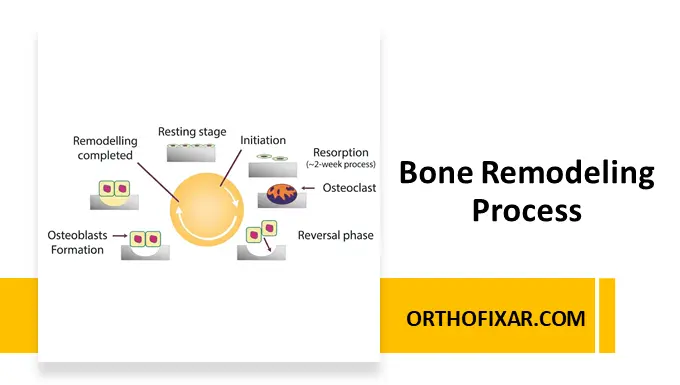
Bone remodeling follows a highly organized sequence known as the Activation–Resorption–Reversal–Formation (ARRF) cycle.
Activation Phase
The remodeling cycle begins when osteocytes detect:
- Mechanical stress
- Microdamage
- Changes in calcium requirements
These signals stimulate osteoblast-lineage cells and recruit osteoclast precursors to the remodeling site.
Key events include:
- Activation of bone-lining cells
- Recruitment of pre-osteoclasts
- Differentiation into mature osteoclasts
Resorption Phase
During this phase, osteoclasts attach to the bone surface and begin excavating a resorption cavity.
Characteristics include:
- Duration of approximately 2–4 weeks
- Dissolution of mineralized bone
- Degradation of collagen matrix
The resorption cavity created by osteoclasts removes old or damaged bone tissue.
At the end of this phase, osteoclasts undergo programmed cell death (apoptosis).
Reversal Phase
The reversal phase is a transitional period between resorption and formation.
During this stage:
- Osteoclasts disappear
- Mononuclear reversal cells cover the excavated surface
- A cement line forms
The cement line serves as the histological boundary between old and newly formed bone.
This phase ensures appropriate communication between resorbing and bone-forming cells.
Formation Phase
The formation phase is dominated by osteoblast activity.
Osteoblasts:
- Migrate to the resorption cavity
- Deposit osteoid matrix
- Produce type I collagen
- Initiate mineralization
Formation generally lasts about three months.
As mineralization progresses, a new structural unit of bone, known as an osteon in cortical bone, is created.
Quiescence Phase
After bone formation is completed, the remodeling site enters a resting state.
During quiescence:
- Bone surfaces become covered by lining cells
- Remodeling activity temporarily ceases
- The newly formed bone functions as mature skeletal tissue
Future remodeling may be reactivated when new mechanical or metabolic signals arise.
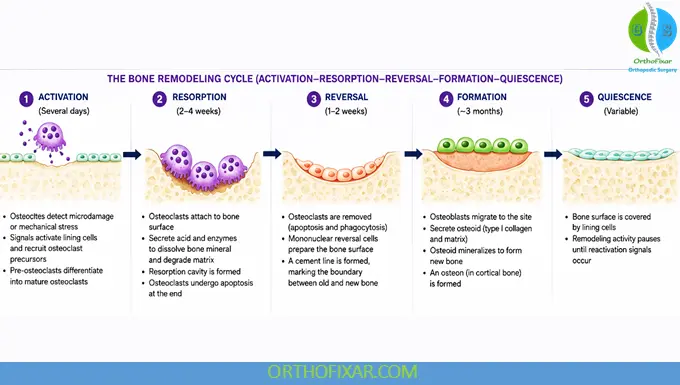
Duration of the Bone Remodeling Cycle
The complete bone remodeling cycle typically requires:
| Stage | Approximate Duration |
|---|---|
| Activation | Several days |
| Resorption | 2–4 weeks |
| Reversal | 1–2 weeks |
| Formation | About 3 months |
| Total Cycle | 4–6 months |
The exact duration varies according to skeletal location, age, hormonal status, and metabolic conditions.
Coupling Between Bone Resorption and Bone Formation
A defining feature of healthy bone remodeling is coupling.
Coupling refers to the phenomenon whereby:
- Osteoclast-mediated resorption occurs first.
- Osteoblast-mediated formation follows.
- The amount of bone formed closely matches the amount removed.
This coupling maintains skeletal homeostasis and preserves bone mass.
Disruption of coupling can lead to:
- Osteoporosis
- Bone loss
- Increased fracture risk
Hormonal Regulation of Bone Remodeling
Several systemic hormones regulate remodeling activity.
Parathyroid Hormone (PTH)
PTH:
- Stimulates osteoclast formation indirectly
- Increases calcium release from bone
- Regulates remodeling initiation
Intermittent PTH exposure may stimulate bone formation, whereas continuous elevation promotes bone resorption.
Vitamin D
Active vitamin D (1,25-dihydroxyvitamin D):
- Enhances calcium absorption
- Supports mineralization
- Influences osteoblast and osteoclast activity
Sex Steroids
Estrogen
Estrogen:
- Suppresses osteoclast activity
- Promotes osteoclast apoptosis
- Preserves bone mass
Estrogen deficiency after menopause accelerates bone resorption and contributes to osteoporosis.
Testosterone
Testosterone:
- Supports bone formation
- Maintains skeletal strength
- Contributes to peak bone mass acquisition
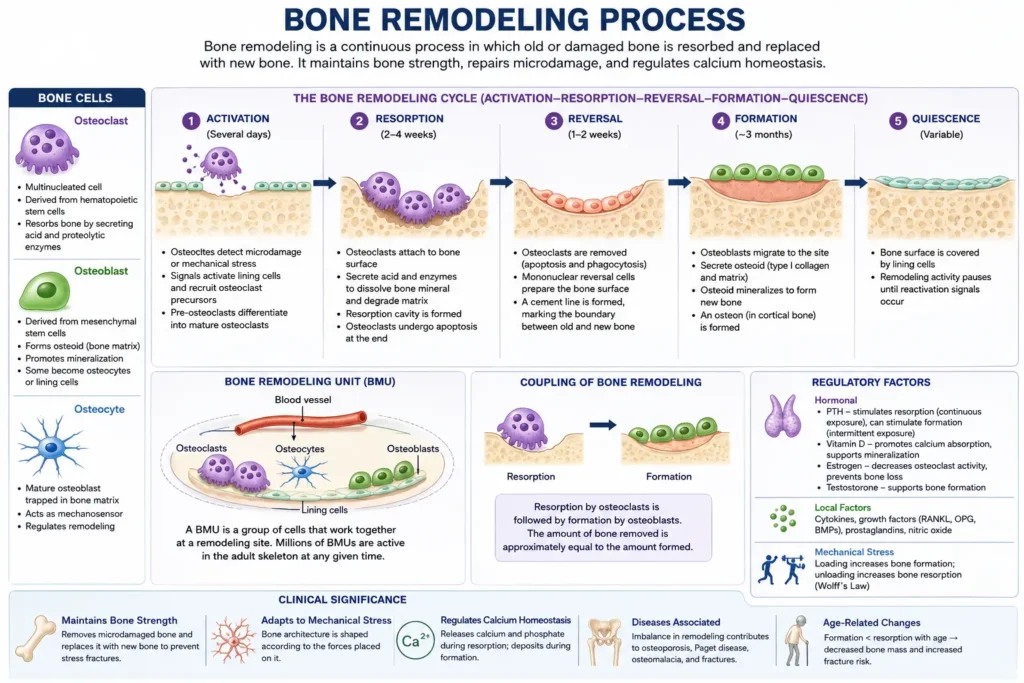
Mechanical Stress and Wolff’s Law
Bone remodeling is highly responsive to mechanical loading.
According to Wolff’s Law, bone architecture adapts to the stresses placed upon it.
Examples include:
- Increased bone density in athletes
- Bone loss during immobilization
- Structural adaptation to changing mechanical demands
Trabeculae become aligned along lines of compressive and tensile forces, maximizing skeletal efficiency and strength.
Cortical vs Trabecular Bone Remodeling
Cortical Bone
Characteristics:
- Dense outer layer of bone
- Lower remodeling rate
- Approximately 3–5% annual turnover
In cortical bone, osteoclasts create tunnel-like structures known as cutting cones that are later filled by osteoblasts.
Trabecular Bone
Characteristics:
- Spongy internal bone
- Greater surface area
- Higher metabolic activity
- Approximately 20–30% annual turnover
Trabecular bone remodels more rapidly and is particularly vulnerable to metabolic and hormonal disturbances.
Age-Related Changes in Bone Remodeling
During Growth
In childhood and adolescence:
- Bone formation exceeds resorption
- Bone mass progressively increases
- Peak bone mass is achieved in early adulthood
During Aging
With advancing age:
- Resorption gradually exceeds formation
- Bone mass declines
- Trabecular connectivity decreases
- Cortical thinning develops
These changes contribute to increased skeletal fragility and fracture risk.
Clinical Significance of Bone Remodeling
Osteoporosis
Osteoporosis develops when bone resorption exceeds bone formation.
Consequences include:
- Reduced bone density
- Microarchitectural deterioration
- Increased fracture risk
Fracture Healing
Bone remodeling plays a critical role in:
- Removal of damaged bone
- Replacement with structurally sound bone
- Restoration of normal architecture
Metabolic Bone Diseases
Abnormal remodeling contributes to:
- Osteomalacia
- Paget disease of bone
- Hyperparathyroidism-related bone disease
- Chronic kidney disease-mineral bone disorder
Key Takeaways
- Bone remodeling is a lifelong process involving the removal and replacement of bone tissue.
- Osteoclasts resorb old bone, while osteoblasts form new bone.
- Remodeling occurs through activation, resorption, reversal, formation, and quiescence phases.
- The process maintains skeletal strength, repairs microdamage, and regulates mineral homeostasis.
- Bone remodeling units (BMUs) coordinate the activities of osteoblasts and osteoclasts.
- Hormones, growth factors, nutrition, and mechanical forces regulate remodeling.
- Aging and disease can disrupt the balance between resorption and formation, leading to bone loss and increased fracture risk.
References & More
- Rowe P, Koller A, Sharma S. Physiology, Bone Remodeling. [Updated 2023 Mar 17]. In: StatPearls [Internet]. Treasure Island (FL): StatPearls Publishing; 2026 Jan-. Available from: https://www.ncbi.nlm.nih.gov/books/NBK499863/
- Hadjidakis, Dimitrios J, and Ioannis I Androulakis. “Bone remodeling.” Annals of the New York Academy of Sciences vol. 1092 (2006): 385-96. doi:10.1196/annals.1365.035. Link
- Kenkre, J S, and Jhd Bassett. “The bone remodelling cycle.” Annals of clinical biochemistry vol. 55,3 (2018): 308-327. doi:10.1177/0004563218759371. Link
- Blom, A., Warwick, D., & Whitehouse, M. R. (2018). Apley & Solomon’s system of orthopaedics and trauma (10th ed.). CRC Press