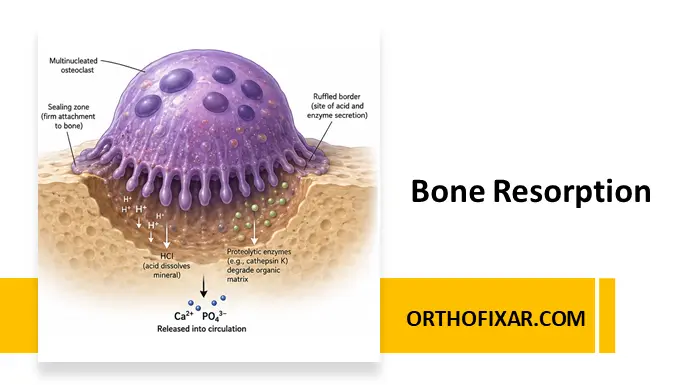
Bone resorption is a physiological process in which mature bone tissue is broken down by specialized cells known as osteoclasts. It is an essential component of bone remodeling, a continuous process that maintains skeletal integrity, repairs microdamage, and regulates calcium and phosphate homeostasis. Under normal conditions, bone resorption is balanced by bone formation carried out by osteoblasts. However, excessive or insufficient bone resorption can result in significant skeletal disorders.
Understanding the molecular mechanisms underlying bone resorption has transformed the management of conditions such as osteoporosis, rheumatoid arthritis, Paget disease of bone, skeletal metastases, and multiple myeloma.
What is Bone Resorption?
Bone resorption is the process by which osteoclasts degrade mineralized bone matrix, releasing calcium and phosphate into the extracellular fluid and bloodstream. This process occurs as part of normal bone remodeling and is necessary for maintaining bone strength and mineral balance.
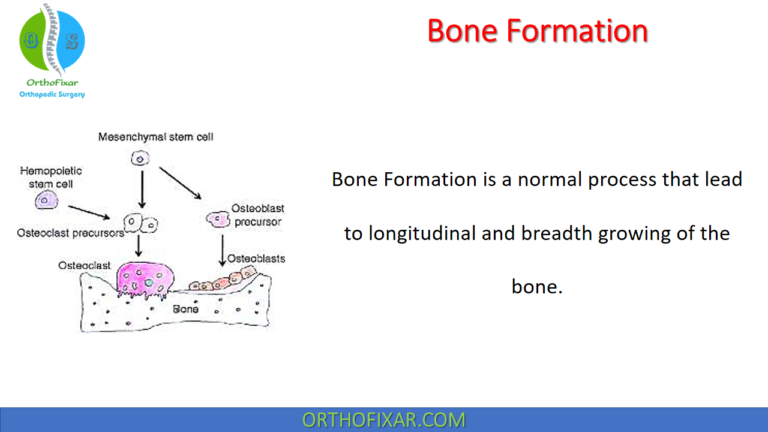
In healthy adults, bone resorption and bone formation remain tightly coupled. When resorption exceeds formation, bone mass decreases, leading to osteopenia and osteoporosis. Conversely, impaired osteoclast function may result in excessive bone accumulation, as seen in osteopetrosis.
Bone Remodeling and the Role of Bone Resorption
Bone remodeling consists of four overlapping phases:
Activation Phase
Signals from osteocytes, hormones, and cytokines recruit osteoclast precursors to specific remodeling sites.
Resorption Phase
Mature osteoclasts attach to the bone surface and dissolve both mineral and organic components of bone.
Reversal Phase
Resorption ceases, and osteoblast precursors are recruited to the site.
Formation Phase
Osteoblasts synthesize new osteoid, which subsequently mineralizes to form mature bone.
This coordinated process ensures maintenance of skeletal architecture and mineral homeostasis.
Osteoclasts: The Primary Cells Responsible for Bone Resorption
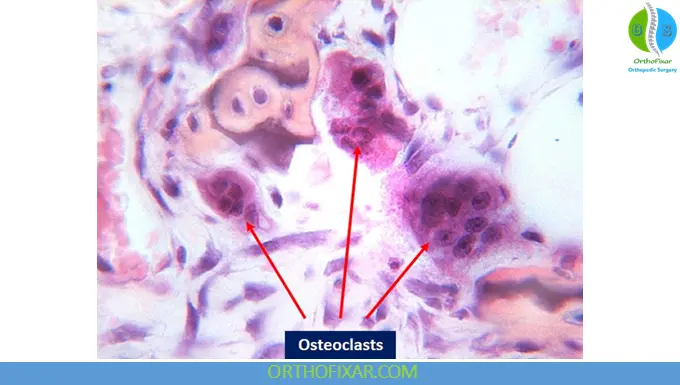
Osteoclasts are large multinucleated cells derived from hematopoietic monocyte-macrophage precursors. Their primary function is the removal of old, damaged, or unnecessary bone.
Characteristics of Osteoclasts
- Derived from monocyte/macrophage lineage
- Multinucleated giant cells
- Specialized for bone degradation
- Rich in lysosomes and proton pumps
- Form a characteristic ruffled border during active resorption
Osteoclasts are uniquely adapted to dissolve both the inorganic and organic components of bone matrix.
The RANK/RANKL/OPG Pathway: Master Regulator of Bone Resorption
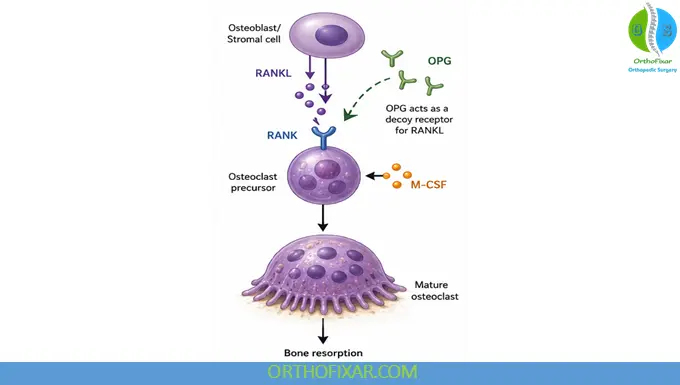
One of the most important discoveries in skeletal biology is the identification of the RANK/RANKL/OPG signaling pathway.
Receptor Activator of Nuclear Factor Kappa-B Ligand (RANKL)
RANKL is produced primarily by:
- Osteoblasts
- Osteocytes
- Bone marrow stromal cells
- Activated immune cells
RANKL acts as the principal osteoclast differentiation factor. It stimulates the development, activation, and survival of osteoclasts.
Receptor Activator of Nuclear Factor Kappa-B (RANK)
RANK is expressed on osteoclast precursor cells. Binding of RANKL to RANK initiates signaling pathways that promote osteoclast maturation and activation.
Osteoprotegerin (OPG)
Osteoprotegerin is produced by osteoblasts and acts as a decoy receptor. It binds RANKL and prevents interaction with RANK, thereby inhibiting osteoclast formation and reducing bone resorption.
Importance of the RANK/RANKL/OPG System
The balance between RANKL and OPG determines osteoclast activity:
- Increased RANKL → increased bone resorption
- Increased OPG → decreased bone resorption
Disruption of this balance contributes to osteoporosis, inflammatory bone disease, and skeletal metastases.
Hormonal Regulation of Bone Resorption
Several systemic hormones influence osteoclast activity.
Parathyroid Hormone (PTH)
Although osteoclasts lack direct PTH receptors, PTH indirectly stimulates bone resorption by increasing RANKL expression in osteoblasts and stromal cells.
PTH also promotes production of active vitamin D, further enhancing osteoclastogenesis.
Vitamin D
The active form of vitamin D, 1,25-dihydroxyvitamin D3, enhances osteoclast formation indirectly by increasing RANKL expression.
Glucocorticoids
Glucocorticoids favor bone loss by:
- Increasing osteoclast survival
- Increasing RANKL activity
- Decreasing OPG production
- Suppressing osteoblast function
Chronic glucocorticoid therapy is a major cause of secondary osteoporosis.
Calcitonin
Calcitonin directly inhibits osteoclast activity and decreases bone resorption.
Sex Hormones
Estrogen suppresses osteoclast-mediated bone resorption. Estrogen deficiency after menopause contributes significantly to osteoporosis and increased fracture risk.
Molecular Mechanisms of Bone Resorption
Before osteoclasts begin active resorption, osteoblasts prepare the bone surface by removing osteoid and releasing signaling molecules that attract osteoclasts.
Formation of the Sealing Zone
The osteoclast attaches firmly to bone, creating a sealed microenvironment.
Development of the Ruffled Border
The plasma membrane folds extensively, forming a ruffled border that increases surface area for secretion.
Acidification of the Resorption Lacuna
Osteoclasts secrete hydrochloric acid through proton pumps, lowering the pH and dissolving hydroxyapatite crystals.
Enzymatic Degradation
Proteolytic enzymes degrade the organic matrix:
Cathepsin K
Cathepsin K is the principal enzyme responsible for collagen degradation.
Tartrate-Resistant Acid Phosphatase (TRAP)
TRAP participates in matrix breakdown and osteoclast function.
Release of Minerals
Calcium and phosphate are released from bone and transported into the circulation, contributing to mineral homeostasis.
Essential Proteins Required for Osteoclast Function
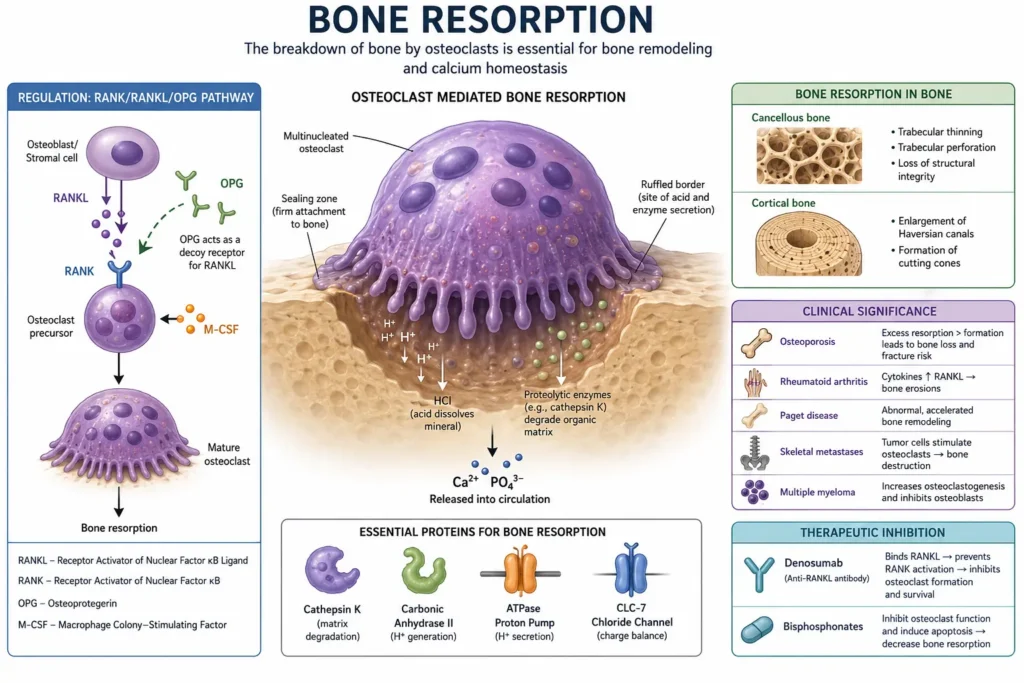
Several proteins are critical for effective bone resorption:
Cathepsin K
Degrades type I collagen and other matrix proteins.
Carbonic Anhydrase II
Generates hydrogen ions necessary for acid production.
ATPase Proton Pump
Transports hydrogen ions into the resorption compartment.
CLC-7 Chloride Channel
Maintains electrical neutrality during acid secretion.
Mutations affecting these proteins impair bone resorption and may result in osteopetrosis or pycnodysostosis.
Bone Resorption in Cancellous and Cortical Bone
Cancellous Bone
Excessive osteoclastic activity causes:
- Trabecular thinning
- Trabecular perforation
- Loss of structural integrity
Cortical Bone
Osteoclasts enlarge existing Haversian canals or create new cutting cones within compact bone, increasing cortical porosity and fracture risk.
Diseases Associated with Increased Bone Resorption
Osteoporosis
The most common metabolic bone disease characterized by excessive bone loss and increased fracture risk.
Rheumatoid Arthritis
Inflammatory cytokines stimulate RANKL expression, leading to bone erosions.
Paget Disease of Bone
Characterized by abnormal and accelerated bone remodeling.
Skeletal Metastases
Breast and prostate cancers commonly induce localized osteoclast activation and bone destruction.
Multiple Myeloma
Myeloma cells promote osteoclastogenesis while suppressing osteoblast activity.
Hyperparathyroidism
Persistent elevations in PTH increase osteoclastic bone resorption.
Diseases Associated with Reduced Bone Resorption
Osteopetrosis
A rare disorder characterized by defective osteoclast function resulting in abnormally dense but fragile bones.
Pycnodysostosis
Caused by cathepsin K deficiency, leading to impaired collagen degradation and abnormal bone remodeling.
Biomarkers of Bone Resorption
Several laboratory markers reflect osteoclastic activity:
Serum Markers
- Tartrate-resistant acid phosphatase (TRAP)
- Bone sialoprotein
Urinary Markers
- Pyridinoline (PYD)
- Deoxypyridinoline (DPD)
- Hydroxyproline
These biomarkers are useful for monitoring metabolic bone diseases and treatment response.
Pharmacological Inhibition of Bone Resorption
Denosumab
Denosumab is a monoclonal antibody against RANKL.
Mechanism of Action
- Binds RANKL
- Prevents RANK activation
- Inhibits osteoclast formation
- Reduces osteoclast survival
- Suppresses bone resorption
Clinical Applications
- Osteoporosis
- Bone metastases
- Multiple myeloma
- Rheumatoid arthritis-associated bone erosions
- Paget disease of bone
Denosumab represents one of the most effective antiresorptive therapies currently available.
Bisphosphonates
Common examples include:
- Alendronate
- Risedronate
- Zoledronic acid
These drugs inhibit osteoclast function and induce osteoclast apoptosis, reducing bone resorption and fracture risk.
Cathepsin K Inhibitors
Odanacatib was developed to inhibit cathepsin K and reduce osteoclastic bone degradation. Although clinical development encountered challenges, cathepsin K remains an important therapeutic target.
Clinical Significance of Bone Resorption
Bone resorption is essential for:
- Skeletal maintenance
- Repair of microdamage
- Calcium homeostasis
- Adaptation to mechanical stress
However, excessive resorption contributes to osteoporosis, inflammatory bone disease, and cancer-related skeletal complications. Understanding osteoclast biology and the RANK/RANKL/OPG pathway has revolutionized the treatment of metabolic and inflammatory bone disorders.
Key Takeaways
- Bone resorption is the breakdown of bone by osteoclasts.
- Osteoclast differentiation requires RANKL, RANK, and M-CSF.
- Osteoprotegerin inhibits osteoclastogenesis by acting as a decoy receptor for RANKL.
- PTH stimulates bone resorption indirectly through osteoblast-mediated RANKL production.
- Cathepsin K, carbonic anhydrase II, CLC-7 chloride channels, and proton pumps are essential for osteoclast function.
- Excessive bone resorption contributes to osteoporosis, rheumatoid arthritis, skeletal metastases, and multiple myeloma.
- Denosumab effectively suppresses bone resorption by targeting RANKL.
- Defective osteoclast function leads to disorders such as osteopetrosis and pycnodysostosis.
References & More
- Rowe P, Koller A, Sharma S. Physiology, Bone Remodeling. [Updated 2023 Mar 17]. In: StatPearls [Internet]. Treasure Island (FL): StatPearls Publishing; 2026 Jan-. Available from: https://www.ncbi.nlm.nih.gov/books/NBK499863/
- Teitelbaum, S L. “Bone resorption by osteoclasts.” Science (New York, N.Y.) vol. 289,5484 (2000): 1504-8. doi:10.1126/science.289.5484.1504. Link
- Khan IA, Bordoni B. Histology, Osteoclasts. [Updated 2023 Apr 24]. In: StatPearls [Internet]. Treasure Island (FL): StatPearls Publishing; 2026 Jan-. Available from: https://www.ncbi.nlm.nih.gov/books/NBK554489/
- Blom, A., Warwick, D., & Whitehouse, M. R. (2018). Apley & Solomon’s system of orthopaedics and trauma (10th ed.). CRC Press