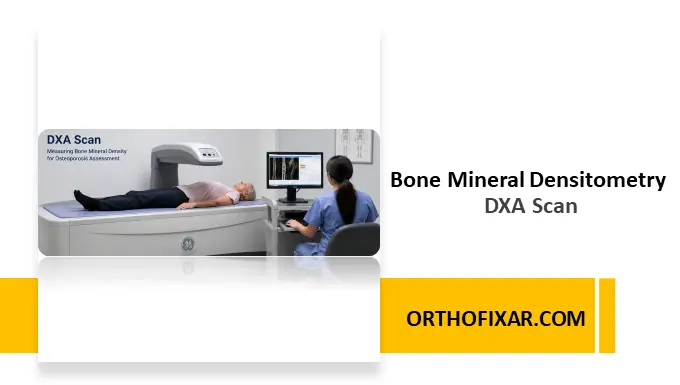
Bone Mineral Densitometry (BMD) is a non-invasive imaging technique used to measure bone mineral density and evaluate bone strength. It plays a crucial role in the diagnosis of osteoporosis, assessment of fracture risk, and monitoring of treatment effectiveness. The most widely used method of bone mineral densitometry is the DXA scan (Dual-Energy X-ray Absorptiometry), which provides highly accurate measurements while exposing patients to minimal radiation.
With the aging population and increasing prevalence of osteoporosis worldwide, BMD assessment has become an essential component of preventive healthcare and musculoskeletal medicine.
What is Bone Mineral Densitometry?
Bone Mineral Densitometry (BMD) refers to the quantitative measurement of mineral content within bones, primarily calcium and phosphorus. These measurements help determine bone strength and identify individuals at risk of fractures.
A decrease in bone mineral density is associated with osteoporosis, osteopenia, and an increased likelihood of fragility fractures involving the hip, spine, and wrist.
The current gold standard for measuring BMD is the DXA scan, which offers excellent precision and reproducibility.
History of Bone Mineral Density Measurement
Early methods for measuring bone density included:
- Single-photon absorptiometry (SPA)
- Dual-photon absorptiometry (DPA)
- Quantitative computed tomography (QCT)
These techniques have largely been replaced by DXA scan technology, which provides superior accuracy, lower radiation exposure, shorter examination times, and lower costs.
Today, DXA is recognized by organizations such as the International Society for Clinical Densitometry (ISCD) and the World Health Organization (WHO) as the standard method for diagnosing osteoporosis.
What is a DXA Scan?
A DXA scan (Dual-Energy X-ray Absorptiometry), sometimes written as DEXA, uses two low-energy X-ray beams of different energies to measure bone mineral density.
Because soft tissues absorb X-rays differently than bone, computer algorithms can isolate bone mineral content and calculate precise BMD values.
The examination is:
- Non-invasive
- Painless
- Rapid
- Highly accurate
- Associated with very low radiation exposure
How Does a DXA Scan Work?
The DXA scanner emits two X-ray beams with different energy levels.
The amount of radiation absorbed by bone depends on:
- Bone thickness
- Mineral content
- Bone composition
The system compares the absorption of the two beams and calculates bone density.
The resulting measurement is expressed as:
- Bone Mineral Content (BMC) in grams
- Bone Mineral Density (BMD) in g/cm²
These values are then compared with standardized reference databases.
Common Sites Evaluated During BMD Testing
Lumbar Spine
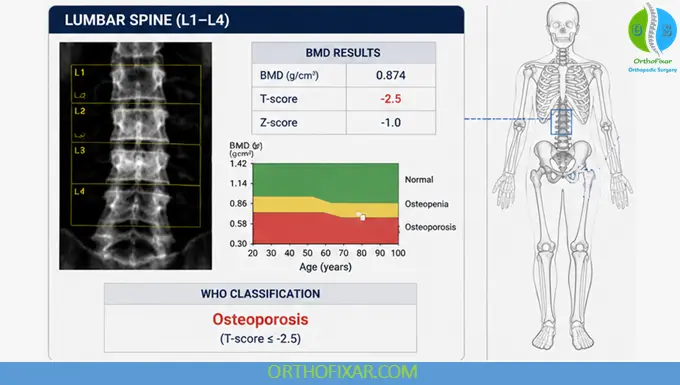
The lumbar vertebrae (L1-L4) are commonly assessed because trabecular bone is highly sensitive to metabolic changes.
Proximal Femur (Hip)
Hip measurements are important because hip fractures are associated with significant morbidity and mortality.
Femoral Neck
The femoral neck is one of the strongest predictors of future fracture risk.
Distal Radius (Forearm)
Forearm measurements may be performed when:
- Hip evaluation is not possible
- Severe obesity limits scanning
- Hyperparathyroidism is suspected
See Also: Bone Scan Radionuclide Imaging: Principles, Applications & Interpretation
Indications for Bone Mineral Densitometry
Screening for Osteoporosis
The primary indication for a DXA scan is osteoporosis screening.
Evaluation of Fracture Risk
BMD measurements help estimate future fracture probability.
Monitoring Osteoporosis Treatment
Serial DXA examinations assess the effectiveness of therapies such as:
- Bisphosphonates
- Denosumab
- Teriparatide
- Hormone replacement therapy
Assessment of Secondary Osteoporosis
Conditions associated with bone loss include:
- Hyperparathyroidism
- Hyperthyroidism
- Rheumatoid arthritis
- Chronic kidney disease
- Malabsorption syndromes
- Long-term corticosteroid therapy
Evaluation Following Fragility Fracture
Patients presenting with low-energy fractures should undergo bone density assessment.
Who Should Undergo a DXA Scan?
Clinical guidelines generally recommend BMD testing for:
Women
- All women aged 65 years and older
- Postmenopausal women with risk factors
Men
- Men aged 70 years and older
- Younger men with significant risk factors
High-Risk Individuals
- Previous fragility fracture
- Long-term glucocorticoid use
- Low body weight
- Family history of osteoporosis
- Smoking
- Excessive alcohol consumption
- Hypogonadism
Patient Preparation for a DXA Scan
Preparation is simple and usually requires:
- Wearing comfortable clothing without metal
- Avoiding calcium supplements for 24 hours before the examination
- Informing the physician about recent contrast studies
- Reporting possible pregnancy
No fasting is required.
DXA Scan Procedure
Step 1: Positioning
The patient lies on a scanning table.
Step 2: Image Acquisition
A scanning arm passes slowly over the body while low-dose X-rays are emitted.
Step 3: Data Analysis
Specialized software calculates:
- Bone mineral density
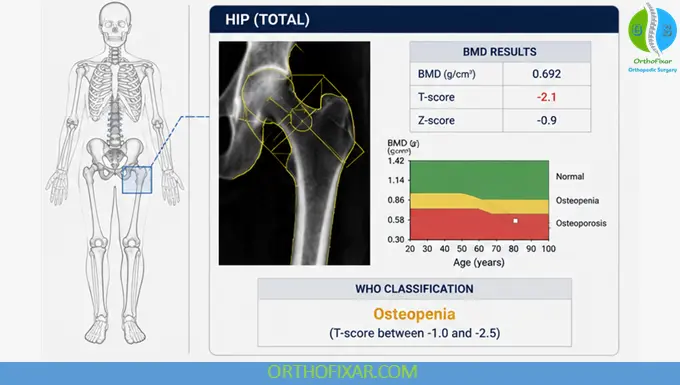
- T-score
- Z-score
The examination typically takes 10–20 minutes.
Understanding DXA Scan Results
T-Score
The T-score compares the patient’s BMD with that of a healthy young adult.
WHO diagnostic criteria:
| T-Score | Classification |
|---|---|
| ≥ -1.0 | Normal |
| -1.0 to -2.5 | Osteopenia |
| ≤ -2.5 | Osteoporosis |
| ≤ -2.5 with fracture | Severe osteoporosis |
Z-Score
The Z-score compares BMD with individuals of the same age and sex.
A Z-score below -2.0 may suggest secondary causes of bone loss.
Advantages of Bone Mineral Densitometry
High Accuracy
DXA provides highly reproducible measurements.
Low Radiation Dose
Radiation exposure is extremely low, often less than a standard chest radiograph.
Fast Examination
Most studies are completed within minutes.
Non-Invasive
No injections or contrast agents are required.
Cost-Effective
DXA remains one of the most economical methods for osteoporosis evaluation.
Limitations of DXA Scan
Despite its advantages, DXA has limitations.
Cannot Assess Bone Quality Completely
Bone strength depends on:
- Microarchitecture
- Bone turnover
- Mineralization
- Collagen integrity
These factors are not fully captured by BMD measurements alone.
Artifacts May Affect Results
Artificially elevated BMD values may occur due to:
- Vertebral osteoarthritis
- Aortic calcification
- Vertebral fractures
- Surgical hardware
Limited Assessment of Fracture Risk
Some patients sustain fractures despite normal BMD values because factors other than bone density influence skeletal strength.
Radiation Exposure During DXA Scan
One of the greatest strengths of DXA is its extremely low radiation dose.
Typical effective dose ranges between:
- 1–10 microsieverts (µSv)
For comparison:
- Chest X-ray: approximately 100 µSv
- Annual natural background radiation: approximately 3000 µSv
This makes DXA one of the safest imaging examinations available.
Alternative Techniques for Measuring Bone Density
Quantitative Computed Tomography (QCT)
Provides volumetric measurements but involves higher radiation exposure.
Peripheral DXA (pDXA)
Measures peripheral skeletal sites such as the forearm or heel.
Quantitative Ultrasound (QUS)
Commonly used for screening but does not replace central DXA for osteoporosis diagnosis.
Clinical Applications of BMD Assessment
Bone mineral densitometry is used in:
- Osteoporosis diagnosis
- Osteopenia detection
- Fracture risk prediction
- Monitoring treatment response
- Endocrine disorders
- Rheumatologic diseases
- Metabolic bone diseases
- Long-term corticosteroid management
Future Developments in Bone Density Imaging
Emerging technologies aim to improve fracture prediction by evaluating:
- Trabecular bone score (TBS)
- High-resolution peripheral QCT
- Finite element analysis
- Artificial intelligence-based fracture risk models
These approaches may complement traditional BMD measurements and provide a more comprehensive assessment of skeletal health.
Key Points
- Bone Mineral Densitometry (BMD) measures bone mineral density and helps evaluate fracture risk.
- The DXA scan is the gold-standard technique for assessing bone density.
- DXA is quick, accurate, non-invasive, and associated with very low radiation exposure.
- T-scores are used to diagnose osteoporosis and osteopenia.
- BMD testing is essential for screening, diagnosis, and monitoring of osteoporosis.
- Results should always be interpreted alongside clinical risk factors and fracture history.
Frequently Asked Questions (FAQs)
What is Bone Mineral Densitometry?
Bone Mineral Densitometry is a diagnostic test used to measure bone mineral density and assess the risk of osteoporosis and fractures.
What is a DXA scan?
A DXA scan is a Dual-Energy X-ray Absorptiometry examination that measures bone density using two low-dose X-ray beams.
Is a DXA scan painful?
No. The examination is completely painless and non-invasive.
How long does a DXA scan take?
Most DXA scans take between 10 and 20 minutes.
What does BMD stand for?
BMD stands for Bone Mineral Density, which reflects the amount of mineral present within bone tissue.
How often should BMD be measured?
The interval varies according to risk factors and treatment status but is commonly every 1–2 years in patients being monitored for osteoporosis.
References & More
- Kanis JA, Melton LJ III, Christiansen C, Johnston CC, Khaltaev N. The diagnosis of osteoporosis. Journal of Bone and Mineral Research. 1994. Pubmed
- Lewiecki EM, Gordon CM, Baim S, et al. International Society for Clinical Densitometry 2007 Adult and Pediatric Official Positions. Osteoporosis International. 2008. Pubmed
- Blake GM, Fogelman I. The role of DXA bone density scans in the diagnosis and treatment of osteoporosis. Postgraduate Medical Journal. 2007. Pubmed
- Engelke K, Glüer CC. Quality and performance measures in bone densitometry. Osteoporosis International. 2006. Pubmed
- Watts NB. Fundamentals and pitfalls of bone densitometry using dual-energy X-ray absorptiometry (DXA). Osteoporosis International. 2004. Pubmed
- NIH Consensus Development Panel on Osteoporosis Prevention, Diagnosis, and Therapy. Osteoporosis prevention, diagnosis, and therapy. JAMA. 2001. Pubmed
- Schousboe JT, Shepherd JA, Bilezikian JP, Baim S. Executive Summary of the 2013 ISCD Position Development Conference. Journal of Clinical Densitometry. 2013. Pubmed