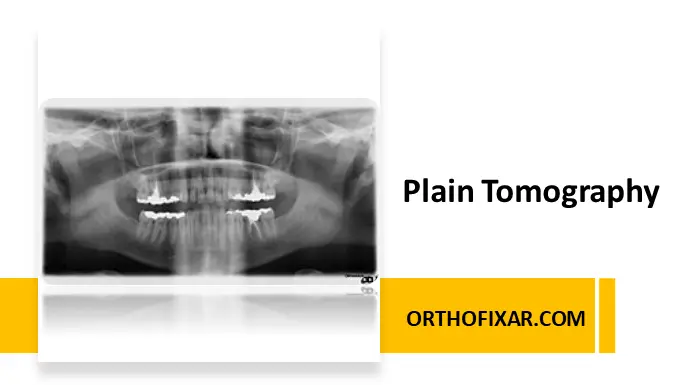
Plain tomography, also known as conventional tomography or linear tomography, is a specialized radiographic technique that was widely used before the advent of advanced cross-sectional imaging modalities such as computed tomography (CT) and magnetic resonance imaging (MRI). The technique allows radiologists to obtain a focused image of a selected anatomical plane while blurring structures located above and below that plane.
Although plain tomography has largely been replaced by CT and MRI, understanding its principles and historical significance remains important in medical education, particularly in radiology and orthopedic practice.
What Is Plain Tomography?
Plain tomography is an imaging technique that creates a clear image of a specific layer or section within the body. During image acquisition, the X-ray tube and film move simultaneously in opposite directions around the patient. This synchronized movement keeps structures within the selected focal plane sharply visible while blurring structures outside the plane.
As a result, anatomical details that may be hidden on conventional radiographs can become visible.
Principle of Plain Tomography
The basic principle of plain tomography is selective focusing.
During exposure:
- The X-ray tube moves in one direction.
- The image receptor or film moves in the opposite direction.
- A predetermined pivot point remains aligned with the plane of interest.
- Structures located within the focal plane remain sharp.
- Structures outside the focal plane become blurred.
This technique effectively reduces the problem of superimposed anatomical structures that commonly limits conventional radiography.
How Plain Tomography Works
The procedure involves the following steps:
- The patient is positioned according to the anatomical region being examined.
- A focal plane is selected.
- The X-ray tube and film move in opposite directions during exposure.
- Images are produced that emphasize the chosen anatomical layer.
- Multiple tomographic sections may be obtained at different depths to evaluate the entire region.
This process allows visualization of lesions hidden within dense anatomical structures.
Clinical Applications of Plain Tomography
Before the widespread use of CT and MRI, plain tomography was an important diagnostic tool in musculoskeletal and chest imaging.
Diagnosis of Segmental Bone Necrosis
Plain tomography was particularly useful in identifying areas of segmental bone necrosis that were difficult to visualize on standard radiographs.
Examples include:
- Osteonecrosis of the femoral head
- Localized cancellous bone infarctions
- Early avascular necrosis
The focused imaging plane could reveal structural abnormalities obscured by surrounding healthy bone.
Detection of Depressed Fractures
Plain tomography improved visualization of depressed fractures involving cancellous bone.
Common sites include:
- Vertebral bodies
- Tibial plateau
- Calcaneus
- Articular surfaces
Subtle depression fractures often become hidden on conventional radiographs because of overlapping bone structures.
Identification of Osteoid Osteoma
Small radiolucent lesions such as osteoid osteoma may be difficult to identify on routine X-rays.
Plain tomography helps by:
- Reducing superimposition
- Improving lesion conspicuity
- Demonstrating the characteristic nidus
This capability historically made it valuable in orthopedic diagnosis.
Detection of Bone Abscesses
Tomography could also reveal small bone abscesses and localized osteolytic lesions that were otherwise difficult to identify.
These lesions often appear as:
- Small radiolucent defects
- Areas of cortical destruction
- Localized bone rarefaction
Advantages of Plain Tomography
Several benefits contributed to the popularity of plain tomography before CT became widely available.
Improved Visualization
By blurring overlying structures, tomography provides better visualization of hidden lesions.
Enhanced Detection of Small Lesions
The technique can reveal subtle radiolucent abnormalities that may not be apparent on standard radiographs.
Better Assessment of Cancellous Bone
Tomography is particularly useful for evaluating trabecular bone architecture and depression fractures.
Relatively Simple Technology
Compared with modern CT scanners, conventional tomographic equipment was less complex and less expensive.
Limitations of Plain Tomography
Despite its advantages, plain tomography has several significant limitations.
Limited Cross-Sectional Detail
Unlike CT and MRI, conventional tomography produces only a focused plane rather than a true cross-sectional image.
Inferior Spatial Resolution
The technique offers lower diagnostic accuracy compared with modern imaging modalities.
Radiation Exposure
Multiple tomographic cuts may increase patient radiation exposure.
Time-Consuming Procedure
Obtaining multiple sections can be labor-intensive and less efficient than CT scanning.
Plain Tomography vs CT
| Feature | Plain Tomography | CT |
|---|---|---|
| Imaging Principle | Mechanical blurring of adjacent structures | Computer-generated cross-sectional images |
| Image Detail | Moderate | Excellent |
| Diagnostic Accuracy | Limited | High |
| Visualization of Bone Lesions | Good | Excellent |
| Soft Tissue Assessment | Poor | Good |
| Scan Time | Longer for multiple cuts | Rapid |
| Clinical Use Today | Rare | Common |
CT provides superior anatomical detail and has almost completely replaced conventional tomography in clinical practice.
Plain Tomography vs MRI
| Feature | Plain Tomography | MRI |
|---|---|---|
| Radiation | Uses ionizing radiation | No ionizing radiation |
| Bone Assessment | Good | Good |
| Soft Tissue Evaluation | Limited | Excellent |
| Marrow Imaging | Poor | Excellent |
| Diagnostic Capability | Limited | Superior |
MRI is particularly valuable for evaluating bone marrow pathology, soft tissues, ligaments, and cartilage, making it significantly more versatile than plain tomography.
Why Plain Tomography Has Been Replaced
The introduction of CT and MRI revolutionized diagnostic imaging by providing:
- True cross-sectional visualization
- Multiplanar reconstruction
- Superior lesion detection
- Better soft tissue contrast
- Greater diagnostic confidence
Consequently, conventional tomography has become largely obsolete in modern medical practice.
Historical Importance in Orthopedics
Although rarely used today, plain tomography played an important role in the development of musculoskeletal imaging.
Historically, it was used for:
- Evaluation of vertebral compression fractures
- Assessment of tibial plateau fractures
- Detection of osteoid osteoma
- Identification of bone abscesses
- Investigation of avascular necrosis
Knowledge of this technique remains valuable for understanding the evolution of diagnostic radiology.
Key Points
- Plain tomography produces a focused image of a selected anatomical plane.
- The X-ray tube and film move in opposite directions during exposure.
- Structures outside the focal plane become blurred.
- The technique was useful for detecting segmental bone necrosis, depressed fractures, osteoid osteoma, and bone abscesses.
- CT and MRI have largely replaced plain tomography because of superior image quality and diagnostic accuracy.
- Plain tomography remains an important historical milestone in radiologic imaging.
Conclusion
Plain tomography was once an essential imaging technique for evaluating skeletal abnormalities hidden by overlapping structures on conventional radiographs. By selectively focusing on a specific anatomical plane, it improved detection of conditions such as segmental bone necrosis, depressed fractures, osteoid osteoma, and bone abscesses. Despite its historical importance, modern CT and MRI have largely supplanted conventional tomography because they provide superior cross-sectional imaging, higher diagnostic accuracy, and improved visualization of both bone and soft tissue structures.
References & More
- WikiPedia – Tomography
- Seynaeve PC, Broos JI. De historiek van de tomografie [The history of tomography]. J Belge Radiol. 1995 Oct;78(5):284-8. Dutch. PMID: 8550391. Pubmed
- ScienceDirect – Tomography