PET scan imaging is one of the most advanced diagnostic imaging techniques in modern medicine. A positron emission tomography scan provides detailed information about physiological and metabolic processes within the body, allowing clinicians to detect diseases before structural abnormalities become visible on conventional imaging modalities.
Unlike CT scan or MRI, which primarily demonstrate anatomical structures, positron emission tomography evaluates cellular function and metabolic activity. This capability makes PET an essential tool in oncology, neurology, cardiology, and medical research.
Understanding the principles, indications, advantages, limitations, and various types of positron emission tomography is crucial for medical students, radiology trainees, and healthcare professionals.
What Is PET Scan Imaging?
PET scan imaging (Positron Emission Tomography) is a nuclear medicine imaging technique that uses radioactive tracers to visualize metabolic and biochemical activity within tissues.
A positron emission tomography test involves administering a radiopharmaceutical labeled with a positron-emitting radionuclide. As the radionuclide decays, positrons interact with electrons in nearby tissues, producing gamma photons that are detected by the PET scanner.
Computer algorithms reconstruct these signals into cross-sectional and three-dimensional images, allowing visualization of metabolic processes throughout the body.
See Also: SPECT Scan Imaging: Principles, Uses & Clinical Applications
Historical Development of Positron Emission Tomography
The development of positron emission tomography began in the mid-20th century with advances in nuclear physics and detector technology. The introduction of fluorine-18 (^18F)-labeled fluorodeoxyglucose (FDG) revolutionized PET imaging by enabling visualization of glucose metabolism.
Modern PET systems are frequently combined with CT or MRI scanners, providing simultaneous metabolic and anatomical information for enhanced diagnostic accuracy.
Basic Principles of PET Imaging
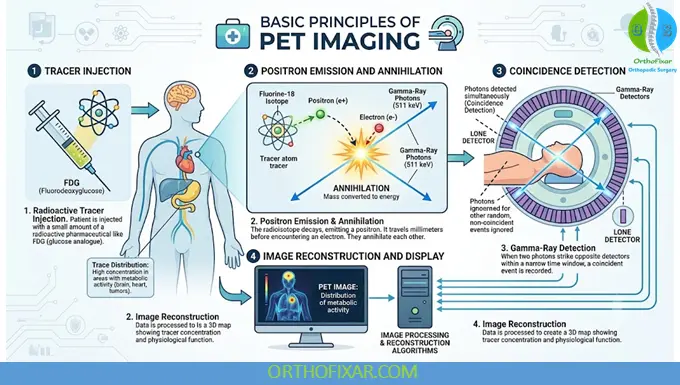
The fundamental principle of a positron emission tomography scan involves detecting pairs of gamma photons generated during positron annihilation.
Step 1: Radiotracer Administration
A radioactive tracer is injected intravenously. The most commonly used tracer is:
- Fluorine-18 fluorodeoxyglucose (18F-FDG)
This tracer behaves similarly to glucose and accumulates in metabolically active tissues.
Step 2: Positron Emission
The radionuclide emits positrons during radioactive decay.
Step 3: Annihilation Event
The positron collides with an electron, resulting in annihilation and the release of two gamma photons traveling in opposite directions.
Step 4: Photon Detection
The PET scanner detects coincident photons using rings of scintillation detectors.
Step 5: Image Reconstruction
Computer processing reconstructs the detected signals into detailed metabolic maps of the body.
Radiopharmaceuticals Used in PET Scan Imaging
Several tracers are utilized depending on the clinical application.
18F-FDG
The most widely used tracer.
Applications:
- Cancer imaging
- Brain metabolism studies
- Cardiac viability assessment
18F-NaF
Used for:
- Skeletal imaging
- Detection of bone metastases
68Ga-DOTATATE
Used for:
- Neuroendocrine tumors
18F-PSMA
Used primarily for:
- Prostate cancer imaging
13N-Ammonia and 82Rb
Used in:
- Myocardial perfusion imaging
See Also: Computed Tomography (CT Scan) Principles & Clinical Applications
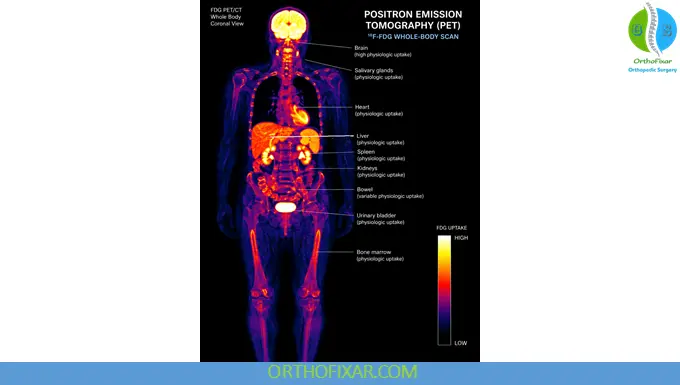
How a Positron Emission Tomography Test is Performed
Patient Preparation
Patients may be instructed to:
- Fast for 4–6 hours
- Avoid strenuous exercise
- Maintain normal hydration
- Control blood glucose levels
Tracer Injection
A radiopharmaceutical is administered intravenously.
Uptake Period
The patient rests quietly for approximately 30–60 minutes while the tracer distributes throughout the body.
Image Acquisition
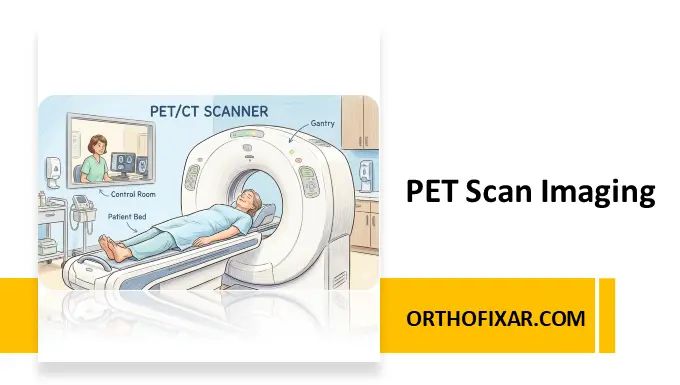
The patient lies on a motorized table that moves through the PET scanner.
Scanning time typically ranges from:
- 20–45 minutes
Image Interpretation
Nuclear medicine physicians analyze tracer uptake patterns to identify areas of abnormal metabolic activity.
Types of Positron Emission Tomography
Several types of positron emission tomography are currently available.
Stand-Alone PET
Provides metabolic information alone.
Advantages:
- Functional assessment
Limitations:
- Limited anatomical localization
PET/CT
The most commonly used form of PET scan imaging.
Advantages:
- Combines metabolic and anatomical information
- Improved lesion localization
- Faster examination times
PET/MRI
Combines PET with magnetic resonance imaging.
Advantages:
- Superior soft-tissue contrast
- Reduced radiation exposure
- Enhanced neurological and pediatric imaging
PET Scan Imaging Versus SPECT Scan
Many students confuse PET with single positron emission computed tomography. However, the correct nuclear medicine technique commonly used is Single Photon Emission Computed Tomography (SPECT).
PET
Characteristics:
- Uses positron-emitting radionuclides
- Higher spatial resolution
- Better quantitative analysis
- Superior sensitivity
SPECT
Characteristics:
- Uses gamma-emitting radionuclides
- Lower cost
- Wider availability
- Useful for cardiac and skeletal imaging
PET generally provides greater image quality and diagnostic accuracy, although SPECT remains valuable in many clinical settings.
Clinical Applications of PET Scan Imaging
Oncology
Cancer imaging represents the most common indication for pet scan imaging.
Applications include:
- Tumor detection
- Initial staging
- Assessment of metastases
- Treatment monitoring
- Detection of recurrence
Common cancers evaluated:
- Lung cancer
- Breast cancer
- Colorectal cancer
- Lymphoma
- Melanoma
- Head and neck malignancies
Neurology
PET contributes significantly to neurological diagnosis.
Applications:
- Alzheimer’s disease
- Dementia evaluation
- Epilepsy localization
- Parkinsonian disorders
- Brain tumor assessment
Cardiology
A positron emission tomography test can evaluate myocardial perfusion and viability.
Applications:
- Coronary artery disease
- Myocardial ischemia
- Viable myocardium identification
- Risk stratification
Infection and Inflammation
PET may detect inflammatory activity in:
- Vasculitis
- Osteomyelitis
- Prosthetic joint infection
- Fever of unknown origin
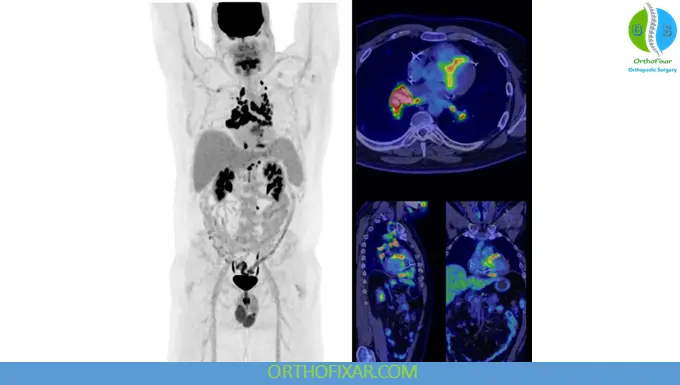
PET Imaging in Oncology
Cancer cells often exhibit increased glucose metabolism.
FDG-PET detects these areas as regions of increased tracer uptake.
Advantages include:
- Whole-body assessment
- Early detection of metastases
- Evaluation of treatment response
- Guidance for biopsy planning
PET has become an indispensable component of modern cancer management.
PET Imaging in Neurological Disorders
Alzheimer’s Disease
PET demonstrates characteristic reductions in cerebral glucose metabolism.
Epilepsy
Interictal PET may identify epileptogenic foci.
Brain Tumors
PET helps:
- Differentiate recurrence from radiation necrosis
- Grade tumors
- Assess treatment response
PET Imaging in Cardiac Disease
Cardiac PET provides highly accurate evaluation of:
- Myocardial perfusion
- Coronary flow reserve
- Myocardial viability
These findings assist in determining whether patients may benefit from coronary revascularization procedures.
Advantages of PET Scan Imaging
Major benefits include:
- Functional imaging capability
- Early disease detection
- Whole-body evaluation
- High sensitivity
- Quantitative analysis
- Improved cancer staging
- Better treatment monitoring
PET frequently detects abnormalities before structural imaging changes occur.
Limitations of Positron Emission Tomography
Despite its strengths, PET has limitations.
False Positives
Increased tracer uptake may occur in:
- Infection
- Inflammation
- Healing tissues
Limited Specificity
Abnormal uptake does not always indicate malignancy.
Radiation Exposure
Patients receive radiation from:
- Radiotracer administration
- CT component in PET/CT studies
Cost
PET examinations are generally more expensive than CT, MRI, or SPECT.
Availability
Advanced PET facilities may not be available in all regions.
Radiation Safety Considerations
The radiation dose from a positron emission tomography scan is generally considered safe when medically justified.
Safety measures include:
- Appropriate patient selection
- Minimizing unnecessary repeat examinations
- Following radiation protection guidelines
Pregnant patients require special consideration due to fetal radiation exposure.
Contraindications and Precautions
Relative contraindications include:
- Pregnancy
- Inability to remain still
- Uncontrolled hyperglycemia
- Severe claustrophobia
Breastfeeding patients may require temporary interruption depending on the radiotracer used.
Future Developments in PET Imaging
Emerging technologies include:
- Digital PET detectors
- Total-body PET systems
- Artificial intelligence-assisted interpretation
- Novel molecular tracers
- Hybrid PET/MRI techniques
These advances continue to improve sensitivity, image quality, and diagnostic precision.
Key Points
- PET scan imaging evaluates metabolic and physiological processes rather than anatomy alone.
- A positron emission tomography test uses radiotracers that emit positrons.
- FDG-PET is the most widely used form of positron emission tomography.
- PET plays a major role in oncology, neurology, cardiology, and infection imaging.
- Modern positron emission tomography scans are frequently combined with CT or MRI.
- PET generally offers higher sensitivity and resolution than single positron emission computed tomography (SPECT).
- Advances in molecular imaging continue to expand the clinical utility of PET technology.
References & More
- Townsend DW. Positron Emission Tomography/Computed Tomography. Semin Nucl Med. 2008. Pubmed
- Jadvar H, Colletti PM. Competitive advantage of PET/MRI. Eur J Radiol. 2014. Pubmed
- Fletcher JW, Djulbegovic B, Soares HP, et al. Recommendations on the use of 18F-FDG PET in oncology. J Nucl Med. 2008. Pubmed
- Boellaard R. Standards for PET image acquisition and quantitative data analysis. J Nucl Med. 2009. Pubmed
- Cherry SR, Sorenson JA, Phelps ME. Physics in Nuclear Medicine. Elsevier.
- Hess S, Blomberg BA, Zhu HJ, et al. The pivotal role of FDG-PET/CT in modern medicine. Acad Radiol. 2014. Pubmed
- Love C, Tomas MB, Tronco GG, Palestro CJ. FDG PET of infection and inflammation. Radiographics. 2005. Pubmed
- Phelps ME. PET: Molecular Imaging and Its Biological Applications. Springer.