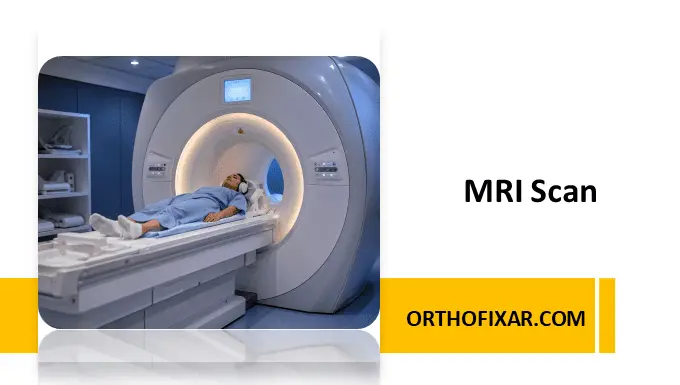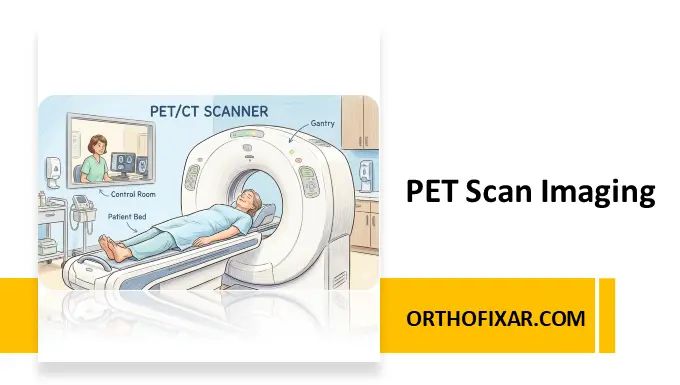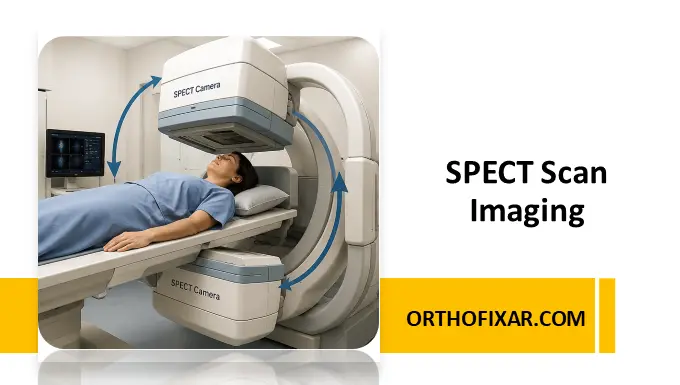
SPECT scan imaging (Single Photon Emission Computed Tomography) is an advanced nuclear medicine imaging technique that provides three-dimensional information about physiological and biochemical processes within the body. Unlike conventional radiography, computed tomography (CT), or magnetic resonance imaging (MRI), which primarily display anatomical structures, SPECT imaging evaluates organ function and tissue metabolism.
SPECT has become an important diagnostic tool in cardiology, neurology, oncology, and musculoskeletal medicine because it allows physicians to visualize blood flow, bone turnover, and cellular activity before structural abnormalities become apparent.
What is SPECT Scan Imaging?
Single Photon Emission Computed Tomography (SPECT) is a tomographic nuclear medicine technique that uses gamma-emitting radiopharmaceuticals to generate cross-sectional images of the body.
After administration of a radioactive tracer, a gamma camera rotates around the patient, collecting data from multiple angles. Computer reconstruction algorithms then create detailed three-dimensional images that demonstrate the distribution of the radiotracer within tissues and organs.
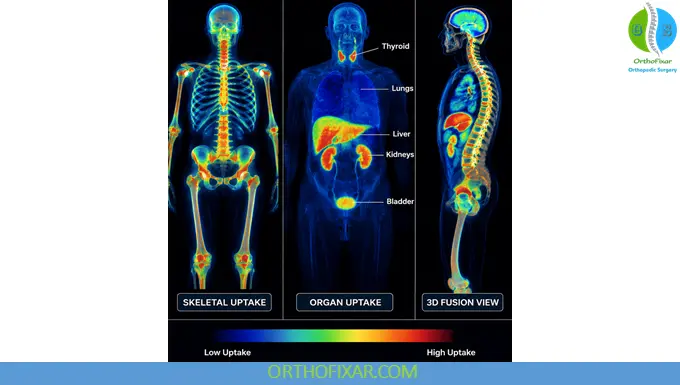
Because tracer uptake reflects physiological activity, SPECT imaging provides valuable functional information that complements anatomical imaging modalities.
Basic Principles of SPECT Imaging
SPECT imaging relies on three fundamental components:
1. Radiopharmaceutical Administration
A radiopharmaceutical consists of:
- A radioactive isotope (radionuclide)
- A biologically active carrier molecule
The carrier directs the tracer to specific tissues, while the radionuclide emits gamma photons detectable by the imaging system.
Common radionuclides include:
- Technetium-99m (Tc-99m)
- Iodine-123 (I-123)
- Thallium-201 (Tl-201)
- Indium-111 (In-111)
2. Gamma Photon Detection
As the radionuclide decays, gamma rays are emitted from the body. A rotating gamma camera detects these photons from multiple projections around the patient.
3. Tomographic Reconstruction
Advanced computer software reconstructs the acquired projections into:
- Axial images
- Coronal images
- Sagittal images
- Three-dimensional representations
This process allows localization and quantification of radiotracer distribution.
See Also: Computed Tomography (CT Scan) Principles & Clinical Applications
How a SPECT Scan is Performed
Patient Preparation
Preparation depends on the clinical indication and radiopharmaceutical used.
Examples include:
- Fasting before some cardiac studies
- Avoiding caffeine before myocardial perfusion imaging
- Medication adjustments when necessary
Radiotracer Injection
The selected radiopharmaceutical is administered, usually intravenously.
Uptake Phase
A waiting period allows the tracer to accumulate within target tissues.
The uptake period may range from minutes to several hours depending on the study.
Image Acquisition
The patient lies on an imaging table while one or more gamma cameras rotate around the body.
Acquisition generally requires:
- 15–45 minutes
- Minimal patient movement
- Comfortable positioning
Image Processing
Specialized software reconstructs images and may perform quantitative analysis of tracer uptake.
SPECT/CT Hybrid Imaging
Modern systems frequently combine SPECT with CT in a single scanner.
Advantages of SPECT/CT
- Improved anatomical localization
- Better lesion characterization
- Attenuation correction
- Increased diagnostic accuracy
- Reduced false-positive findings
SPECT/CT has become the standard approach for many oncologic, orthopedic, and cardiac applications.
Clinical Applications of SPECT Scan Imaging
Cardiac Imaging
Myocardial perfusion SPECT is among the most common nuclear medicine procedures worldwide.
It evaluates:
- Coronary artery disease
- Myocardial ischemia
- Myocardial infarction
- Cardiac viability
- Risk stratification in heart disease
Areas with reduced blood flow demonstrate decreased radiotracer uptake.
Common Cardiac Tracers
- Tc-99m sestamibi
- Tc-99m tetrofosmin
- Thallium-201
Neurological Imaging
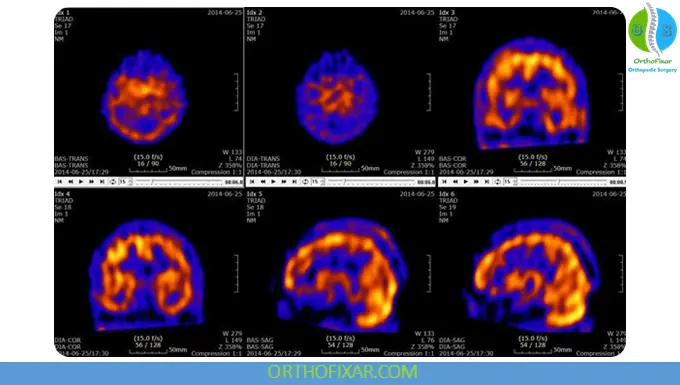
Brain SPECT assesses cerebral blood flow and functional abnormalities.
Common indications include:
- Dementia evaluation
- Alzheimer’s disease assessment
- Epilepsy localization
- Parkinsonian syndromes
- Cerebrovascular disease
Functional abnormalities may be detected before structural changes become visible on CT or MRI.
Bone SPECT Imaging
Bone SPECT significantly improves lesion detection compared with planar bone scintigraphy.
Common orthopedic indications include:
- Occult fractures
- Stress fractures
- Osteomyelitis
- Prosthetic joint complications
- Avascular necrosis
- Spinal pain evaluation
- Spondylolysis
The most frequently used tracer is:
- Tc-99m methylene diphosphonate (MDP)
Increased uptake reflects enhanced osteoblastic activity and bone remodeling.
Oncology Applications
SPECT imaging contributes to cancer diagnosis and staging by identifying abnormal metabolic or receptor activity.
Applications include:
- Neuroendocrine tumors
- Thyroid cancer
- Bone metastases
- Sentinel lymph node mapping
- Tumor localization
Hybrid SPECT/CT improves detection and anatomical localization of malignant lesions.
Infection and Inflammation Imaging
Radiolabeled leukocyte studies and other tracers can identify inflammatory processes.
Indications include:
- Osteomyelitis
- Prosthetic joint infection
- Fever of unknown origin
- Soft tissue infections
Advantages of SPECT Imaging
Functional Assessment
SPECT evaluates physiological activity rather than merely anatomical appearance.
Early Disease Detection
Functional abnormalities often precede structural changes.
Three-Dimensional Imaging
Tomographic reconstruction improves lesion localization.
Wide Availability
SPECT systems are available in many hospitals and imaging centers.
Cost-Effective
Compared with PET imaging, SPECT is generally more accessible and less expensive.
Limitations of SPECT Imaging
Despite its usefulness, SPECT has certain limitations.
Lower Spatial Resolution
Resolution is generally lower than:
- CT
- MRI
- PET
Longer Acquisition Times
Some examinations require prolonged imaging periods.
Radiation Exposure
Patients receive a small dose of ionizing radiation from administered radiopharmaceuticals.
Motion Artifacts
Patient movement can reduce image quality and diagnostic accuracy.
Radiation Safety in SPECT Imaging
The radiation dose from most SPECT studies is considered low and medically justified when clinically indicated.
Safety measures include:
- Using the lowest effective tracer dose
- Appropriate patient selection
- Following radiation protection principles
- Encouraging hydration after the examination when appropriate
Adverse reactions to radiopharmaceuticals are uncommon.
SPECT Versus PET Imaging
| Feature | SPECT | PET |
|---|---|---|
| Radiotracer Emission | Single gamma photons | Positron emission |
| Cost | Lower | Higher |
| Availability | Widely available | Less available |
| Spatial Resolution | Moderate | Higher |
| Quantification | Limited | Superior |
| Clinical Use | Cardiology, bone imaging, neurology | Oncology, cardiology, neurology |
Although PET generally offers higher sensitivity and resolution, SPECT remains an essential and widely used functional imaging modality.
Future Developments in SPECT Imaging
Recent technological advances continue to improve SPECT performance.
Key innovations include:
- Solid-state detectors
- Advanced reconstruction algorithms
- Quantitative SPECT
- Artificial intelligence-assisted image analysis
- Improved hybrid SPECT/CT systems
These developments are enhancing image quality, reducing scan times, and expanding clinical applications.
Key Points
- SPECT scan imaging is a nuclear medicine technique that provides three-dimensional functional information.
- Radiopharmaceuticals emit gamma photons detected by rotating gamma cameras.
- SPECT is widely used in cardiology, neurology, oncology, and musculoskeletal imaging.
- SPECT/CT combines functional and anatomical information for greater diagnostic accuracy.
- Bone SPECT is particularly valuable for detecting occult fractures, infection, and prosthetic complications.
- The technique allows early detection of disease by identifying physiological abnormalities before structural changes occur.
- Modern advances continue to improve image quality and quantitative assessment.
References & More
- National Research Council (US) and Institute of Medicine (US) Committee on the Mathematics and Physics of Emerging Dynamic Biomedical Imaging. Mathematics and Physics of Emerging Biomedical Imaging. Washington (DC): National Academies Press (US); 1996. Chapter 5, Single Photon Emission Computed Tomography. Available from: https://www.ncbi.nlm.nih.gov/books/NBK232492/
- Khalil MM, Tremoleda JL, Bayomy TB, Gsell W. Molecular SPECT Imaging: An Overview. Int J Mol Imaging. 2011;2011:796025. doi: 10.1155/2011/796025. Epub 2011 Apr 5. PMID: 21603240; PMCID: PMC3094893. Pubmed
- Yandrapalli S, Puckett Y. SPECT Imaging(Archived). 2022 Oct 3. In: StatPearls [Internet]. Treasure Island (FL): StatPearls Publishing; 2026 Jan–. PMID: 33232084. Pubmed
- Blom, A., Warwick, D., & Whitehouse, M. R. (2018). Apley & Solomon’s system of orthopaedics and trauma (10th ed.). CRC Press