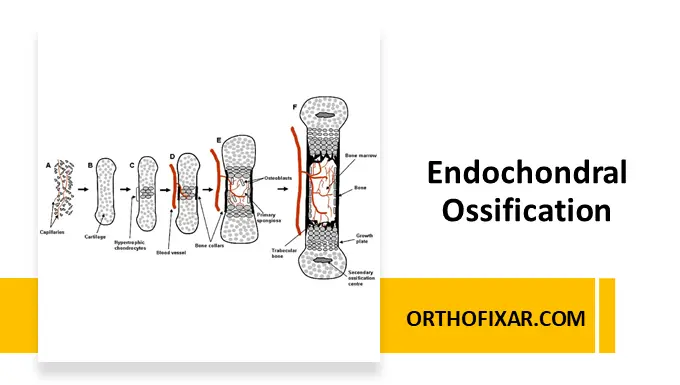
Endochondral ossification is the primary mechanism through which most bones of the human skeleton develop. It is responsible for the formation of long bones, the growth of tubular bones during childhood and adolescence, and the longitudinal increase in bone length. Unlike intramembranous ossification, which forms bone directly from mesenchymal tissue, endochondral ossification involves the replacement of a pre-existing cartilage model by bone.
This process begins during embryonic development and continues until skeletal maturity, when the epiphyseal growth plates close. Endochondral ossification is also recapitulated during fracture healing, making it a fundamental concept in anatomy, histology, embryology, orthopedics, and regenerative medicine.
What is Endochondral Ossification?
Endochondral ossification is a process of bone formation in which a hyaline cartilage template is gradually replaced by bone tissue. It is responsible for the development of:
- Long bones (femur, tibia, humerus)
- Short bones
- Most irregular bones
- Vertebrae
- Parts of the pelvis
- Growth of bones during childhood and adolescence
The process begins with mesenchymal cell condensation, followed by chondrogenesis, cartilage maturation, vascular invasion, and eventual replacement of cartilage by bone.
Difference Between Endochondral and Intramembranous Ossification
| Feature | Endochondral Ossification | Intramembranous Ossification |
|---|---|---|
| Bone precursor | Hyaline cartilage model | Mesenchymal tissue |
| Main bones formed | Long bones and most skeletal bones | Flat bones of skull and clavicle |
| Growth plate involvement | Present | Absent |
| Longitudinal growth | Yes | No |
| Secondary ossification centers | Present | Absent |
Overview of Long Bone Development
During fetal development, a cartilage model of the future bone is formed. Ossification first begins in the center of the shaft (diaphysis), creating the primary ossification center.
At birth:
- The cartilage model is largely complete.
- Ossification has already started in the diaphysis.
- Secondary ossification centers begin developing within the epiphyses.
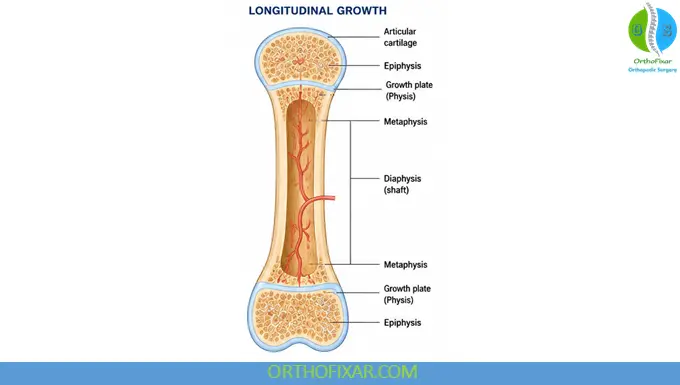
A layer of cartilage remains between the epiphysis and diaphysis. This cartilage forms the growth plate (physis), which allows continued longitudinal growth until late adolescence.
Primary and Secondary Ossification Centers
Primary Ossification Center
The primary ossification center develops in the diaphysis during fetal life.
Key events include:
- Chondrocyte hypertrophy.
- Matrix calcification.
- Blood vessel invasion.
- Osteoblast differentiation.
- Formation of woven bone.
The ossification process spreads toward both ends of the developing bone.
Secondary Ossification Centers
Secondary ossification centers develop within the epiphyses, usually around birth or shortly thereafter.
Their formation results in:
- Ossified epiphyses
- Persistence of articular cartilage
- Formation of the epiphyseal growth plate
The growth plate remains active until skeletal maturity.
The Growth Plate (Physis)
The physis, or epiphyseal growth plate, is a specialized cartilaginous structure located between the epiphysis and metaphysis.
It is the primary site responsible for longitudinal bone growth.
As long as the growth plate remains active, bones continue to lengthen. Eventually, the growth plate undergoes complete ossification, resulting in epiphyseal closure and cessation of growth.
Histological Zones of the Growth Plate
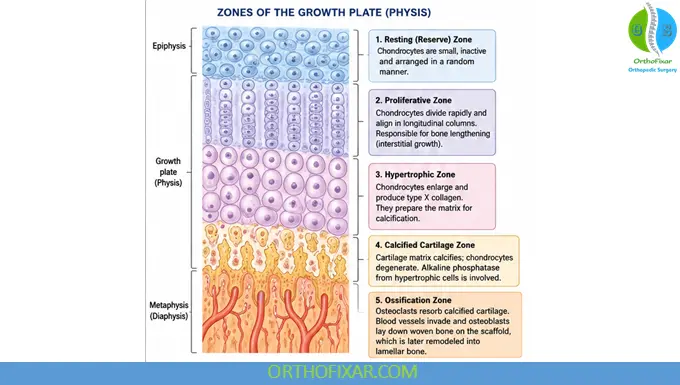
The growth plate is organized into distinct cellular zones that represent different stages of chondrocyte maturation.
Resting Zone (Reserve Zone)
The resting zone lies adjacent to the epiphysis.
Characteristics include:
- Small, inactive chondrocytes
- Random cellular arrangement
- Storage of progenitor chondrocytes
- Maintenance of growth plate architecture
This zone serves as a reservoir for future proliferating chondrocytes.
Proliferative Zone
The proliferative zone contains actively dividing chondrocytes.
Characteristics include:
- Rapid mitosis
- Longitudinal alignment of cells
- Formation of cellular columns
- Production of extracellular matrix
This zone contributes directly to bone elongation through interstitial cartilage growth.
Hypertrophic Zone
As proliferating chondrocytes mature, they enlarge significantly and enter the hypertrophic zone.
Characteristics include:
- Marked increase in cell size
- Cellular differentiation
- Production of type X collagen
- Release of factors promoting vascular invasion
Hypertrophic chondrocytes play a crucial role in preparing cartilage for mineralization.
Zone of Calcified Cartilage
Near the metaphyseal border, the cartilage matrix becomes mineralized.
Characteristics include:
- Matrix calcification
- Chondrocyte degeneration
- Increased alkaline phosphatase activity
- Preparation for bone deposition
Calcified cartilage serves as a temporary scaffold for future bone formation.
Ossification Zone (Metaphyseal Zone)
This is the region where cartilage is replaced by bone.
Key events include:
- Osteoclastic resorption of calcified cartilage
- Invasion by blood vessels
- Recruitment of osteoprogenitor cells
- Osteoblast-mediated bone deposition
Initially, woven bone is formed on the calcified cartilage scaffold and is subsequently remodeled into mature lamellar bone.
Stages of Endochondral Ossification
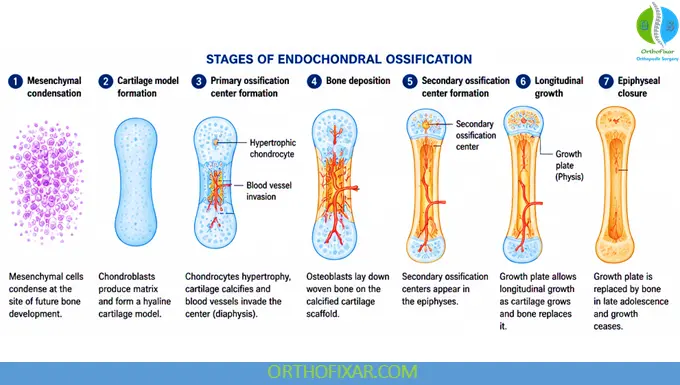
Stage 1: Mesenchymal Cell Condensation
Mesenchymal stem cells aggregate at sites of future bone formation.
These cells differentiate into chondroblasts under the influence of signaling molecules and transcription factors.
Stage 2: Formation of Cartilage Model
Chondroblasts produce extracellular matrix and form a hyaline cartilage template that resembles the future bone.
The cartilage model grows through:
- Appositional growth
- Interstitial growth
Stage 3: Development of Primary Ossification Center
Chondrocytes in the center of the cartilage model enlarge and become hypertrophic.
This is followed by:
- Matrix calcification
- Chondrocyte apoptosis
- Vascular invasion
The primary ossification center develops within the diaphysis.
Stage 4: Bone Deposition
Osteoblasts deposit osteoid onto remnants of calcified cartilage.
This osteoid mineralizes and forms woven bone.
Stage 5: Formation of Secondary Ossification Centers
Secondary ossification centers develop within the epiphyses.
Cartilage persists only at:
- Articular surfaces
- Epiphyseal growth plates
Stage 6: Growth Plate-Mediated Longitudinal Growth
Bone elongation continues through coordinated activity of the growth plate zones.
Continuous cartilage production on the epiphyseal side and ossification on the metaphyseal side increase bone length.
Stage 7: Epiphyseal Closure
At the end of puberty, growth plate cartilage is gradually replaced by bone.
The epiphysis and metaphysis fuse, leaving an epiphyseal line and terminating longitudinal growth.
Cellular Components of Endochondral Ossification
Chondrocytes
Chondrocytes are the principal cells of cartilage.
Functions include:
- Matrix synthesis
- Proliferation
- Hypertrophy
- Regulation of mineralization
Osteoblasts
Osteoblasts synthesize osteoid and facilitate bone mineralization.
Functions include:
- Collagen production
- Bone matrix formation
- Mineral deposition
Osteoclasts
Osteoclasts remove calcified cartilage and immature bone.
Functions include:
- Matrix resorption
- Bone remodeling
- Creation of marrow spaces
Endothelial Cells
Blood vessel invasion is essential for successful ossification.
Functions include:
- Delivery of nutrients
- Recruitment of osteogenic cells
- Promotion of bone formation
Molecular Regulation of Endochondral Ossification
Several signaling pathways regulate growth plate activity and bone formation:
Indian Hedgehog (Ihh)
- Controls chondrocyte proliferation
- Regulates hypertrophic differentiation
Parathyroid Hormone-Related Protein (PTHrP)
- Delays chondrocyte hypertrophy
- Maintains proliferative activity
Bone Morphogenetic Proteins (BMPs)
- Promote chondrogenesis
- Stimulate osteogenesis
Fibroblast Growth Factors (FGFs)
- Regulate cartilage growth
- Influence growth plate maturation
Vascular Endothelial Growth Factor (VEGF)
- Promotes angiogenesis
- Facilitates vascular invasion of cartilage
Endochondral Ossification in Fracture Healing
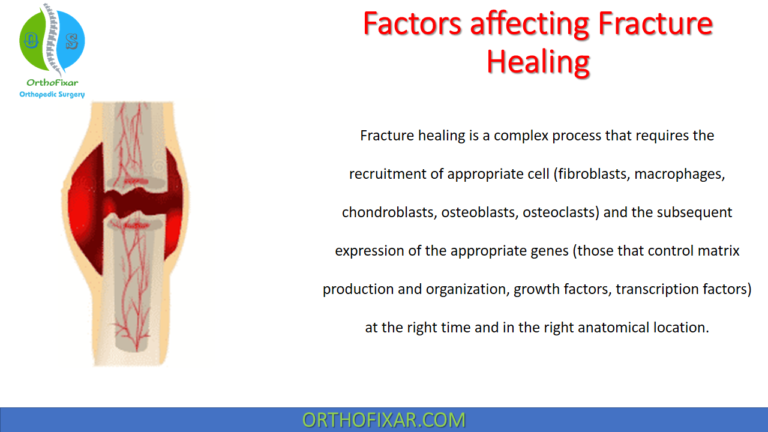
A process similar to embryonic endochondral ossification occurs during secondary fracture healing.
The sequence includes:
- Hematoma formation
- Soft callus formation
- Cartilaginous callus development
- Cartilage mineralization
- Replacement by woven bone
- Remodeling into lamellar bone
This mechanism is particularly important in fractures treated non-operatively or with relative stability.
Clinical Significance
Growth Plate Injuries
Damage to the physis may result in:
- Premature physeal closure
- Limb length discrepancy
- Angular deformities
Achondroplasia
A genetic disorder affecting FGFR3 signaling.
Consequences include:
- Impaired endochondral ossification
- Short-limbed dwarfism
- Abnormal growth plate function
Rickets
Defective mineralization of growth plate cartilage leads to:
- Growth abnormalities
- Skeletal deformities
- Delayed ossification
Osteoarthritis and Cartilage Disorders
Alterations in chondrocyte differentiation pathways may contribute to degenerative joint diseases.
Key Examination Points
- Endochondral ossification forms most bones of the body.
- Longitudinal bone growth occurs at the epiphyseal growth plate.
- The growth plate contains resting, proliferative, hypertrophic, calcification, and ossification zones.
- Primary ossification centers develop in the diaphysis.
- Secondary ossification centers develop in the epiphyses.
- Woven bone is formed first and later remodeled into lamellar bone.
- Growth ceases when the epiphyseal plate closes during late adolescence.
- A similar process occurs during fracture repair.
Conclusion
Endochondral ossification is the fundamental biological process responsible for the formation and longitudinal growth of most bones in the human body. Through the coordinated activity of growth plate chondrocytes, vascular invasion, osteoblasts, and osteoclasts, a cartilage template is progressively replaced by mature bone. Understanding the stages of endochondral ossification and the organization of the growth plate is essential for interpreting normal skeletal development, growth disorders, fracture healing, and orthopedic pathology.
References & More
- Mackie, E J et al. “Endochondral ossification: how cartilage is converted into bone in the developing skeleton.” The international journal of biochemistry & cell biology vol. 40,1 (2008): 46-62. doi:10.1016/j.biocel.2007.06.009. Link
- Breeland G, Sinkler MA, Menezes RG. Embryology, Bone Ossification. [Updated 2023 May 1]. In: StatPearls [Internet]. Treasure Island (FL): StatPearls Publishing; 2026 Jan-. Available from: https://www.ncbi.nlm.nih.gov/books/NBK539718/
- Blom, A., Warwick, D., & Whitehouse, M. R. (2018). Apley & Solomon’s system of orthopaedics and trauma (10th ed.). CRC Press