Bone is not a static scaffold. It is continuously broken down and rebuilt throughout life in a process called bone remodeling, and the biochemical byproducts of that process, known as bone turnover markers, can be measured in blood to assess how actively the skeleton is being formed and resorbed. Among the many biochemical markers explored over the past three decades, two have emerged as the clinical reference standard: procollagen type 1 N-terminal propeptide (P1NP) and the C-terminal cross-linked telopeptide of type 1 collagen (CTX).
This article reviews what bone turnover markers are, how the P1NP lab test and CTX blood test are used together, and how these bone markers for osteoporosis fit into modern fracture-risk assessment and treatment monitoring, based on PubMed, NCBI, and StatPearls sources.
Clinical Snapshot
The International Osteoporosis Foundation (IOF) and the International Federation of Clinical Chemistry and Laboratory Medicine (IFCC) recommend serum P1NP as the reference marker of bone formation and serum CTX-1 as the reference marker of bone resorption, for both fracture-risk assessment and monitoring of osteoporosis treatment.
What Are Bone Turnover Markers?
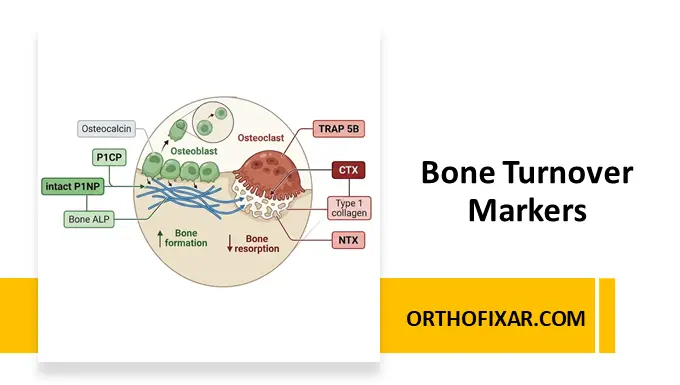
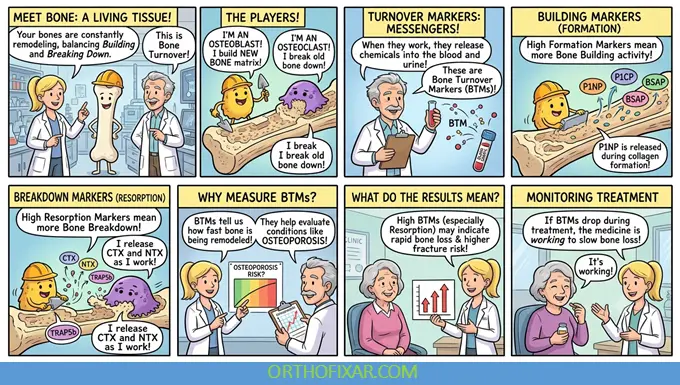
Bone turnover markers (BTMs) are byproducts of the bone remodeling cycle that can be detected in serum or urine. Bone remodeling involves two coupled processes: resorption, carried out by osteoclasts that break down old bone, and formation, carried out by osteoblasts that lay down new bone matrix. Each of these cellular activities releases measurable molecules into the circulation, which is what allows bone turnover to be tracked through a simple blood draw rather than a bone biopsy.
Because BTMs reflect whole-body skeletal activity rather than the condition of any single bone site, they have limited value for diagnosing localized bone problems, but they respond much faster than bone mineral density (BMD) scans to changes in bone metabolism, which makes them useful for monitoring treatment response and medication adherence.
Bone Formation Markers
Markers of bone formation are produced by osteoblasts during the synthesis of new bone matrix. The main formation markers include:
- Procollagen type 1 N-terminal propeptide (P1NP) — currently the preferred formation marker
- Bone-specific alkaline phosphatase (BSAP)
- Osteocalcin
- Procollagen type 1 C-terminal propeptide (P1CP)
Bone Resorption Markers
Markers of bone resorption are generated as osteoclasts enzymatically break down type 1 collagen in bone. The main resorption markers include:
- C-terminal cross-linked telopeptide of type 1 collagen (CTX-1) — currently the preferred resorption marker
- N-terminal cross-linked telopeptide of type 1 collagen (NTX-1)
- Tartrate-resistant acid phosphatase 5b (TRACP5b)
- Pyridinoline and deoxypyridinoline
- Hydroxyproline (largely historical; not bone-specific)
P1NP Lab Test: The Preferred Bone Formation Marker
What the P1NP Blood Test Measures
Type 1 procollagen contains N- and C-terminal extensions that are cleaved off by specific proteases as procollagen is converted into mature collagen during new bone formation. The cleaved N-terminal fragment is P1NP, and its concentration in serum is generally considered one of the more sensitive available indicators of osteoblast activity and bone formation rate. The P1NP blood test is measured by immunoassay, most commonly on automated electrochemiluminescence platforms.
P1NP Reference Ranges
Reported P1NP reference ranges vary by assay platform, laboratory, age group, and menopausal status, and there is currently no single universally standardized reference interval. Representative published ranges include approximately 15 to 70 µg/L in the general adult population per StatPearls, 15.1 to 58.6 ng/mL for premenopausal women per one clinical laboratory reference set, and age-stratified intervals from population studies showing ranges such as roughly 14 to 42 ng/mL depending on sex and age group. Because of this variability, results should always be interpreted against the specific reference range provided by the reporting laboratory rather than a single fixed cutoff.
| Population | Approximate P1NP Range | Source Type |
|---|---|---|
| General adult population | ~15–70 µg/L | StatPearls / NCBI Bookshelf |
| Premenopausal women | 15.1–58.6 ng/mL | Clinical laboratory reference |
| Healthy women, age 35–45 | 13.72–32.90 ng/mL | Population reference-interval study |
| Healthy men, age 35–45 | 16.89–42.43 ng/mL | Population reference-interval study |
| Postmenopausal osteoporosis | Median ~51.7 ng/mL (elevated vs. controls) | Cross-sectional clinical study |
Preanalytical Considerations for P1NP Testing
One practical advantage of the P1NP blood test is that its levels are not significantly influenced by recent food intake, and it shows relatively low diurnal variability, meaning strict fasting is not required for this marker alone. Samples are generally stable for several months when frozen at or below −20 °C, and moderate hemolysis can interfere with results, while icterus or lipemia typically does not.
CTX: The Primary Bone Resorption Marker
What CTX Measures
CTX is a degradation fragment of type 1 collagen released into circulation when osteoclasts enzymatically break down bone matrix. Because it is generated directly during the resorption process, it serves as a real-time indicator of osteoclast activity.
CTX Reference Ranges and Preanalytical Factors
Reported CTX reference ranges also vary substantially by assay and population, with figures from roughly 100 to 700 ng/L cited in general adult ranges and narrower, age- and sex-stratified intervals reported in dedicated population studies. Unlike P1NP, CTX is affected by diurnal rhythm and recent food intake, so an early-morning fasting sample is recommended when precise longitudinal comparisons are needed, and serial samples should ideally be drawn at a consistent time of day.
Preanalytical Tip
Because CTX is sensitive to food intake and time of day while P1NP is not, discordant preanalytical handling is a common cause of unexpected changes between two draws. When ordering P1NP and CTX together, request an early morning, fasting sample for both to keep results comparable over time.
P1NP and CTX: Why These Two Markers Are Used Together
Complementary Roles in Bone Remodeling Assessment
P1NP and CTX are typically ordered together because bone remodeling is a coupled process: formation and resorption normally rise and fall together, and comparing the two markers gives a fuller picture of overall turnover than either marker alone. This is why leading professional bodies, including the IOF, the European Calcified Tissue Society, and the IFCC, converged on recommending this specific pairing as the reference standard for clinical bone turnover assessment.
Monitoring Osteoporosis Treatment Response
Because BTMs respond to therapy within weeks to months, well before measurable changes appear on DXA, P1NP and CTX are useful for confirming that a patient is responding appropriately to treatment and taking medication as prescribed. In general terms:
- Antiresorptive therapy (e.g., bisphosphonates, denosumab) is expected to lower CTX, and often P1NP as well, reflecting suppressed bone turnover.
- Anabolic therapy (e.g., teriparatide, parathyroid hormone analogues) is expected to raise P1NP, often with an initial rise in CTX as well, reflecting stimulated bone formation.
One multicenter real-world study found that teriparatide treatment increased P1NP levels within three months, including an approximate 50 percent increase in treated women, while denosumab reduced CTX levels within three months by a comparable magnitude. A separate prospective cohort study proposed practical target values, finding that P1NP below approximately 30 µg/L and CTX below approximately 0.25 µg/L best distinguished patients adherent to antiresorptive therapy from those who were not, and that these thresholds correlated with subsequent bone mineral density gains.
Bone Markers for Osteoporosis: Clinical Applications
Fracture Risk Prediction
Elevated bone resorption markers, including CTX and urinary deoxypyridinoline, have been associated with roughly a two-fold higher risk of hip, vertebral, and other fragility fractures in prospective postmenopausal cohorts. Findings for formation markers and fracture risk have been less consistent across study populations, but several studies link elevated baseline P1NP and CTX to greater subsequent bone loss and fracture risk, and combining bone turnover marker results with BMD measurement has been shown to help identify women at especially high fracture risk.
Treatment Monitoring for Antiresorptive Therapy
In patients started on bisphosphonates or denosumab, a decline in CTX (and often P1NP) after several months of therapy provides biochemical confirmation of treatment effect and adherence, which is particularly useful given how commonly osteoporosis medications are taken incorrectly or discontinued without informing the prescriber.
Monitoring Anabolic Therapy
For patients on osteoanabolic agents such as teriparatide, a rise in P1NP of at least 40 percent from baseline has been described as a reasonable therapeutic response, with an increase of 100 to 200 percent considered a strong response, based on published laboratory guidance.
Other Bone Turnover Markers Worth Knowing
Osteocalcin
Osteocalcin, also called bone Gla protein, is produced specifically by osteoblasts and is valued for its tissue specificity and relatively low within-person variability. Serum osteocalcin levels generally rise with high bone turnover states and fall with effective antiresorptive treatment, though its fragments in circulation are heterogeneous, which can limit assay comparability between laboratories.
Bone-Specific Alkaline Phosphatase (BSAP)
BSAP is an enzymatic product of osteoblasts and is particularly useful in patients with chronic kidney disease, where it is endorsed as a marker for renal osteodystrophy and mineral bone disorder, since it is not affected by reduced renal clearance the way some other markers can be.
NTX, Deoxypyridinoline, and TRACP5b
N-telopeptide (NTX), deoxypyridinoline (DPD), and tartrate-resistant acid phosphatase 5b (TRACP5b) are additional resorption markers. TRACP5b has been proposed as a monitoring option in patients on oral bisphosphonates or zoledronate, with diagnostic accuracy reported to be comparable to that of P1NP and CTX in that setting.
Bone Turnover Markers Beyond Osteoporosis
Paget Disease of Bone
Total and bone-specific alkaline phosphatase remain the best-characterized markers for Paget disease, generally outperforming osteocalcin, which tends not to rise meaningfully in this condition and responds poorly to treatment. P1NP has also emerged as a sensitive formation marker in Paget disease, useful both at diagnosis and for tracking response to bisphosphonate therapy, while resorption markers such as CTX and NTX can help quantify disease activity, particularly in patients with polyostotic involvement.
Chronic Kidney Disease–Mineral and Bone Disorder (CKD-MBD)
In patients with CKD, bone-specific alkaline phosphatase is currently endorsed for assessing mineral and bone disorder, since interpretation of collagen-based markers like P1NP and CTX can be complicated by altered renal clearance in this population.
Primary Hyperparathyroidism
Bone turnover markers, including osteocalcin and alkaline phosphatase, are typically elevated in primary hyperparathyroidism, reflecting the high-turnover state driven by excess parathyroid hormone. Their role in predicting BMD recovery after parathyroidectomy shows some promise, though study data remain limited and inconsistent.
Malignancy-Associated Bone Disease
Bone alkaline phosphatase has been studied as a possible surrogate marker for bone metastasis in some solid tumors, with one pilot study in gastric cancer patients reporting significantly higher bone ALP levels in those with bone metastases compared with those without, though further prospective validation is still needed before this can be used as a standard clinical tool.
Limitations and Challenges of Bone Turnover Marker Testing
Despite their clinical usefulness, bone turnover markers have well-documented limitations that clinicians should keep in mind:
- Lack of standardization — reference ranges vary meaningfully across assay platforms, with differences of up to 15 to 20 percent reported between different analyzer systems, and the joint IOF-IFCC Working Group on Bone Marker Standards has concluded that, as currently implemented, standardization gaps limit routine clinical use.
- Biological variability — BTM concentrations show substantial inter-individual variation, and reference intervals are wider still in postmenopausal populations, which limits the precision of “normal” cutoffs for any single patient.
- Preanalytical sensitivity — CTX in particular is affected by time of day, recent food intake, and sample handling, requiring standardized fasting, morning collection for reliable serial comparisons.
- Limited site specificity — BTMs reflect whole-skeleton turnover and cannot localize disease to a specific bone or site.
- Population-specific data gaps — most reference-range studies have been conducted in premenopausal, healthy cohorts, with the assumption extended to postmenopausal and diseased populations, an assumption that may not always hold.
How to Interpret Bone Turnover Marker Results
Least Significant Change (LSC)
Because of natural biological and analytical variability, a single BTM value should not be over-interpreted in isolation. Clinical laboratories often report a “least significant change” for serial monitoring; for P1NP, this has been cited as approximately ±25 percent, meaning a change smaller than this magnitude between two draws may simply reflect normal variability rather than a true clinical change.
Reference Intervals and Standardization Efforts
The IFCC-IOF Working Group for the Standardization of Bone Marker Assays, established in 2012, continues to work toward harmonized reference intervals and assay standardization for P1NP and CTX-1 to make these bone markers for osteoporosis more consistently interpretable across laboratories and countries. Until standardization is complete, results should be interpreted using the specific reference interval and assay platform reported by the testing laboratory, ideally with serial measurements performed on the same platform over time.
Practical Takeaway
Bone turnover markers, especially P1NP and CTX, are a complement to DXA bone density testing, not a replacement for it. They are most useful for confirming medication adherence, detecting early treatment response, and supporting fracture-risk assessment alongside clinical risk factors and BMD.
Frequently Asked Questions
What is the P1NP lab test used for?
The P1NP lab test measures procollagen type 1 N-terminal propeptide, a byproduct released when osteoblasts form new type 1 collagen. It functions as a bone formation marker and is used to help assess fracture risk and monitor how well osteoporosis therapy, particularly anabolic agents, is working.
What is the difference between P1NP and CTX?
P1NP reflects osteoblast-driven bone formation, while CTX reflects osteoclast-driven bone resorption. The IOF and IFCC recommend measuring both together as the reference standard for bone formation and resorption, respectively.
Do I need to fast before a P1NP blood test?
P1NP itself is not meaningfully affected by food intake, so strict fasting is not required for this marker alone. CTX, however, is sensitive to diurnal variation and recent meals, so when P1NP and CTX are drawn together, an early morning fasting sample is recommended for consistency.
How are bone markers for osteoporosis used in clinical practice?
Bone markers for osteoporosis are used alongside DXA scans rather than in place of them. They respond faster than bone density testing to treatment changes, helping confirm adherence, detect early treatment response, and provide supplementary fracture-risk information.
What does a high P1NP result mean?
An elevated P1NP result generally reflects increased bone formation activity, which can occur in untreated osteoporosis, recent fracture healing, Paget disease, primary hyperparathyroidism, or as an expected response to anabolic osteoporosis therapy. Results should always be interpreted in the full clinical context.
References & More
- Biochemical Markers of Osteoporosis. StatPearls [Internet]. NCBI Bookshelf. Available from: https://www.ncbi.nlm.nih.gov/books/NBK559306/
- Effectiveness and Usefulness of Bone Turnover Marker in Osteoporosis Patients: A Multicenter Study in Korea. PMC. Available from: https://pmc.ncbi.nlm.nih.gov/articles/PMC10721375/
- Target Values and Daytime Variation of Bone Turnover Markers in Monitoring Osteoporosis Treatment After Fractures. JBMR Plus, via NCBI/PMC. Available from: https://www.ncbi.nlm.nih.gov/pmc/articles/PMC9189911/
- Bone turnover markers (β-CTX, PINP, ALP) in osteoporosis: correlation with bone loss and fracture risk stratification. NCBI/PMC. Available from: https://www.ncbi.nlm.nih.gov/pmc/articles/PMC12812736/
- Metabolomic Associations with Serum Bone Turnover Markers. NCBI/PMC. Available from: https://www.ncbi.nlm.nih.gov/pmc/articles/PMC7602719/
- The utility of procollagen type 1 N-terminal propeptide for the bone status assessment in postmenopausal women. PMC. Available from: https://pmc.ncbi.nlm.nih.gov/articles/PMC4334007/
- Establishing Reference Intervals for Bone Turnover Markers in the Healthy Shanghai Population and the Relationship with Bone Mineral Density in Postmenopausal Women. PMC. Available from: https://pmc.ncbi.nlm.nih.gov/articles/PMC3600195/
- Osteocalcin and bone remodelling in Paget’s disease of bone, primary hyperparathyroidism, hypercalcaemia of malignancy and involutional osteoporosis. PubMed. Available from: https://pubmed.ncbi.nlm.nih.gov/2787049/
- Biochemical assessment of Paget’s disease of bone. PubMed. Available from: https://pubmed.ncbi.nlm.nih.gov/17229003/
- Bone alkaline phosphatase as a surrogate marker of bone metastasis in gastric cancer patients. NCBI/PMC. Available from: https://www.ncbi.nlm.nih.gov/pmc/articles/PMC4932725/
- Bone-Specific Alkaline Phosphatase as a Complementary Diagnostic Marker for the Assessment of Children and Adolescents with Secondary Osteoporosis. NCBI/PMC. Available from: https://www.ncbi.nlm.nih.gov/pmc/articles/PMC11898864/