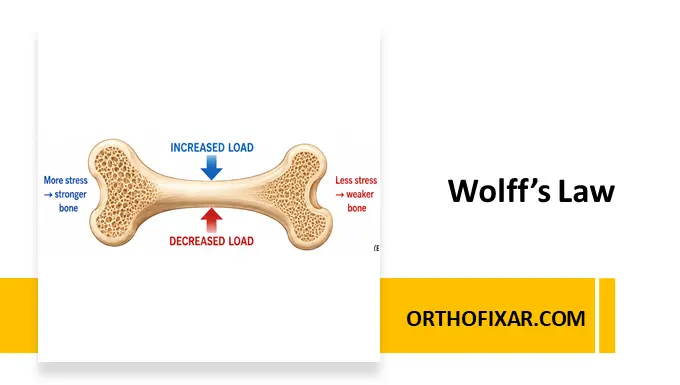
Wolff’s law is a fundamental orthopedic and physiological principle stating that bone continuously adapts its structure according to the mechanical loads placed upon it. Increased loading stimulates bone formation, making the bone stronger and denser, whereas decreased loading results in bone resorption and reduced bone mass.
This principle explains why exercise strengthens bones, prolonged immobilization weakens the skeleton, and orthopedic implants must be designed to preserve normal stress distribution.
Originally described by the German surgeon Julius Wolff in 1892, Wolff’s law remains one of the cornerstones of orthopedics, sports medicine, rehabilitation, and musculoskeletal biology.
History of Wolff’s Law
Julius Wolff
Julius Wolff (1836–1902) was a German orthopedic surgeon who observed that:
- Bone architecture changes throughout life.
- Trabecular bone aligns along lines of mechanical stress.
- Bone remodels according to functional demands.
His observations formed the basis of modern concepts of skeletal adaptation and bone biomechanics.
Definition of Wolff’s Law
Wolff’s law can be defined as:
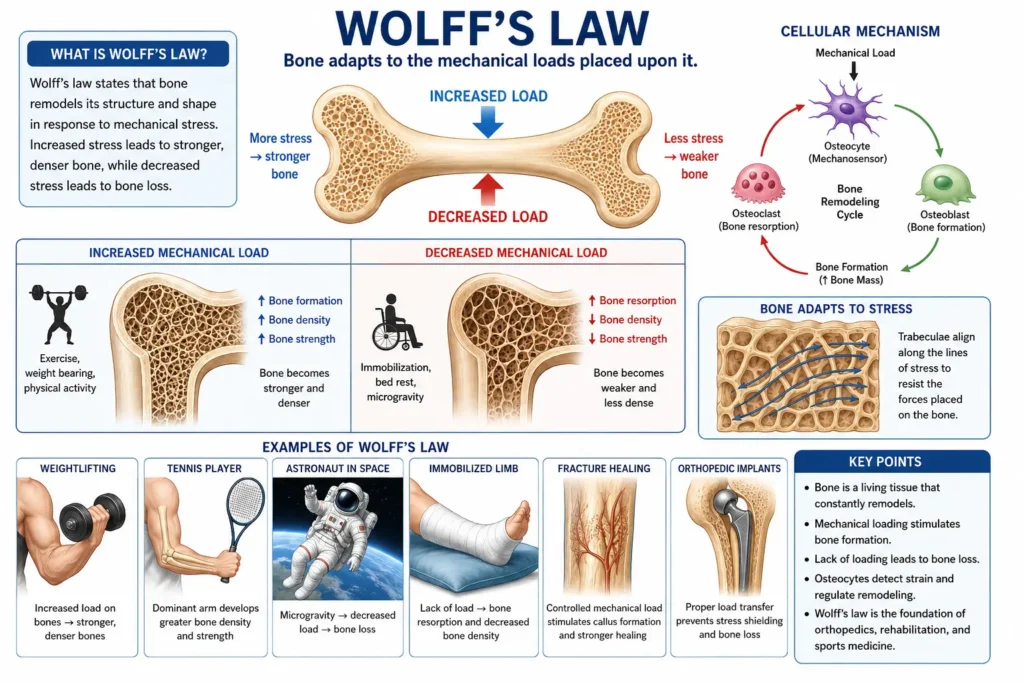
Bone remodels its internal architecture and external shape in response to mechanical loading so that it becomes optimally adapted to resist the stresses it experiences.
Simply put:
- More stress → stronger bone
- Less stress → weaker bone
Basic Principles of Wolff’s Law
Several biological principles explain Wolff’s law.
Bone Is a Living Tissue
Bone is constantly renewed through remodeling by:
- Osteoblasts (bone formation)
- Osteoclasts (bone resorption)
- Osteocytes (mechanosensors)
Mechanical Loading Stimulates Bone Formation
Physical loading causes microscopic deformation (strain) within bone.
The strain is detected by osteocytes, which activate signaling pathways that stimulate osteoblast activity.
Examples include:
- Walking
- Running
- Weightlifting
- Jumping
- Resistance training
Lack of Mechanical Stress Causes Bone Loss
Reduced loading decreases osteoblast activity while increasing bone resorption.
Common causes include:
- Bed rest
- Immobilization
- Paralysis
- Microgravity
- Sedentary lifestyle
Bone Remodeling Process
Bone remodeling occurs throughout life and consists of several stages.
Step 1: Mechanical Load
Mechanical stress creates microscopic strain.
↓
Step 2: Osteocyte Detection
Osteocytes detect deformation.
↓
Step 3: Cellular Signaling
Chemical mediators regulate osteoblasts and osteoclasts.
↓
Step 4: Bone Formation or Resorption
Depending on loading:
- Increased stress → bone formation
- Reduced stress → bone resorption
Cellular Mechanism of Wolff’s Law
Osteocytes
Osteocytes serve as the primary mechanosensors.
Functions include:
- Detect strain
- Coordinate remodeling
- Release signaling molecules
- Regulate osteoblasts and osteoclasts
Osteoblasts
Osteoblasts:
- Produce osteoid
- Mineralize new bone
- Increase cortical thickness
- Increase trabecular density
Osteoclasts
Osteoclasts:
- Remove unnecessary bone
- Shape bone architecture
- Eliminate damaged bone
Bone Remodeling Signaling Pathways
Mechanical loading activates several molecular pathways.
Wnt/β-catenin Pathway
One of the most important pathways.
Effects:
- Stimulates osteoblast differentiation
- Promotes bone formation
- Inhibits bone loss
Sclerostin
Produced by osteocytes.
Mechanical loading suppresses sclerostin production, allowing increased bone formation.
RANK/RANKL/OPG System
Regulates osteoclast activity.
Maintains the balance between:
- Bone formation
- Bone resorption
Trabecular Bone and Wolff’s Law
Trabecular bone remodels rapidly because it has:
- Large surface area
- High metabolic activity
- Rich blood supply
Trabeculae orient themselves along principal stress lines, maximizing strength while minimizing weight.
Cortical Bone Adaptation
Cortical bone also adapts by:
- Increasing thickness
- Changing diameter
- Improving resistance to bending
- Increasing resistance to torsion
Examples of Wolff’s Law
Weightlifting
Resistance training increases:
- Bone mineral density
- Cortical thickness
- Bone strength
Tennis Players
The dominant arm develops:
- Greater cortical thickness
- Higher bone density
- Stronger cortical bone
Running
Impact loading stimulates remodeling of:
- Femur
- Tibia
- Pelvis
- Calcaneus
Astronauts
In microgravity:
- Mechanical loading disappears
- Bone resorption increases
- Rapid bone loss occurs
This demonstrates the importance of mechanical stress for maintaining skeletal health.
Immobilized Limb
After prolonged casting:
- Bone density decreases
- Trabeculae become thinner
- Cortical bone weakens
Once weight bearing resumes, remodeling gradually restores bone strength.
Wolff’s Law During Fracture Healing
Wolff’s law plays a major role in fracture healing.
Controlled mechanical loading:
- Stimulates callus formation
- Accelerates remodeling
- Improves bone strength
- Restores normal architecture
Excessive motion, however, may delay healing or result in nonunion.
Wolff’s Law and Orthopedic Implants
Modern orthopedic implant design is based largely on Wolff’s law.
Examples include:
Joint Replacement
Proper implant fixation helps maintain physiological load transmission.
Poor stress distribution may result in:
- Stress shielding
- Periprosthetic bone loss
- Implant loosening
Plates and Screws
Stable fixation allows:
- Controlled loading
- Secondary bone healing
- Callus formation
Intramedullary Nails
These devices share load with bone, encouraging remodeling while maintaining stability.
Stress Shielding
Stress shielding occurs when an implant carries too much mechanical load.
Consequences include:
- Bone resorption
- Reduced bone density
- Implant loosening
- Periprosthetic fractures
Modern implant materials and designs aim to minimize stress shielding.
Wolff’s Law in Osteoporosis
In osteoporosis:
- Bone resorption exceeds formation.
- Mechanical loading through exercise can slow bone loss and modestly increase bone mineral density.
Recommended activities include:
- Walking
- Stair climbing
- Resistance training
- Weight-bearing exercise
- Balance training
Exercise should complement, not replace, appropriate pharmacologic therapy when indicated.
Wolff’s Law in Rehabilitation
Rehabilitation programs use progressive loading to:
- Restore muscle strength
- Increase bone density
- Improve joint function
- Reduce fracture risk
- Enhance mobility
Progressive loading should be individualized based on healing status and patient tolerance.
Wolff’s Law in Sports Medicine
Athletes benefit from controlled mechanical loading because it:
- Strengthens bone
- Improves skeletal resilience
- Reduces fracture risk
- Enhances performance
However, excessive repetitive loading without adequate recovery can contribute to stress fractures.
Frost’s Mechanostat Theory
Harold Frost expanded Wolff’s law by proposing the Mechanostat Theory.
According to this theory:
- Low strain leads to bone loss.
- Physiological strain maintains bone.
- Moderate increases in strain stimulate bone formation.
- Excessive strain may result in microdamage and stress fractures.
This concept explains why both insufficient and excessive loading can be detrimental.
Factors Influencing Bone Remodeling
Numerous factors influence the remodeling response:
Mechanical Factors
- Magnitude of load
- Frequency
- Duration
- Direction
- Rate of loading
Biological Factors
- Age
- Genetics
- Hormones
- Nutrition
- Vitamin D
- Calcium intake
Medical Conditions
- Osteoporosis
- Diabetes
- Chronic kidney disease
- Rheumatoid arthritis
- Long-term glucocorticoid therapy
Clinical Applications of Wolff’s Law
Wolff’s law is applied in many medical specialties.
Orthopedics
- Fracture management
- Joint replacement
- Internal fixation
- Limb reconstruction
Physical Therapy
- Progressive weight-bearing
- Strength training
- Balance exercises
Sports Medicine
- Injury prevention
- Performance optimization
- Return-to-sport protocols
Dentistry
- Orthodontic tooth movement
- Dental implant osseointegration
- Alveolar bone remodeling
Limitations of Wolff’s Law
Although highly influential, Wolff’s law has limitations.
- Bone adaptation is influenced by both mechanical and biological factors.
- Hormones, inflammatory mediators, genetics, and medications affect remodeling.
- Excessive loading can damage bone rather than strengthen it.
- Bone remodeling varies with age and disease.
- Modern mechanobiology provides a more comprehensive understanding than Wolff’s original concept alone.
Clinical Pearls
- Bone adapts continuously to mechanical stress.
- Weight-bearing exercise increases bone strength.
- Immobilization rapidly causes bone loss.
- Controlled loading improves fracture healing.
- Excessive stress may lead to stress fractures.
- Orthopedic implant design aims to preserve physiological load transfer.
- Osteocytes are the primary mechanosensors responsible for initiating remodeling.
Frequently Asked Questions (FAQ)
What is Wolff’s law?
Wolff’s law states that bone remodels according to the mechanical loads it experiences, becoming stronger under increased loading and weaker when loading is reduced.
Who discovered Wolff’s law?
Julius Wolff, a German orthopedic surgeon, first described the principle in 1892.
Why is Wolff’s law important?
It explains bone remodeling, fracture healing, osteoporosis management, orthopedic implant design, rehabilitation, and adaptation to exercise.
Does exercise strengthen bones?
Yes. Regular weight-bearing and resistance exercise stimulates bone formation and helps maintain or improve bone mineral density.
Can immobilization weaken bone?
Yes. Prolonged immobilization leads to increased bone resorption, decreased bone density, and reduced skeletal strength.
What cells are responsible for Wolff’s law?
Osteocytes detect mechanical strain, osteoblasts form new bone, and osteoclasts resorb bone during the remodeling process.
Key Takeaways
Wolff’s law remains one of the foundational principles of orthopedic science. Bone is a dynamic tissue that continually adapts to its mechanical environment through coordinated remodeling by osteocytes, osteoblasts, and osteoclasts. Appropriate mechanical loading strengthens the skeleton, whereas unloading promotes bone loss. This concept underpins modern approaches to fracture management, rehabilitation, implant design, sports medicine, and osteoporosis prevention, while contemporary mechanobiology has expanded the original theory by incorporating molecular signaling pathways and the influence of systemic biological factors.
References & More
- Teichtahl AJ, Wluka AE, Wijethilake P, Wang Y, Ghasem-Zadeh A, Cicuttini FM. Wolff’s law in action: a mechanism for early knee osteoarthritis. Arthritis Res Ther. 2015 Sep 1;17(1):207. doi: 10.1186/s13075-015-0738-7. PMID: 26324398; PMCID: PMC4556408. [PubMed]
- Rowe P, Koller A, Sharma S. Physiology, Bone Remodeling. [Updated 2023 Mar 17]. In: StatPearls [Internet]. Treasure Island (FL): StatPearls Publishing; 2026 Jan-. Available from: https://www.ncbi.nlm.nih.gov/books/NBK499863/
- Frost HM. Wolff’s Law and bone’s structural adaptations to mechanical usage: an overview for clinicians. Angle Orthod. 1994;64(3):175-88. [PubMed]