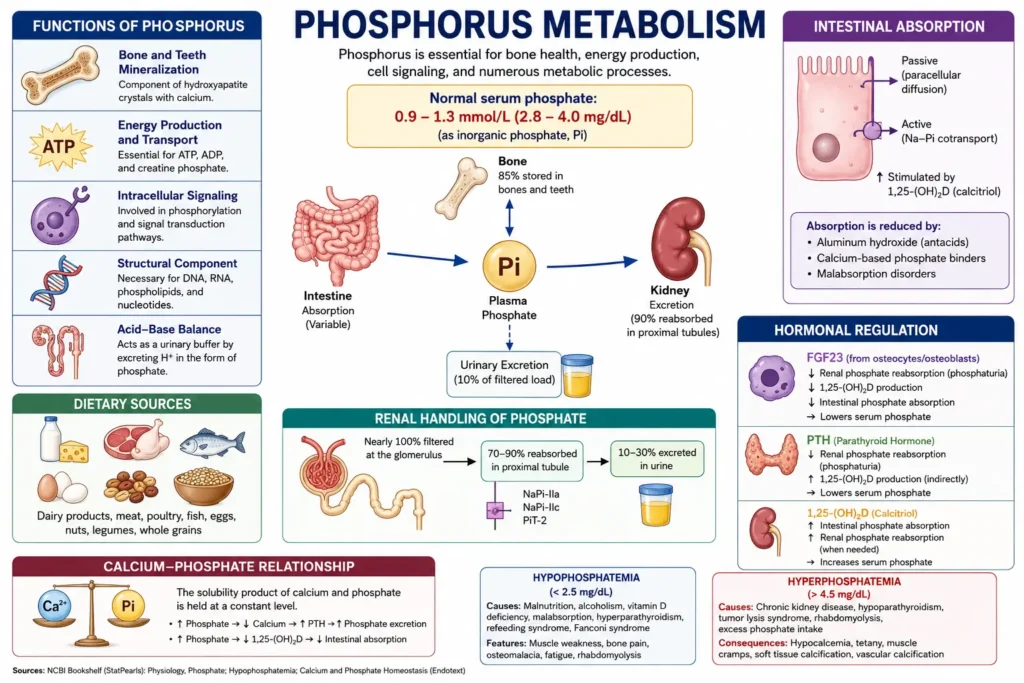
Phosphorus is an essential mineral that plays a critical role in skeletal integrity, cellular metabolism, energy production, intracellular signaling, and acid-base balance. Although commonly associated with bone mineralization alongside calcium, phosphorus is equally important in numerous biochemical processes necessary for normal cellular function.
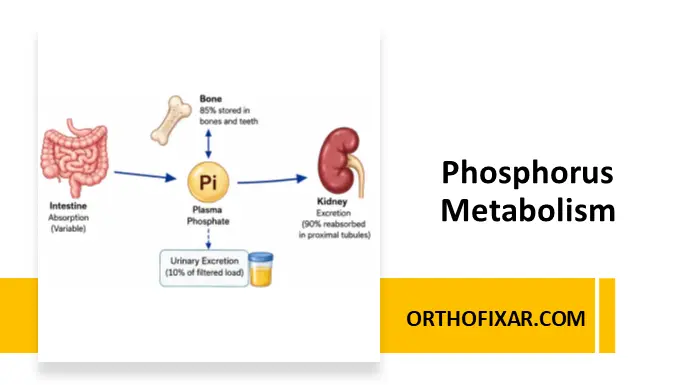
In the human body, phosphorus exists primarily as inorganic phosphate (Pi), with approximately 85% stored in bones and teeth, while the remainder is distributed within soft tissues and extracellular fluid. The maintenance of phosphate homeostasis involves a complex interaction between the intestines, kidneys, bones, and endocrine regulators, particularly fibroblast growth factor 23 (FGF23), parathyroid hormone (PTH), and vitamin D.
Overview of Phosphorus Metabolism
Phosphorus is abundant in the typical diet and is found in:
- Dairy products
- Meat and poultry
- Fish
- Eggs
- Nuts and legumes
- Whole grains
After ingestion, phosphate is absorbed primarily in the small intestine, especially the jejunum. Intestinal absorption occurs through both passive and active transport mechanisms and is enhanced by active vitamin D (1,25-dihydroxyvitamin D). Excess phosphorus is efficiently excreted by the kidneys, making renal function crucial for phosphate balance.
Normal plasma phosphate concentration is maintained within a narrow range:
- 0.9–1.3 mmol/L
- 2.8–4.0 mg/dL
This tight regulation is essential because both hypophosphatemia and hyperphosphatemia can lead to significant clinical consequences.
Physiological Functions of Phosphorus
Bone and Teeth Mineralization
The most recognized function of phosphorus is its role in the formation of hydroxyapatite crystals.
Hydroxyapatite consists primarily of calcium and phosphate and provides:
- Mechanical strength to bones
- Structural integrity of teeth
- Skeletal mineralization
Approximately 85% of total body phosphorus is stored within the skeletal system. Phosphate and calcium combine to form hydroxyapatite, which is the primary mineral component of bone.
Energy Production and Transport
Phosphorus is a fundamental component of:
- Adenosine triphosphate (ATP)
- Adenosine diphosphate (ADP)
- Creatine phosphate
ATP serves as the universal energy currency of the cell. Nearly all energy-dependent cellular activities require phosphate-containing compounds.
Intracellular Signaling
Phosphate plays a central role in cellular communication through phosphorylation and dephosphorylation reactions.
These mechanisms regulate:
- Enzyme activation
- Signal transduction pathways
- Hormone responses
- Gene expression
Protein kinases and phosphatases continuously modify proteins by adding or removing phosphate groups.
Structural Component of Cells
Phosphorus is an essential constituent of:
- DNA
- RNA
- Cell membrane phospholipids
- Nucleotides
Therefore, phosphate is indispensable for cellular growth, replication, and repair.
Acid-Base Balance
Inorganic phosphate functions as an important urinary buffer.
Phosphate helps maintain physiological pH by binding hydrogen ions within the renal tubules, thereby contributing to acid-base homeostasis.
See Also: Calcium Homeostasis: Functions, Absorption, Regulation & Clinical Importance
Intestinal Absorption of Phosphate
Dietary phosphate is absorbed predominantly in the small intestine.
Two mechanisms are involved:
Passive Paracellular Absorption
This process occurs through diffusion and depends largely on dietary phosphate intake.
Active Transport
Active absorption occurs through sodium-phosphate cotransporters and is stimulated by 1,25-dihydroxyvitamin D (calcitriol). Increased vitamin D levels enhance phosphate absorption from the gastrointestinal tract.
Factors Reducing Phosphate Absorption
Several substances reduce intestinal phosphate absorption, including:
- Aluminum hydroxide antacids
- Calcium-containing phosphate binders
- Certain gastrointestinal disorders causing malabsorption
Aluminum hydroxide binds phosphate within the intestinal lumen, reducing its availability for absorption.
Renal Handling of Phosphate
The kidneys are the primary organs responsible for phosphate regulation.
Almost all plasma phosphate is filtered through the glomeruli. Approximately 70–90% of filtered phosphate is reabsorbed in the proximal convoluted tubule through sodium-phosphate cotransporters.
Proximal Tubular Reabsorption
Major transport proteins include:
- NaPi-IIa
- NaPi-IIc
- PiT-2 transporters
Changes in the activity of these transporters directly affect serum phosphate concentrations.
Hormonal Regulation of Phosphate Homeostasis
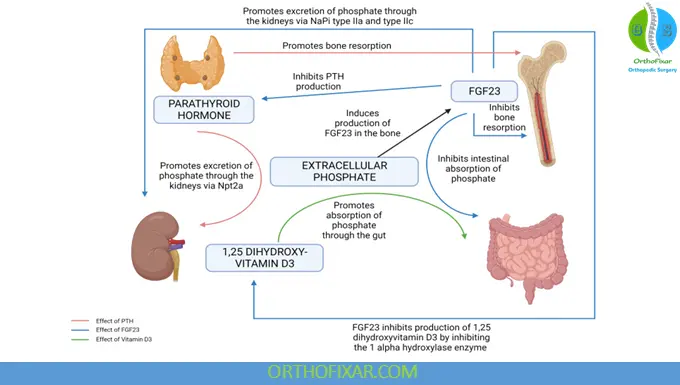
Phosphate homeostasis is primarily controlled by three hormones:
- Fibroblast Growth Factor 23 (FGF23)
- Parathyroid Hormone (PTH)
- 1,25-Dihydroxyvitamin D (Calcitriol)
Fibroblast Growth Factor 23 (FGF23)
FGF23 is currently recognized as the principal phosphaturic hormone.
It is produced primarily by:
- Osteocytes
- Osteoblasts
FGF23 secretion increases in response to elevated phosphate levels.
Actions of FGF23
- Reduces renal phosphate reabsorption
- Increases urinary phosphate excretion
- Suppresses synthesis of 1,25-dihydroxyvitamin D
- Decreases intestinal phosphate absorption
The net effect is a reduction in serum phosphate concentration.
Parathyroid Hormone (PTH)
PTH is secreted by the parathyroid glands when serum calcium levels decrease.
Effects on Phosphate
PTH:
- Inhibits phosphate reabsorption in the proximal tubule
- Promotes phosphaturia (urinary phosphate excretion)
- Lowers serum phosphate concentration
Although PTH indirectly increases intestinal phosphate absorption by stimulating vitamin D activation, its dominant renal effect is increased phosphate excretion.
Vitamin D (1,25-Dihydroxyvitamin D)
Calcitriol enhances:
- Intestinal calcium absorption
- Intestinal phosphate absorption
By increasing sodium-phosphate transporter expression in the intestine, vitamin D contributes to maintaining adequate phosphate availability for skeletal mineralization.
Relationship Between Calcium and Phosphate
Calcium and phosphate metabolism are closely interconnected.
The calcium-phosphate product remains relatively constant under physiological conditions.
Reciprocal Relationship
When phosphate levels rise:
- Calcium levels tend to decrease
- PTH secretion increases
- Renal phosphate excretion rises
- Serum phosphate falls toward normal
Similarly, excessive calcium can reduce serum phosphate levels.
This reciprocal relationship is important in maintaining mineral homeostasis and preventing ectopic calcification.
Disorders of Phosphate Metabolism
Hypophosphatemia
Hypophosphatemia is defined as low phosphorus concentrate in the blood:
Serum phosphate < 2.5 mg/dL
Causes
- Malnutrition
- Alcoholism
- Vitamin D deficiency
- Malabsorption syndromes
- Hyperparathyroidism
- Refeeding syndrome
- Fanconi syndrome
Clinical Features
- Muscle weakness
- Fatigue
- Bone pain
- Osteomalacia
- Rhabdomyolysis
- Neurological dysfunction in severe cases
Hyperphosphatemia
Hyperphosphatemia is defined as high phosphorus concentrate in the blood:
Serum phosphate > 4.5 mg/dL
Causes
- Chronic kidney disease (most common)
- Hypoparathyroidism
- Tumor lysis syndrome
- Rhabdomyolysis
- Excess phosphate intake
Clinical Consequences
High phosphate levels can bind circulating calcium and produce hypocalcemia.
Patients may develop:
- Tetany
- Muscle cramps
- Perioral numbness
- Soft tissue calcification
- Cardiovascular calcification in chronic kidney disease
Clinical Importance of FGF23
Recent research has highlighted the importance of FGF23 in phosphate regulation and chronic kidney disease.
Elevated FGF23 levels are associated with:
- Chronic kidney disease progression
- Left ventricular hypertrophy
- Cardiovascular morbidity
- Disturbances in vitamin D metabolism
FGF23 has therefore become an important biomarker and therapeutic target in disorders of mineral metabolism.
Key Points for Medical Students
- Phosphorus is essential for bone mineralization, ATP production, intracellular signaling, and nucleic acid synthesis.
- Approximately 85% of body phosphorus is stored in bones and teeth.
- Normal serum phosphate concentration is 0.9–1.3 mmol/L (2.8–4.0 mg/dL).
- The proximal tubule is the major site of phosphate reabsorption.
- FGF23 is the primary phosphaturic hormone.
- PTH promotes phosphate excretion through the kidneys.
- Vitamin D enhances intestinal phosphate absorption.
- Calcium and phosphate concentrations exhibit an inverse relationship.
- Chronic kidney disease is the most common cause of hyperphosphatemia.
Conclusion
Phosphorus is a vital mineral involved in skeletal health, cellular metabolism, energy transfer, and intracellular signaling. Phosphate homeostasis depends on coordinated regulation by the intestines, kidneys, bone, and endocrine system. FGF23, PTH, and vitamin D work together to maintain phosphate levels within a narrow physiological range. Understanding phosphorus metabolism is essential for diagnosing and managing disorders such as hypophosphatemia, hyperphosphatemia, chronic kidney disease, and metabolic bone diseases.
References & More
- Bansal VK. Serum Inorganic Phosphorus. In: Walker HK, Hall WD, Hurst JW, editors. Clinical Methods: The History, Physical, and Laboratory Examinations. 3rd ed. Butterworths; Boston: 1990. [PubMed].
- Calvo MS, Lamberg-Allardt CJ. Phosphorus. Adv Nutr. 2015 Nov;6(6):860-2. [PubMed].
- Sahay M, Vali SP, Ramesh VD. The Case. A child with metabolic acidosis and growth retardation. Kidney Int. 2009 May;75(10):1121-2. [PubMed]
- Shaker JL, Deftos L. Calcium and Phosphate Homeostasis. [Updated 2023 May 17]. In: Feingold KR, Adler RA, Ahmed SF, et al., editors. Endotext [Internet]. South Dartmouth (MA): MDText.com, Inc.; 2000-. Available from: https://www.ncbi.nlm.nih.gov/books/NBK279023
- Kaur J, Castro D. Hypophosphatemia. [Updated 2024 Feb 12]. In: StatPearls [Internet]. Treasure Island (FL): StatPearls Publishing; 2026 Jan-. Available from: https://www.ncbi.nlm.nih.gov/books/NBK493172/
- Qadeer HA, Bashir K. Physiology, Phosphate. [Updated 2023 Aug 28]. In: StatPearls [Internet]. Treasure Island (FL): StatPearls Publishing; 2026 Jan-. Available from: https://www.ncbi.nlm.nih.gov/sites/books/NBK560925/
- Blom, A., Warwick, D., & Whitehouse, M. R. (2018). Apley & Solomon’s system of orthopaedics and trauma (10th ed.). CRC Press