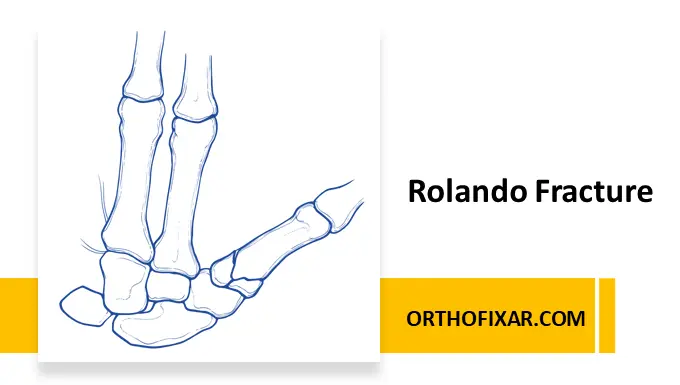
A Rolando fracture is a comminuted intra-articular fracture at the base of the first metacarpal (thumb). It typically presents with a “Y-shaped” or “T-shaped” fracture pattern, involving multiple fragments and extending into the carpometacarpal (CMC) joint.
This injury was first described in 1910 by the Italian surgeon Silvio Rolando and is considered a more severe variant of thumb base fractures compared to Bennett fractures.
Epidemiology
- Represents approximately 15–20% of thumb metacarpal base fractures
- Accounts for 1.4–4% of all hand fractures
- Typically affects young active individuals following high-energy trauma
Mechanism of Injury
Rolando fractures usually occur due to:
- Axial load applied to a partially flexed thumb
- Common scenarios:
- Falls onto the hand
- Punching injuries
- Motor vehicle trauma
This force causes compression at the trapeziometacarpal joint, leading to fragmentation of the articular surface.
See Also: Bennett Fracture
Pathoanatomy
- Involves multiple intra-articular fragments (often ≥3)
- Typical components:
- Metacarpal shaft
- Volar fragment
- Dorsal fragment
- Strong deforming forces:
- Abductor pollicis longus → proximal and dorsal displacement
- Ligament attachments stabilize some fragments
This results in joint incongruity and instability, making treatment challenging.
Clinical Presentation
Patients commonly present with:
- Pain at the base of the thumb
- Swelling and tenderness
- Reduced grip strength
- Limited thumb motion
- Possible deformity
If untreated, this can lead to chronic instability and arthritis.
Diagnosis
Imaging
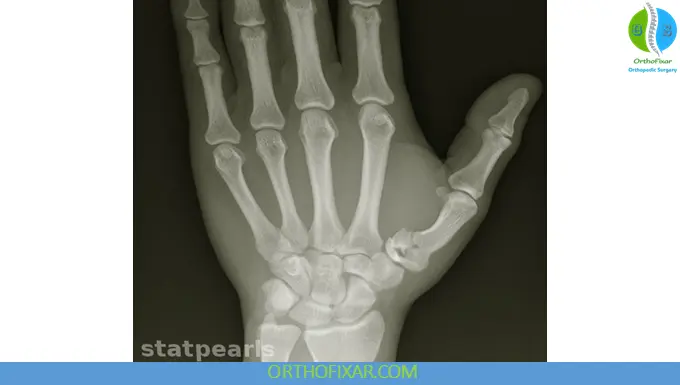
- Plain radiographs (X-rays)
- AP, lateral, and oblique views
- CT scan (recommended)
- Provides detailed visualization of:
- Fragment number
- Articular involvement
- Surgical planning
- Provides detailed visualization of:
Classification
Although no universally accepted classification exists, Rolando fractures are generally:
- Classic type: Y- or T-shaped (3 fragments)
- Comminuted type: multiple fragments (more severe)
Treatment of Rolando Fracture
1. Non-operative Management (Rare)
Indications:
- Minimally displaced fractures (<1 mm)
Treatment:
- Thumb spica cast immobilization
However, most cases are unstable and require surgery.
2. Surgical Management (Standard of Care)
Due to instability and intra-articular involvement, operative treatment is recommended in most cases.
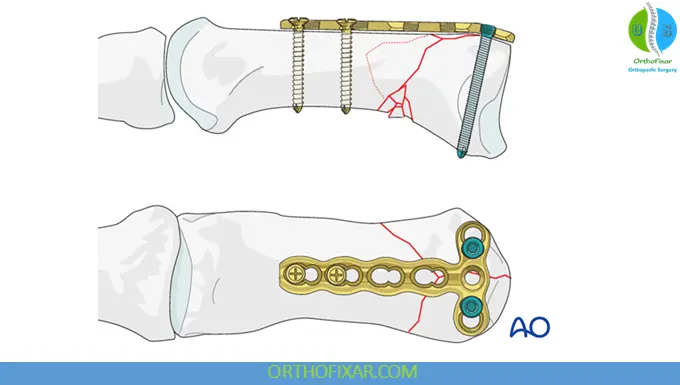
a) Open Reduction and Internal Fixation (ORIF)
- Indicated when:
- Large fragments are present
- Techniques:
- Mini plates (T-plate)
- Screws or K-wires
Benefits:
- Anatomical reduction
- Early mobilization
- Better functional outcomes
b) External Fixation (Ligamentotaxis)
- Used in:
- Highly comminuted fractures
- Mechanism:
- Restores alignment using soft tissue tension
Advantages:
- Minimally invasive
- Preserves blood supply
Limitations:
- May result in imperfect articular reduction
c) Percutaneous Pinning
- Suitable for:
- Select fracture patterns
- Often combined with closed reduction
Rehabilitation
- Early mobilization once fixation is stable
- Physiotherapy focuses on:
- Range of motion
- Grip strength
- Full recovery may take several months
Complications
Rolando fractures have a worse prognosis than Bennett fractures due to comminution.
Common complications:
- Post-traumatic osteoarthritis
- Joint stiffness
- Malunion
- Decreased grip strength
- Chronic pain
Prognosis
- Many Rolando fractures require surgery (up to 80%+)
- Outcome depends on:
- Accuracy of articular reduction
- Early management
- Even with optimal treatment:
- Risk of arthritis remains significant
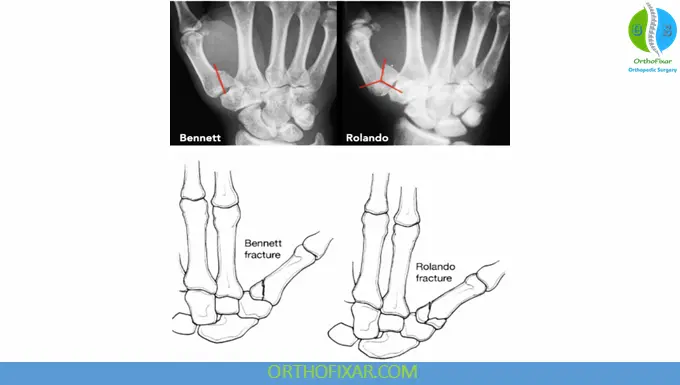
Rolando vs Bennett Fracture
| Feature | Rolando Fracture | Bennett Fracture |
|---|---|---|
| Pattern | Comminuted (≥3 fragments) | Two-part fracture |
| Stability | Highly unstable | Less unstable |
| Prognosis | Worse | Better |
| Treatment | Usually surgical | Sometimes conservative |
Key Takeaways
- Rolando fracture = comminuted intra-articular base of thumb fracture
- Mechanism: axial load on flexed thumb
- Diagnosis: X-ray + CT scan
- Treatment: mostly surgical (ORIF or external fixation)
- Complication risk: high (arthritis, stiffness)
References & More
- Feletti F, Varacallo MA. Rolando Fracture. [Updated 2023 Aug 4]. In: StatPearls [Internet]. Treasure Island (FL): StatPearls Publishing; 2026 Jan-. Available from: Pubmed
- Mumtaz MU, Ahmad F, Kawoosa AA, Hussain I, Wani I. Treatment of Rolando Fractures by Open Reduction and Internal Fixation using Mini T-Plate and Screws. J Hand Microsurg. 2016 Aug;8(2):80-5. doi: 10.1055/s-0036-1583300. Epub 2016 May 12. PMID: 27625535; PMCID: PMC5018985. Pubmed
- Windsor TA, Blosser KM, Richardson AC. Rolando fracture. Clin Case Rep. 2019 Nov 19;7(12):2603-2604. doi: 10.1002/ccr3.2544. PMID: 31893116; PMCID: PMC6935654. Pubmed
- Egol KA. Handbook of fractures. 6th ed. Philadelphia: Lippincott Williams & Wilkins; 2019.