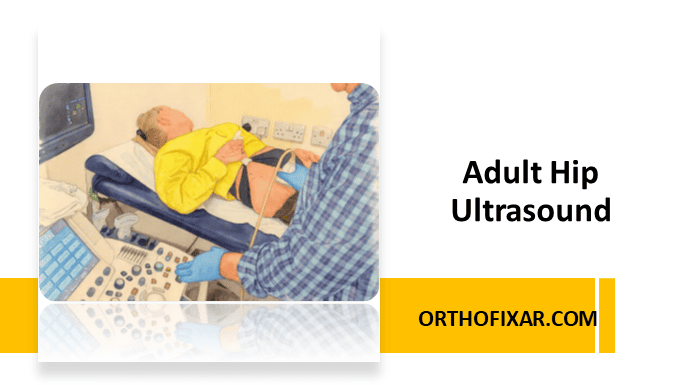
Adult hip ultrasound is an essential tool for evaluating both intra-articular and extra-articular pathologies of the hip joint. Because the hip is a large synovial joint enclosed by a thick capsule and reinforced by strong ligaments—the iliofemoral, ischiofemoral, and pubofemoral ligaments—accurate hip ultrasound imaging helps clinicians assess pain, inflammation, tendon injuries, and joint effusion in real time.
The femoral head and acetabulum are each covered by hyaline articular cartilage. The acetabular rim also contains the fibrocartilaginous labrum, which plays a role in joint stability. Many of these structures can be clearly visualized on hip ultrasound or hip sonogram when performed with proper technique.
See Also: Hip Joint Anatomy
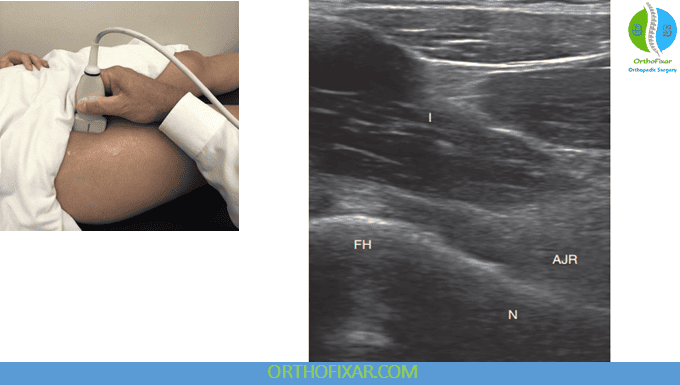
Anterior Hip Ultrasound
The anterior portion of the adult hip ultrasound examination is typically performed with the patient in a supine position.
Technique
- Place the transducer in a longitudinal plane, aligned with the femoral neck.
- This oblique orientation follows the natural axis of the femoral neck.
Structures Visualized
- Contour of the femoral head, femoral neck, and acetabulum
- Anterior joint recess, where joint effusion or synovitis may appear as swelling or excess fluid
- Labrum, which should appear hyperechoic and triangular proximally
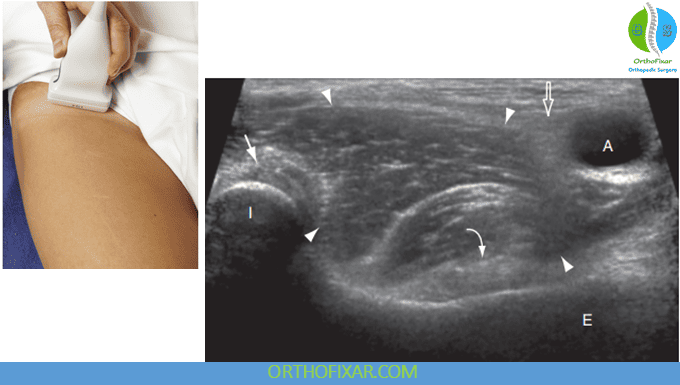
Rotating the probe into a transverse (short-axis) orientation allows visualization of:
- Iliopsoas muscle and tendon
- Femoral head profile
- In the inguinal region:
Iliopsoas tendon, rectus femoris tendon, femoral artery, and femoral nerve, along with the bony AIIS
This part of the hip sonogram is essential for detecting bursitis, tendinopathy, and anterior impingement-related findings.
See Also: Hip Joint X-Ray Imaging
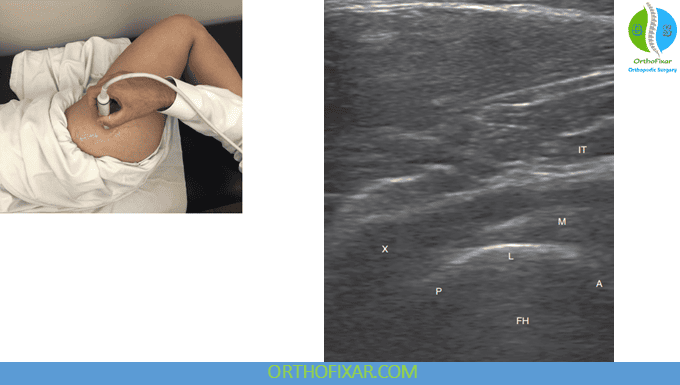
Lateral Hip Ultrasound
Examination of the lateral hip focuses on the abductor tendons and the greater trochanter area—common sites of gluteal tendinopathy.
Technique
- Position the patient on the opposite (contralateral) hip.
- Place the transducer over the lateral hip in the short axis to locate the greater trochanter.
Structures Visualized
At the apex of the trochanter, two important facets can be identified:
- Anterior facet → attachment of the gluteus minimus
- Lateral facet → attachment of the gluteus medius
Rotating the probe 90° into the long axis allows clear visualization of:
- Gluteus medius tendon (lateral facet)
- Gluteus minimus tendon (anterior facet)
Both structures should appear as hyperechoic tendons inserting into the greater trochanter.
This region is crucial in diagnosing greater trochanteric pain syndrome (GTPS).
Posterior Hip Ultrasound
The posterior hip region contains key structures such as the sacroiliac joint and the piriformis muscle—often implicated in buttock pain.
Technique
- Begin with a short-axis view over the sacral foramina and sacroiliac joint.
- The superior SI joint appears wider; the inferior portion is narrower.
- Move the transducer obliquely laterally toward the greater trochanter.
Structures Visualized
- Piriformis muscle in its long axis
- Piriformis tendon, lying just above the bony contour of the ilium
By rotating the patient’s hip, passive movement of the piriformis tendon can be observed—helpful in diagnosing piriformis syndrome and related neuropathies.
Clinical Applications of Adult Hip Ultrasound
A comprehensive adult hip ultrasound examination can help diagnose:
- Hip joint effusion or synovitis
- Tendon injuries (iliopsoas, rectus femoris, gluteus medius/minimus)
- Bursitis
- Greater trochanteric pain syndrome
- Labral pathology
- Piriformis syndrome
- Femoral neurovascular abnormalities
Because hip ultrasound imaging is dynamic, radiation-free, and cost-effective, it remains one of the most valuable tools for evaluating hip pain in adults.
References & More
- Probyn L, Flores D, Rowbotham E, Cresswell M, Atinga A. High-resolution ultrasound in the evaluation of the adult hip. J Ultrason. 2023 Nov 23;23(95):e223-e238. doi: 10.15557/jou.2023.0031. PMID: 38020511; PMCID: PMC10668929. PubMed
- Radiology Key
- Orthopedic Physical Assessment by David J. Magee, 7th Edition.