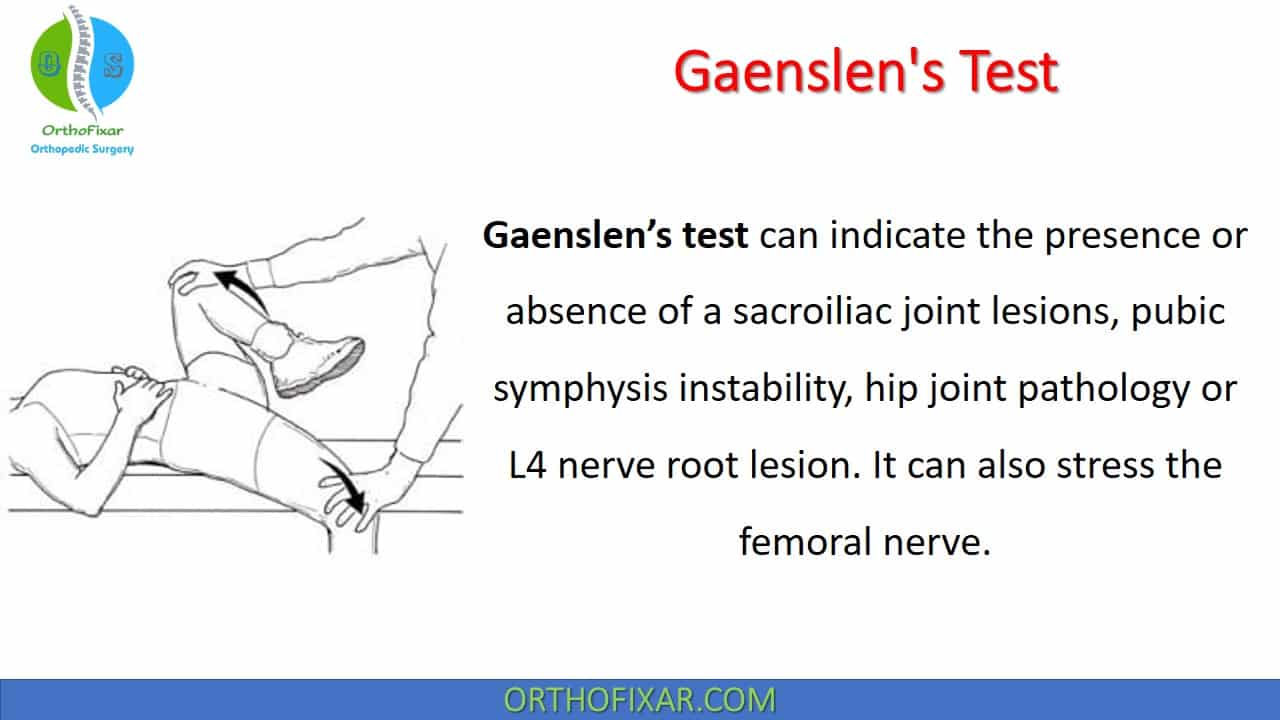
Gaenslen’s test can indicate the presence or absence of a sacroiliac joint lesions, pubic symphysis instability, hip joint pathology or L4 nerve root lesion. It can also stress the femoral nerve.
How do you perform the Gaenslen test?
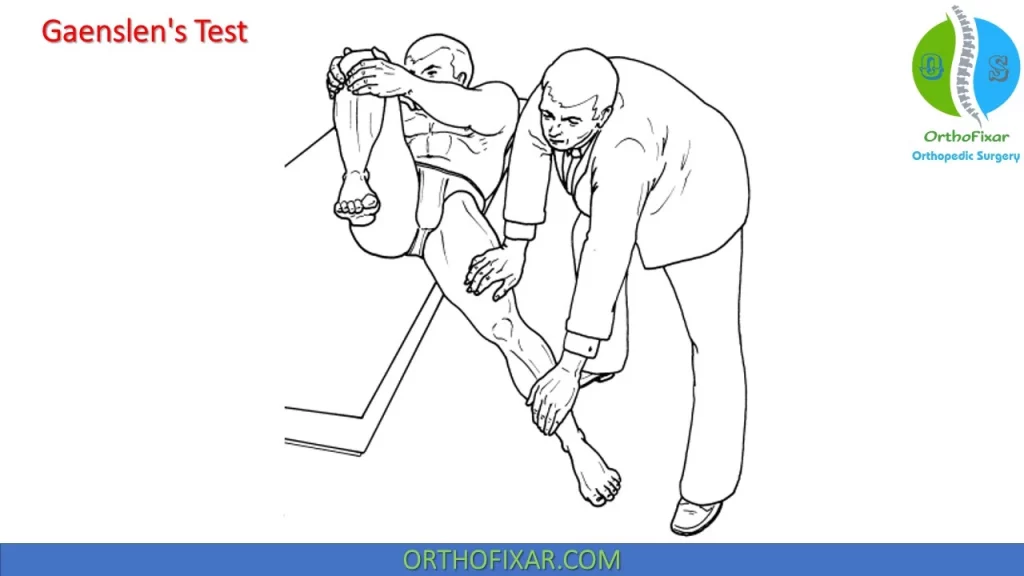
- The patient is positioned supine at the edge of the side of the bed with the painful leg resting very near to the end of the bed, and resting symptoms are assessed.
- The leg furthest from the edge of the bed (non-tested leg) is flexed 90 degrees at the hip and held by the clinician using one hand.
- The clinician passively positions the upper leg (test leg) into hyperextension at the hip so that it hangs over the edge of the table.
- The clinician applies a further stretch to the test leg into hip extension and adduction up to six times while a flexion based counter force is applied to the flexed leg.
See Also: Thomas Test
See Also: Three Phase Hyperextension Test or Mennell sign
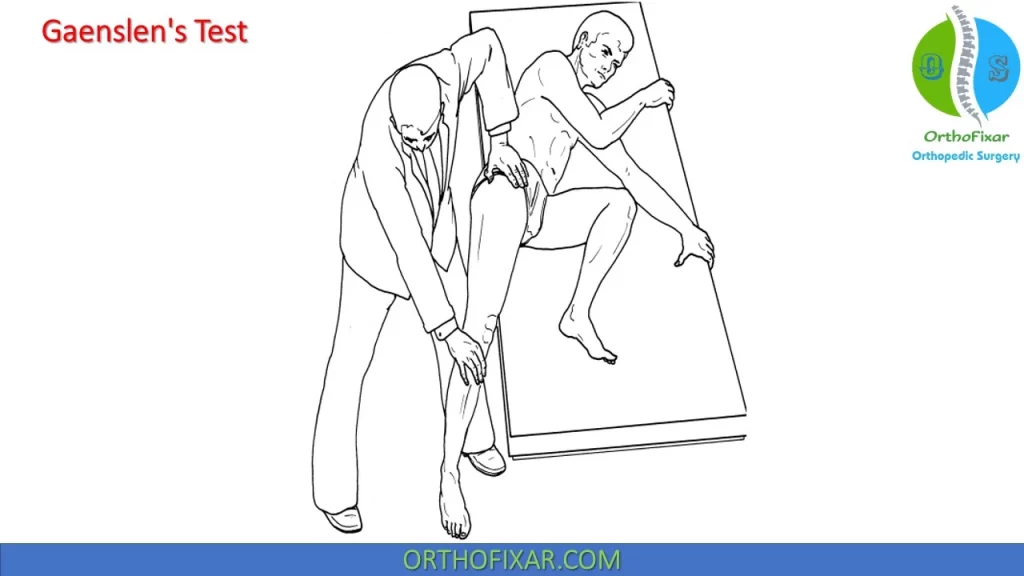
The Gaenslen test may also be performed with the patient in a lateral position:
The patient lies on the side with the upper leg (test leg) hyperextended at the hip. The patient holds the lower leg flexed against the chest. The examiner stabilizes the pelvis while extending the hip of the uppermost leg. Pain indicates a positive test. The pain may be caused by an ipsilateral sacroiliac joint lesion, hip pathology, or an L4 nerve root lesion.
What does a positive Gaenslen Test mean?
If there is dysfunction in the sacroiliac joint, hyperextension of the leg will lead to motion in the sacroiliac joint, causing pain or exacerbation of existing pain and the Gaenslen’s test is considered positive .
Pain may also be caused by hip pathology or an ipsilateral nerve root lesion.
See Also: Lasegue Test
Gaenslen Test Accuracy
This test demonstrates poor diagnostic value secondary to poor to fair specificity. Overall, there is limited research pertaining to this test in order to make strong conclusions.
A study by Parisa Nejati to assess the reliability and validity of motion palpation and pain provocation compared with sacroiliac joint (SIJ) block as the gold-standard assessment method of patients with sacroiliac joint dysfunction (SIJD), he found that the Gaenslen’s test had a sensitivity and a specificity of:
- Sensitivity: 61.5 %
- Specificity: 33.3 %
Another study by Salih Ozgocmen on 40 patients with chronic low back pain, this study aimed to evaluate the value of sacroiliac pain provocation tests in early active sacroiliitis (Mennell test, Gaenslen test and Thigh thrust test), the sensitivity of these tests were 55% for the right side and 45% for the left side. While the specificity were 83% for the right side and 86% for the left side.
This study stated that at least two of three tests need to be positive to indicate sacroiliitis.
Gaenslen’s Test – Summary Table
| Aspect | Summary |
|---|---|
| Purpose | Detect SI joint dysfunction, pubic symphysis instability, hip pathology, or L4 nerve root lesion; stresses femoral nerve. |
| Patient Position (Supine) | Patient lies near table edge with test leg hanging off; opposite leg flexed to 90°. |
| Maneuver (Supine) | Clinician extends and slightly adducts the test leg while applying counter-flexion force on the opposite leg. |
| Alternative Position (Lateral) | Patient lies on non-painful side; lower leg flexed, upper/test leg extended while pelvis is stabilized. |
| Positive Test | Reproduction of pain in SI joint region, hip, or along L4 distribution. |
| Indications of Positive Result | SI joint lesion, hip pathology, or ipsilateral L4 nerve root irritation. |
| Sensitivity | 55–61.5% (varies by study). |
| Specificity | 33.3% (Nejati) up to 83–86% (Ozgocmen). |
| Clinical Notes | Limited standalone value; best used as part of a cluster with other SIJ provocation tests. |
FAQ
What is the Gaenslen’s Test used for?
It is a pain-provocation test used to assess sacroiliac joint dysfunction, pubic symphysis instability, hip joint pathology, or an L4 nerve root lesion. It also places tension on the femoral nerve.
How is the Gaenslen’s Test performed in the supine position?
The patient lies near the edge of the table with one leg hanging off. The opposite leg is flexed to 90° at the hip. The clinician extends and slightly adducts the hanging leg while applying a counter-flexion force to the other leg.
Can the Gaenslen’s Test be done in another position?
Yes. It can also be performed in the lateral position, with the patient lying on the non-painful side. The lower leg is flexed, and the upper/test leg is hyperextended while the examiner stabilizes the pelvis.
What indicates a positive Gaenslen’s Test?
Reproduction of the patient’s pain during the maneuver. This usually suggests SI joint dysfunction, but pain may also arise from hip pathology or nerve root irritation.
What structures are stressed during the test?
The test loads the sacroiliac joint, stresses the pubic symphysis, and applies stretch to the femoral nerve. Hyperextension also stresses anterior hip structures.
How accurate is the Gaenslen’s Test?
Accuracy varies among studies. Reported sensitivity ranges from 55–61.5%, and specificity ranges from 33.3% to 86% depending on the population studied.
Can Gaenslen’s Test diagnose sacroiliitis on its own?
No. The standalone diagnostic value is weak. It should be used as part of a cluster of SIJ provocation tests, such as the Thigh Thrust and Mennell tests.
Does the test differentiate between SI joint and hip pathology?
Not reliably. A positive result indicates pain, but clinical correlation and additional tests are needed to identify the true source.
Is the test painful for patients?
It can be, especially if there is SI joint irritation or anterior hip tightness. Pain reproduction is the key diagnostic factor.
When should I avoid performing the Gaenslen’s Test?
Avoid it in cases of recent pelvic fracture, severe hip osteoarthritis, unstable lumbar spine, acute trauma, or when hyperextension is not tolerated.
Reference
- Hoppenfeld S: Physical Examination of the Hip and Pelvis, Physical Examination of the Spine and Extremities. East Norwalk, CT: AppletonCentury-Crofts, 1976:143.
- McGill SM. Kinetic potential of the lumbar trunk musculature about three orthogonal orthopaedic axes in extreme postures. Spine (Phila Pa 1976). 1991 Jul;16(7):809-15. doi: 10.1097/00007632-199107000-00021. PMID: 1925758.
- Nejati P, Sartaj E, Imani F, Moeineddin R, Nejati L, Safavi M. Accuracy of the Diagnostic Tests of Sacroiliac Joint Dysfunction. J Chiropr Med. 2020 Mar;19(1):28-37. doi: 10.1016/j.jcm.2019.12.002. Epub 2020 Sep 12. PMID: 33192189; PMCID: PMC7646135.
- Ozgocmen S, Bozgeyik Z, Kalcik M, Yildirim A. The value of sacroiliac pain provocation tests in early active sacroiliitis. Clin Rheumatol. 2008 Oct;27(10):1275-82. doi: 10.1007/s10067-008-0907-z. Epub 2008 May 6. PMID: 18458988.
- Clinical Tests for the Musculoskeletal System 3rd Edition.
- Dutton’s Orthopaedic Examination, Evaluation, And Intervention 3rd Edition.