Definition of Marfan Syndrome
Marfan syndrome is a rare inherited connective tissue disorder that affects the body’s connective tissues, which provide strength and flexibility to organs, blood vessels, bones, eyes, and skin. The condition is most commonly caused by mutations in the FBN1 gene, which encodes fibrillin-1, an essential structural protein.
Marfan syndrome primarily affects:
- The cardiovascular system
- The skeletal system
- The eyes
- The lungs and skin
The condition is inherited in an autosomal dominant pattern, meaning a child has a 50% chance of inheriting the disorder if one parent carries the mutation. However, some cases arise from new spontaneous mutations.
Epidemiology of Marfan Syndrome
Marfan syndrome occurs in approximately 2–3 individuals per 10,000 people worldwide. Both males and females are equally affected, and the syndrome occurs across all ethnic groups.
Early diagnosis is critical because cardiovascular complications, particularly aortic aneurysm and dissection, can become life-threatening if untreated.
Causes and Genetics of Marfan Syndrome
FBN1 Gene Mutation
Most patients with Marfan syndrome have mutations in the FBN1 gene located on chromosome 15. This gene produces fibrillin-1, which is crucial for connective tissue integrity. Mutations weaken connective tissue and increase transforming growth factor-beta (TGF-β) signaling, contributing to disease manifestations.
Inheritance Pattern
- Autosomal dominant inheritance
- 50% transmission risk to offspring
- Approximately 25% of cases occur due to de novo mutations
Signs and Symptoms of Marfan Syndrome
The severity of Marfan syndrome varies significantly between individuals.
Cardiovascular Symptoms
Cardiovascular complications are the leading cause of morbidity and mortality.
Common findings include:
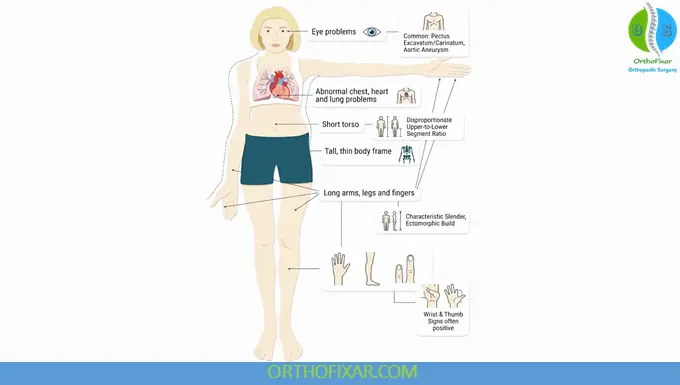
- Aortic root dilation
- Aortic aneurysm
- Aortic dissection
- Mitral valve prolapse
- Heart murmurs
Aortic dissection is the most serious complication and requires emergency medical attention.
Skeletal Features
Patients often have characteristic skeletal findings such as:
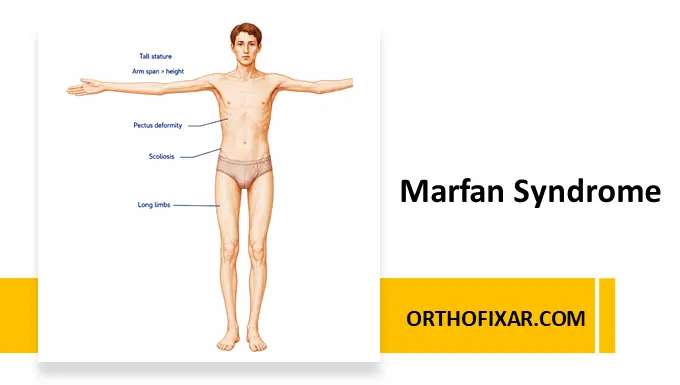
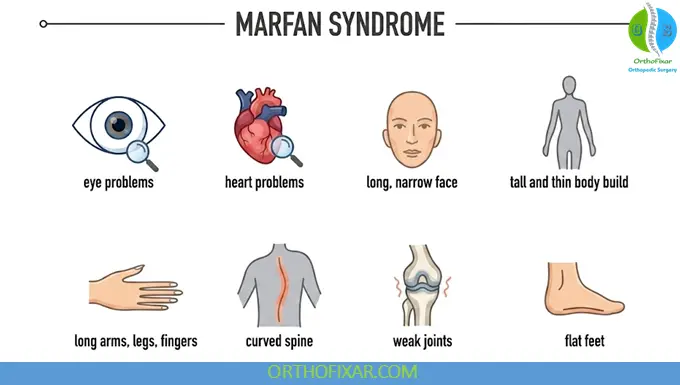
- Tall stature
- Long limbs and fingers (arachnodactyly)
- Pectus excavatum or pectus carinatum
- Scoliosis
- Hypermobile joints
- Flat feet
- Arm span greater than height
See Also: Generalized Hypermobility of Joints: An Overview
Eye Manifestations
Ocular abnormalities are highly common.
These include:
- Ectopia lentis (lens dislocation)
- Severe myopia
- Retinal detachment
- Early cataracts
Ectopia lentis is considered a major diagnostic feature in the Ghent criteria.
Other Symptoms
Additional manifestations may include:
- Stretch marks unrelated to weight change
- Spontaneous pneumothorax
- Dural ectasia
- Sleep apnea
See Also: Ehlers-Danlos Syndrome (EDS): Types, Symptoms & Treatment
How is Marfan Syndrome Diagnosed?
Marfan Syndrome Test and Clinical Evaluation
A Marfan syndrome test usually involves a combination of:
- Detailed family history
- Physical examination
- Cardiovascular imaging
- Eye examination
- Genetic testing
Diagnosis is commonly based on the Revised Ghent Criteria, which emphasize:
- Aortic root dilation
- Ectopia lentis
- FBN1 mutation status
- Systemic clinical score
The Revised Ghent Criteria
The Revised Ghent Nosology is the internationally accepted diagnostic standard.
Key components include:
- Aortic root aneurysm/dissection
- Lens dislocation
- Pathogenic FBN1 mutation
- Systemic score based on physical findings
The updated criteria place greater importance on cardiovascular manifestations and genetic confirmation.
Marfan Genetic Test
What Is a Marfan Genetic Test?
A Marfan genetic test analyzes the FBN1 gene to identify pathogenic variants associated with the disorder.
Genetic testing is especially useful for:
- Confirming uncertain diagnoses
- Testing at-risk family members
- Evaluating children with incomplete clinical findings
- Prenatal counseling
Types of Genetic Testing
Common testing methods include:
- Single-gene FBN1 sequencing
- Connective tissue disorder panels
- Whole exome sequencing in complex cases
A positive genetic result strongly supports diagnosis, although not all clinically affected patients have identifiable mutations.
Imaging and Diagnostic Workup
Echocardiography
Echocardiography is essential for monitoring:
- Aortic root diameter
- Valve abnormalities
- Cardiac function
Regular imaging surveillance helps prevent catastrophic complications.
MRI and CT Imaging
MRI or CT angiography may be used to evaluate:
- Entire aorta
- Dural ectasia
- Vascular complications
Ophthalmologic Examination
Slit-lamp examination helps identify lens dislocation and retinal abnormalities.
Marfan Syndrome Therapy
Goals of Marfan Syndrome Therapy
The primary goals of Marfan syndrome therapy are:
- Prevent aortic enlargement
- Reduce risk of dissection
- Manage complications
- Improve quality of life
Medical Treatment
Beta-Blockers
Beta-blockers have long been considered standard therapy because they reduce stress on the aortic wall and slow aortic dilation.
Common agents include:
- Atenolol
- Propranolol
- Metoprolol
Angiotensin Receptor Blockers (ARBs)
ARBs such as losartan have become increasingly important in Marfan syndrome therapy.
Research demonstrates that ARBs may significantly reduce aortic root enlargement.
Common ARBs include:
- Losartan
- Irbesartan
- Valsartan
Combination Therapy
Recent meta-analyses suggest that combining beta-blockers with ARBs may provide superior protection against progressive aortic dilation.
Surgical Management
Aortic Root Surgery
Preventive surgery may be recommended when the aortic root reaches a dangerous size.
Procedures include:
- Valve-sparing aortic root replacement
- Composite graft replacement
Early elective surgery has dramatically improved survival in Marfan syndrome patients.
Lifestyle Recommendations
Patients with Marfan syndrome should:
- Avoid intense isometric exercise
- Avoid heavy weightlifting
- Maintain regular cardiac follow-up
- Monitor blood pressure carefully
- Receive genetic counseling
Pregnancy requires specialized cardiovascular monitoring due to increased aortic stress.
Prognosis of Marfan Syndrome
Life expectancy has improved substantially over recent decades because of:
- Earlier diagnosis
- Advanced imaging
- Modern medications
- Preventive surgery
With proper monitoring and treatment, many individuals now live near-normal lifespans.
Complications of Marfan Syndrome
Potential complications include:
- Aortic dissection
- Heart failure
- Retinal detachment
- Severe scoliosis
- Pneumothorax
Regular multidisciplinary care is essential for reducing complications.
Frequently Asked Questions (FAQ)
Is Marfan syndrome hereditary?
Yes. Marfan syndrome is usually inherited in an autosomal dominant pattern.
What is the best Marfan syndrome test?
Diagnosis typically requires a combination of:
– Echocardiography
– Eye examination
– Clinical evaluation
– Marfan genetic test
Can Marfan syndrome be cured?
There is currently no cure, but modern Marfan syndrome therapy can significantly reduce complications and improve survival.
What is the most dangerous complication?
Aortic dissection is the most life-threatening complication of Marfan syndrome.
Conclusion
Marfan syndrome is a complex inherited connective tissue disorder that affects multiple organ systems, especially the cardiovascular system. Early recognition, accurate diagnosis using the Revised Ghent Criteria, and appropriate Marfan syndrome therapy are essential for preventing serious complications.
Advances in genetic testing, cardiovascular imaging, ARB therapy, and surgical management have significantly improved patient outcomes. Individuals suspected of having Marfan syndrome should undergo comprehensive evaluation, including a Marfan genetic test and ongoing cardiovascular monitoring.
References & More
- von Kodolitsch Y, Robinson PN. Marfan syndrome: an update of genetics, medical and surgical management. Heart. 2007 Jun;93(6):755-60. doi: 10.1136/hrt.2006.098798. PMID: 17502658; PMCID: PMC1955191. Pubmed
- Salik I, Rawla P. Marfan Syndrome. [Updated 2023 Jan 23]. In: StatPearls [Internet]. Treasure Island (FL): StatPearls Publishing; 2026 Jan-. Available from: Pubmed
- Salik I, Rawla P. Marfan Syndrome. 2023 Jan 23. In: StatPearls [Internet]. Treasure Island (FL): StatPearls Publishing; 2026 Jan–. PMID: 30726024. Pubmed