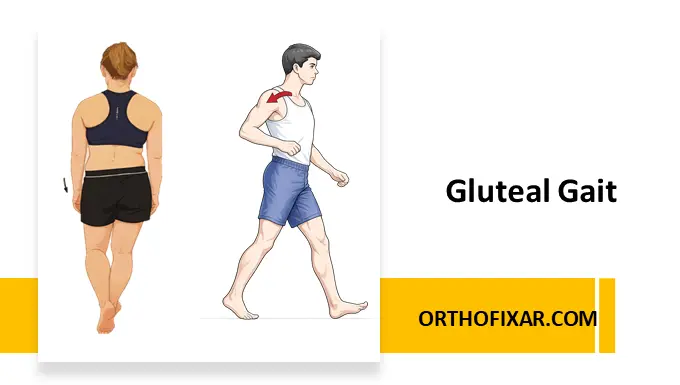
Gluteal gait is an abnormal walking pattern resulting from weakness or dysfunction of the gluteal muscles, which play a critical role in hip stability and pelvic control during ambulation. The two principal forms of gluteal gait are Gluteus Maximus Gait and Gluteus Medius Gait (Trendelenburg Gait), each reflecting impairment of specific muscle groups with distinct biomechanical consequences. Recognition of these gait patterns is essential for accurate diagnosis of neuromuscular and orthopedic conditions affecting the hip.
Gluteus Maximus Gait
Definition and Mechanism
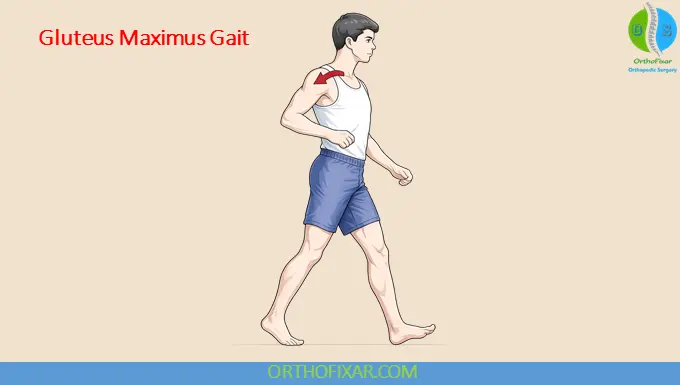
The gluteus maximus is the primary hip extensor, particularly active during initial contact (heel strike) and early stance phase. When this muscle is weak or paralyzed, the patient is unable to adequately control hip flexion at heel strike.
To compensate, the patient forcefully thrusts the thorax posteriorly at initial contact, shifting the center of gravity behind the hip joint. This maneuver reduces the external flexion moment at the hip, allowing passive structures to maintain hip extension during stance.
Gait Characteristics
- Posterior thrust of the trunk at heel strike
- Characteristic backward lurch of the trunk
- Difficulty with activities requiring strong hip extension (e.g., climbing stairs, rising from a seated position)
Common Causes
- L5–S1 radiculopathy
- Inferior gluteal nerve injury
- Muscular dystrophies
- Postoperative hip conditions
See Also: Gait Cycle
Gluteus Medius Gait (Trendelenburg Gait)
Definition and Mechanism
The gluteus medius and minimus function as primary hip abductors and pelvic stabilizers during the stance phase of gait. Weakness of these muscles results in loss of frontal-plane pelvic stability.
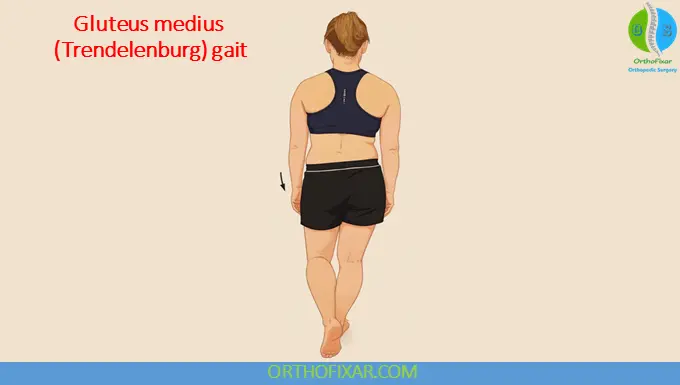
During single-limb stance, the pelvis fails to remain level, and the contralateral side drops due to insufficient abductor force on the stance leg. To compensate, the patient shifts the thorax laterally over the stance limb to maintain the center of gravity within the base of support.
Gait Characteristics
- Excessive lateral trunk lean toward the stance leg
- Pelvic drop on the contralateral (swing) side
- Positive Trendelenburg sign
- Increased energy expenditure during walking
In cases of bilateral gluteus medius weakness, the gait becomes exaggerated with pronounced side-to-side trunk motion, producing a waddling or “chorus girl swing” gait.
Common Causes
- Superior gluteal nerve injury
- Congenital dislocation of the hip
- Coxa vara
- Hip osteoarthritis
- Post–total hip arthroplasty
Comparison of Gluteal Gait Types
| Feature | Gluteus Maximus Gait | Gluteus Medius (Trendelenburg) Gait |
|---|---|---|
| Primary muscle affected | Gluteus maximus | Gluteus medius and minimus |
| Plane of instability | Sagittal plane | Frontal plane |
| Trunk compensation | Posterior trunk lurch | Lateral trunk lean |
| Key clinical sign | Backward thrust at heel strike | Positive Trendelenburg sign |
| Typical appearance | Backward lurching gait | Waddling or lateral sway |
Clinical Significance
Identifying gluteal gait patterns provides valuable insight into underlying neuromuscular or structural pathology of the hip. Careful gait observation, combined with focused physical examination and imaging when indicated, helps guide appropriate management, including physical therapy, orthotic support, or surgical intervention.
References & More
- Lim MR, Huang RC, Wu A, et al. Evaluation of the elderly patient with an abnormal gait. J Am Acad Orthop Surg. 2007;15(2):107–117. Pubmed
- Gandbhir VN, Lam JC, Lui F, et al. Trendelenburg Gait. [Updated 2024 Feb 29]. In: StatPearls [Internet]. Treasure Island (FL): StatPearls Publishing; 2025 Jan-. Available from: Pubmed
- Orthopedic Physical Assessment by David J. Magee, 7th Edition.