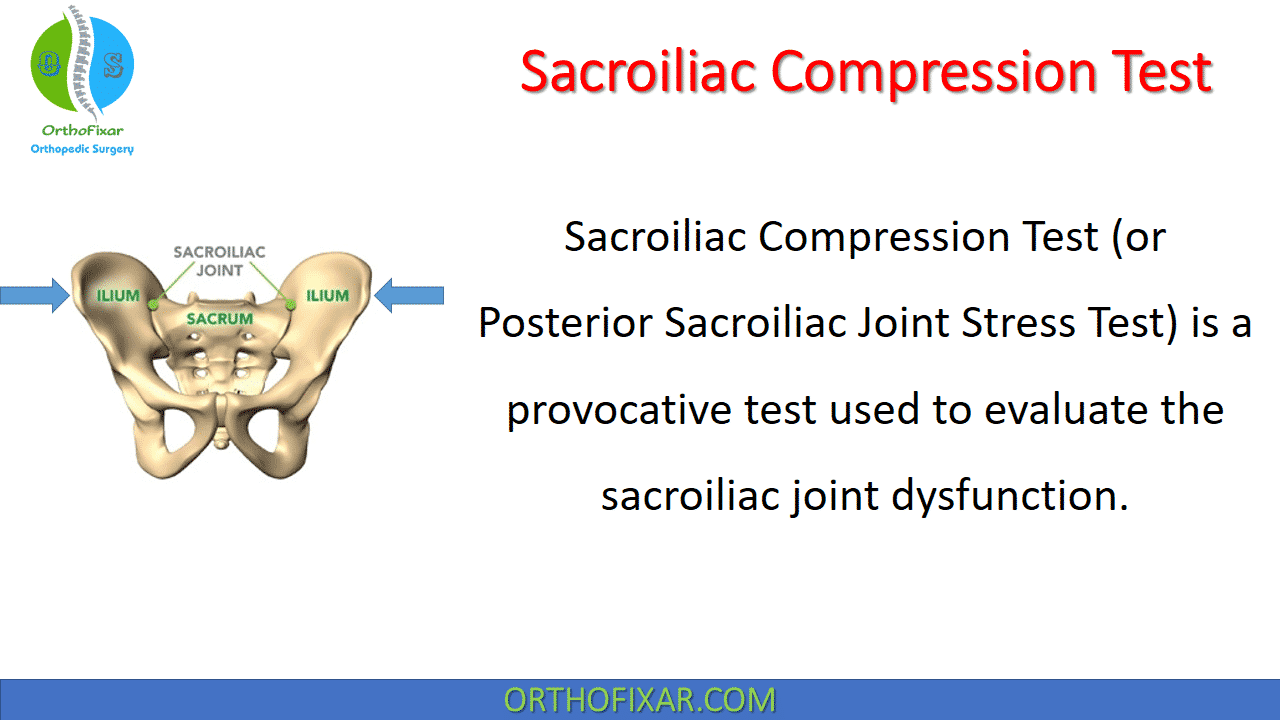
Sacroiliac Compression Test (or Posterior Sacroiliac Joint Stress Test) is a provocative test used to evaluate the sacroiliac joint dysfunction. It reproduces pain by compressing the pelvic ring and stressing the SI joint. The test also helps clinicians evaluate whether low-back or pelvic pain originates from the sacroiliac articulation.
Because sacroiliac pain is difficult to diagnose clinically, this test is rarely used alone; instead, it is typically interpreted as part of a cluster of provocation tests to improve diagnostic reliability.
The SI Compression Test aims to:
- Reproduce the patient’s familiar pain
- Stress the sacroiliac joint and surrounding ligaments
- Help differentiate SI joint pain from lumbar or hip pathology
Provocation maneuvers like the compression test have demonstrated clinical value in identifying SI joint pathology, particularly when used in combination with other tests such as the thigh thrust or sacral thrust.
How do perform the Sacroiliac Compression Test?
Sacroiliac Compression Test is done with patient side-lying, affected side up, with hips flexed approximately 45 degrees and knees flexed approximately 90 degrees, examiner applies a force vertically downward on the anterior superior iliac crest, the stress is maintained for 30 seconds once an end-feel is obtained.
See Also: Sacroiliac Stress Test
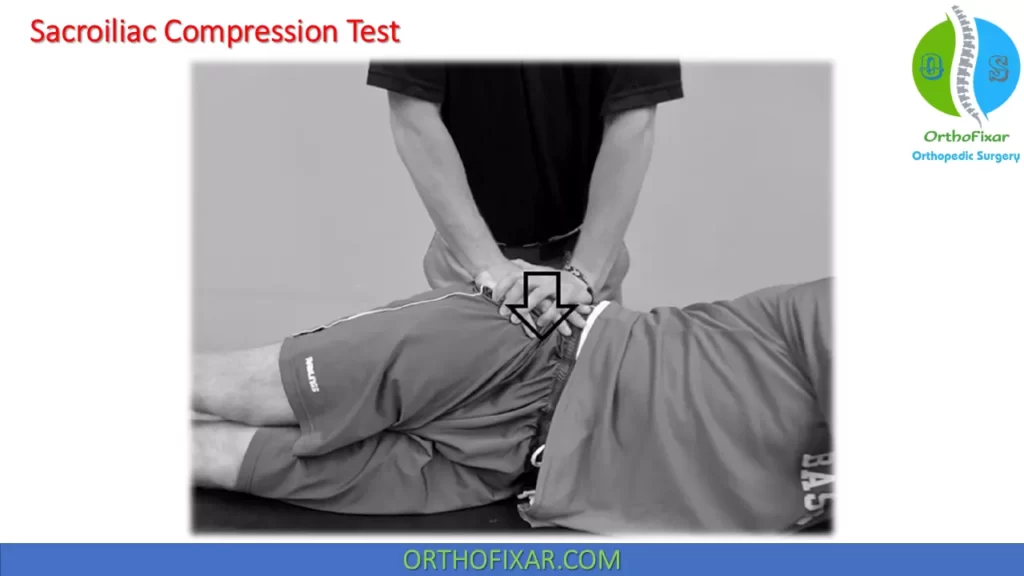
This test can be done with the patient in the supine position, where the clinician, standing behind the patient, applies a medial force to both innominates, using both hands, the stress is also maintained for 30 seconds once an end-feel is obtained.
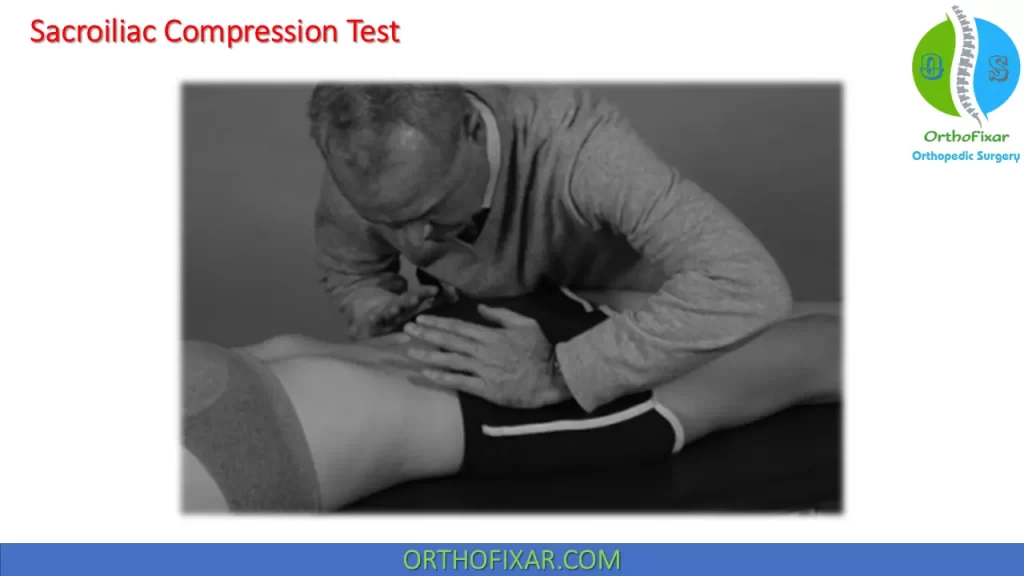
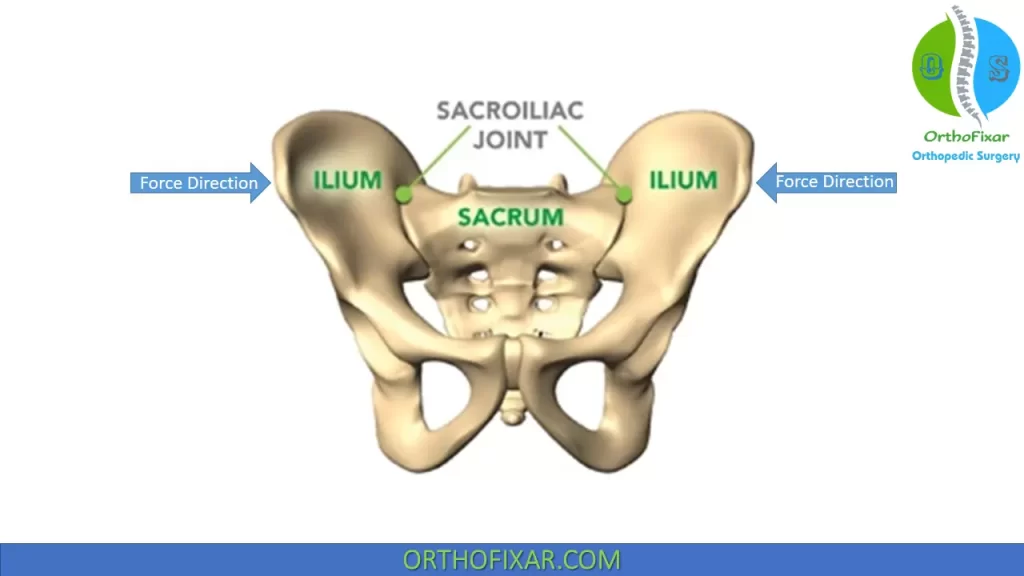
The procedure creates a medial force that tends to gap the posterior aspect of the sacroiliac joint, while compressing its anterior aspect.
What is a positive SI compression test?
The reproduction of pain over one or both of the sacroiliac joint is considered a positive test.
The posterior (dorsal) SI ligament, which is accessible just below the posterior inferior iliac spine, should be palpated for tenderness.
Accuracy
A study on 48 patients with chronic lumbopelvic pain referred for sacroiliac joint injection, found the sensitivity of 69% and a specificity of 69% for this test (in this study, 80% pain relief with injection of local anesthetics into sacroiliac joint).
| Population | Reference Standard | Sens | Spec | +LR | -LR |
|---|---|---|---|---|---|
| 40 patients with chronic low back pain | Sacroiliitis apparent on MRI | .22 | .83 | 1.37 | .92 |
| 60 patients with chronic low back pain referred to pain clinic | 50% pain relief with injection of local anesthetics into sacroiliac joint | .60 | .70 | 2.0 | .57 |
SI Joint Provocation Tests
| Test | Mechanism | How It Provokes SI Pain | Typical Sensitivity | Typical Specificity | Clinical Notes |
|---|---|---|---|---|---|
| SI Compression Test | Posterior pelvic compression | Approximates iliac crests → stresses posterior SI ligaments | ~60–65% | ~65–70% | Useful screening test; rarely diagnostic alone |
| Distraction Test | Anterior pelvic stress | Applies outward force to ASIS → stresses anterior SI ligaments | ~55–60% | ~75–80% | Often paired with compression for ligament assessment |
| Thigh Thrust Test | Posterior shear force | Axial load through femur drives ilium posteriorly | ~85–90% | ~70–75% | One of the most sensitive SI tests |
| Sacral Thrust Test | Direct posterior SI compression | Downward force on sacrum creates shear across SI joints | ~55–60% | ~70–75% | Good adjunct test; stresses entire SI complex |
| FABER (Patrick’s) Test | Combined hip/SI stress | Flexion-abduction-external rotation transmits stress to SI joint | ~60% | ~65–75% | Also screens hip pathology; pain location matters |
| Gaenslen Test | Torsional pelvic stress | One hip flexed, other extended → rotational SI stress | ~50–55% | ~70–80% | Helpful for unilateral SI pain patterns |
References
- Nejati P, Sartaj E, Imani F, Moeineddin R, Nejati L, Safavi M. Accuracy of the Diagnostic Tests of Sacroiliac Joint Dysfunction. J Chiropr Med. 2020 Mar;19(1):28-37. doi: 10.1016/j.jcm.2019.12.002. Epub 2020 Sep 12. PMID: 33192189; PMCID: PMC7646135. Pubmed
- Magee DJ. 4th ed. Philadelphia, PA: Saunders Elsevier; 2006. Orthopedic Physical Assessment; pp. 642–643.
- Laslett M, Aprill CN, McDonald B, Young SB. Diagnosis of sacroiliac joint pain: validity of individual provocation tests and composites of tests. Man Ther. 2005;10:207-218.
- Ozgocmen S, Bozgeyik Z, Kalcik M, Yildirim A. The value of sacroiliac pain provocation tests in early active sacroiliitis. Clin Rheumatol. 2008;10: 1275-1282.
- van der Wurff P, Buijs EJ, Groen GJ. A multitest regimen of pain provocation tests as an aid to reduce unnecessary minimally invasive sacroiliac joint procedures. Arch Phys Med Rehabil. 2006;87:10-14.
- Vleeming A, Pool-Goudzwaard AL, Hammudoghlu D, Stoeckart R, Snijders CJ, Mens JM. The function of the long dorsal sacroiliac ligament: its implication for understanding low back pain. Spine (Phila Pa 1976). 1996 Mar 1;21(5):556-62. doi: 10.1097/00007632-199603010-00005. PMID: 8852309. Pubmed
- Stuber KJ. Specificity, sensitivity, and predictive values of clinical tests of the sacroiliac joint: a systematic review of the literature. J Can Chiropr Assoc. 2007 Mar;51(1):30-41. PMID: 17657289; PMCID: PMC1924656. Pubmed
- Dutton’s Orthopaedic Examination, Evaluation, And Intervention 3rd Edition.
- Netter’s Orthopaedic Clinical Examination An Evidence-Based Approach 3rd Edition Book.