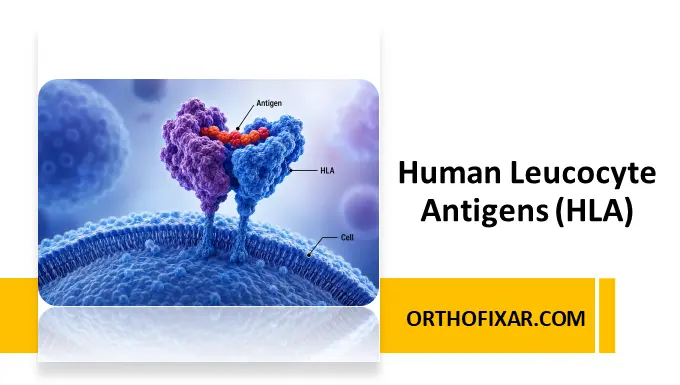
Human leucocyte antigens (HLA) are a group of cell-surface proteins that play a fundamental role in the human immune system. They help the body distinguish between self and non-self tissues, allowing immune cells to recognize and eliminate pathogens while preserving healthy cells.
The HLA system is one of the most polymorphic genetic systems in humans and is critically important in organ transplantation, autoimmune diseases, infectious disease susceptibility, and pharmacogenomics. Understanding Human leucocyte antigens, HLA and MHC, hla b27 antigen, hla antigen, and various hla types is essential for medical students, healthcare professionals, and researchers.
What Are Human Leucocyte Antigens (HLA)?
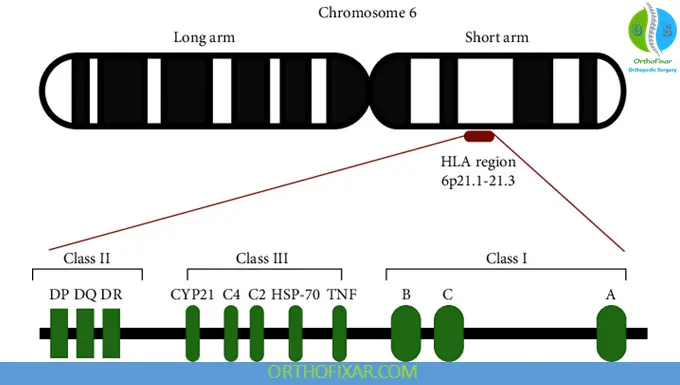
Human leucocyte antigens (HLA) are proteins encoded by genes located on chromosome 6 within the major histocompatibility complex (MHC). These proteins are expressed on the surface of most cells and serve as antigen-presenting molecules.
The primary function of HLA molecules is to present peptide fragments to T lymphocytes, enabling the immune system to detect infections, abnormal cells, and foreign tissues.
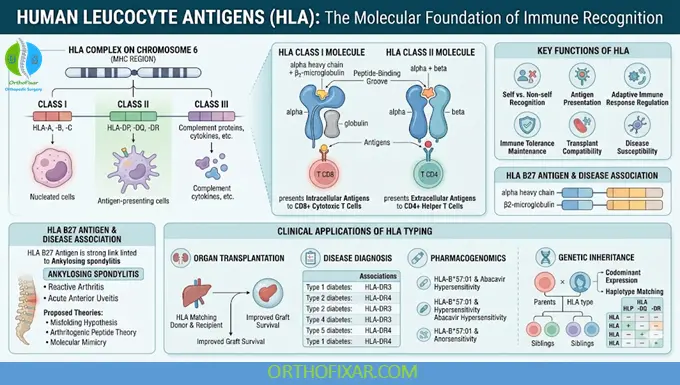
Key Functions of HLA
- Recognition of self versus non-self antigens
- Presentation of antigens to T cells
- Regulation of adaptive immune responses
- Maintenance of immune tolerance
- Determination of transplant compatibility
- Influence on susceptibility to autoimmune diseases
HLA and MHC: Understanding the Relationship
The terms HLA and MHC are often used interchangeably, but they are not exactly the same.
Major Histocompatibility Complex (MHC)
The Major Histocompatibility Complex (MHC) is a genomic region located on chromosome 6 that contains genes involved in immune regulation.
Human Leucocyte Antigens (HLA)
HLA refers specifically to the human version of MHC molecules.
Therefore:
- MHC = General term used across species
- HLA = Human MHC proteins
The HLA system represents the human immune recognition machinery encoded within the MHC region.
See Also: Plasma Gamma Globulins: Functions, Testing & Gamma Globulin Therapy
Structure of the HLA Complex
The HLA complex occupies approximately 4 million base pairs on chromosome 6p21.3.
It is divided into three major regions:
HLA Class I Region
Includes:
- HLA-A
- HLA-B
- HLA-C
These molecules are present on nearly all nucleated cells.
Their primary role is presenting intracellular antigens to CD8+ cytotoxic T lymphocytes.
HLA Class II Region
Includes:
- HLA-DP
- HLA-DQ
- HLA-DR
These molecules are mainly expressed on antigen-presenting cells such as:
- Dendritic cells
- Macrophages
- B lymphocytes
They present extracellular antigens to CD4+ helper T cells.
HLA Class III Region
Contains genes encoding:
- Complement proteins
- Cytokines
- Inflammatory mediators
Unlike Class I and II, Class III proteins do not directly present antigens.
HLA Class I Molecules
Components
Class I molecules consist of:
- Alpha heavy chain
- β2-microglobulin
Distribution
Found on:
- Leukocytes
- Endothelial cells
- Epithelial cells
- Most nucleated tissues
Function
Class I HLA molecules present intracellular peptides derived from:
- Viruses
- Tumor cells
- Intracellular bacteria
These peptides activate CD8+ T cells, leading to destruction of infected or malignant cells.
HLA Class II Molecules
Components
Class II molecules contain:
- Alpha chain
- Beta chain
Expression
Restricted mainly to professional antigen-presenting cells.
Function
Class II molecules present extracellular antigens derived from:
- Bacteria
- Parasites
- Environmental proteins
These antigens stimulate CD4+ helper T cells and coordinate adaptive immunity.
HLA Types and Their Classification
The extensive genetic diversity of the HLA system results in thousands of allelic variants.
Common HLA Types
HLA-A Types
Examples:
- HLA-A*01
- HLA-A*02
- HLA-A*03
HLA-B Types
Examples:
- HLA-B27
- HLA-B57
- HLA-B58
HLA-C Types
Examples:
- HLA-Cw6
- HLA-Cw7
HLA-DR Types
Examples:
- HLA-DR1
- HLA-DR3
- HLA-DR4
HLA-DQ Types
Examples:
- HLA-DQ2
- HLA-DQ8
The remarkable diversity of these hla types helps populations respond to a broad range of infectious agents.
HLA Antigen and Immune Recognition
An hla antigen functions as a molecular display platform that presents peptide fragments to T cells.
The immune response depends on whether the presented peptide is recognized as:
- Self
- Foreign
- Altered self
This mechanism forms the basis of:
- Infection control
- Tumor surveillance
- Autoimmune disease development
- Organ transplant rejection
HLA B27 Antigen
The hla b27 antigen is one of the most clinically important HLA molecules.
What Is HLA-B27?
HLA-B27 is a Class I HLA protein encoded by the HLA-B gene.
Although many individuals carrying HLA-B27 remain healthy, its presence significantly increases the risk of certain autoimmune and inflammatory diseases.
Diseases Associated with HLA B27 Antigen
Ankylosing Spondylitis
The strongest disease association.
Approximately 85–95% of patients with ankylosing spondylitis are HLA-B27 positive.
Reactive Arthritis
Previously known as Reiter syndrome.
Frequently associated with HLA-B27 positivity.
Psoriatic Arthritis
Especially the axial subtype.
Enteropathic Arthritis
Associated with inflammatory bowel disease.
Acute Anterior Uveitis
A common extra-articular manifestation.
Undifferentiated Spondyloarthritis
Many patients demonstrate HLA-B27 positivity.
Why Does HLA-B27 Increase Disease Risk?
The exact mechanism remains incompletely understood.
Proposed theories include:
Misfolding Hypothesis
Abnormal protein folding may trigger inflammatory responses.
Arthritogenic Peptide Theory
Certain peptides presented by HLA-B27 may provoke autoimmune reactions.
Molecular Mimicry
Microbial antigens may resemble self-antigens, leading to immune cross-reactivity.
HLA Typing
HLA typing identifies specific HLA alleles present in an individual.
Methods of HLA Typing
Serological Typing
Older method based on antibody reactions.
PCR-Based Typing
Detects specific genetic sequences.
Sequence-Specific Oligonucleotide Typing
Provides improved precision.
Next-Generation Sequencing (NGS)
Offers high-resolution allele identification.
Clinical Applications of HLA Typing
Organ Transplantation
Matching donor and recipient HLA types improves graft survival.
Used in:
- Kidney transplantation
- Liver transplantation
- Heart transplantation
- Bone marrow transplantation
Disease Diagnosis
Useful in confirming susceptibility to certain diseases.
Examples:
| Disease | Associated HLA |
|---|---|
| Ankylosing spondylitis | HLA-B27 |
| Celiac disease | HLA-DQ2, HLA-DQ8 |
| Type 1 diabetes | HLA-DR3, HLA-DR4 |
| Rheumatoid arthritis | HLA-DR4 |
| Narcolepsy | HLA-DQB1*06:02 |
Pharmacogenomics
Certain HLA alleles predict adverse drug reactions.
Examples:
- HLA-B*57:01 and abacavir hypersensitivity
- HLA-B*15:02 and carbamazepine-induced Stevens-Johnson syndrome
HLA and Organ Transplantation
Successful transplantation depends heavily on HLA compatibility.
Why HLA Matching Matters
Poor matching increases:
- Acute rejection
- Chronic rejection
- Graft failure
Better matching improves:
- Long-term graft survival
- Immune tolerance
- Patient outcomes
Important Matching Loci
- HLA-A
- HLA-B
- HLA-C
- HLA-DR
- HLA-DQ
HLA and Autoimmune Diseases
Many autoimmune disorders show strong HLA associations.
Mechanisms
Possible explanations include:
- Defective immune tolerance
- Abnormal antigen presentation
- Enhanced autoreactive T-cell activation
Common Associations
| Autoimmune Disease | HLA Association |
|---|---|
| Ankylosing spondylitis | HLA-B27 |
| Rheumatoid arthritis | HLA-DR4 |
| Celiac disease | HLA-DQ2/DQ8 |
| Multiple sclerosis | HLA-DRB1*15 |
| Type 1 diabetes | HLA-DR3/DR4 |
HLA and Infectious Diseases
HLA polymorphisms influence susceptibility to infectious diseases.
Examples include:
- HIV infection progression
- Hepatitis B infection
- Hepatitis C infection
- Malaria
- Tuberculosis
Some HLA alleles confer protection, while others increase susceptibility.
Genetic Inheritance of HLA
HLA genes are inherited as haplotypes.
Key Features
- One haplotype inherited from each parent
- Codominant expression
- High degree of polymorphism
Siblings have approximately:
- 25% chance of identical HLA matching
- 50% chance of partial matching
- 25% chance of no significant match
This information is critical in stem cell donor selection.
Future Applications of HLA Research
Emerging areas include:
Personalized Medicine
Tailoring treatments according to HLA genotype.
Cancer Immunotherapy
Improving tumor antigen recognition.
Vaccine Development
Designing vaccines that account for HLA diversity.
Precision Transplantation
Enhancing donor-recipient matching using genomic technologies.
Key Points
- Human leucocyte antigens are cell-surface proteins responsible for antigen presentation and immune recognition.
- The HLA system represents the human form of the major histocompatibility complex.
- Understanding HLA and MHC is fundamental to immunology and transplantation medicine.
- The hla b27 antigen is strongly associated with ankylosing spondylitis and other spondyloarthropathies.
- Different hla types influence susceptibility to autoimmune, infectious, and inflammatory diseases.
- HLA typing is essential for transplantation, disease diagnosis, and pharmacogenomics.
- The hla antigen system remains one of the most important determinants of immune function and personalized medicine.
References & More
- Medhasi S, Chantratita N. Human Leukocyte Antigen (HLA) System: Genetics and Association with Bacterial and Viral Infections. J Immunol Res. 2022 May 26;2022:9710376. doi: 10.1155/2022/9710376. PMID: 35664353; PMCID: PMC9162874. Link
- Trowsdale, John, and Julian C Knight. “Major histocompatibility complex genomics and human disease.” Annual review of genomics and human genetics vol. 14 (2013): 301-23. doi:10.1146/annurev-genom-091212-153455. Link