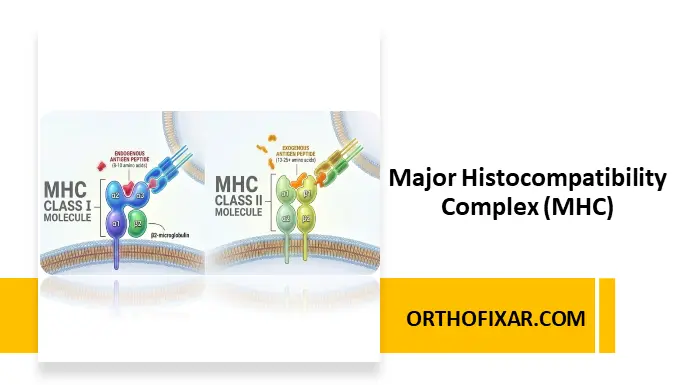
The major histocompatibility complex (MHC) is one of the most important genetic systems involved in immune recognition and antigen presentation. It plays a critical role in distinguishing self from non-self, enabling the immune system to identify and eliminate pathogens, infected cells, and abnormal tissues.
The MHC complex consists of a group of genes that encode cell-surface proteins responsible for presenting antigenic peptides to T lymphocytes. These proteins, known as major histocompatibility complex molecules, are essential for adaptive immunity, organ transplantation compatibility, autoimmune disease susceptibility, and vaccine responses.
Understanding the major histocompatibility complex is fundamental for students, clinicians, immunologists, and researchers studying human immune function.
What is the Major Histocompatibility Complex?
The major histocompatibility complex (MHC) is a cluster of highly polymorphic genes that encode proteins responsible for antigen presentation. These proteins bind peptide fragments derived from pathogens or cellular proteins and display them on the cell surface for recognition by T cells.
The interaction between an antigen and an antigen MHC complex allows T lymphocytes to detect infected or abnormal cells and initiate appropriate immune responses.
In humans, the MHC is known as the Human Leukocyte Antigen (HLA) system and is located on chromosome 6.
Key Functions of the MHC
- Presentation of antigens to T cells
- Recognition of self and non-self molecules
- Regulation of adaptive immune responses
- Determination of tissue compatibility during transplantation
- Influence on susceptibility to autoimmune diseases
- Contribution to vaccine effectiveness
Historical Background
The discovery of the major histocompatibility complex originated from transplantation studies. Researchers observed that transplanted tissues were often rejected unless donor and recipient tissues were genetically similar.
Subsequent investigations identified specific genetic regions controlling graft acceptance and rejection. In humans, these genes became known as Human Leukocyte Antigens (HLA), while in mice they were termed H-2 complex genes.
This discovery revolutionized immunology and earned several Nobel Prizes.
See Also: Human Leucocyte Antigens (HLA): Structure, Function & Types
Location of the MHC Complex
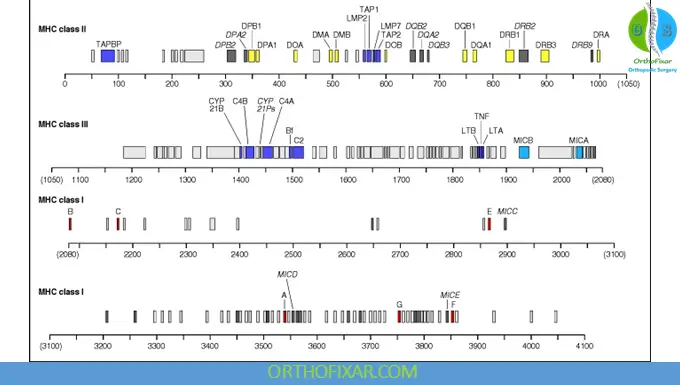
The human MHC complex is located on the short arm of chromosome 6 at position 6p21.3.
It spans approximately 4 megabases and contains over 200 genes involved in immune regulation.
The MHC region is divided into:
- Class I region
- Class II region
- Class III region
Each region contains genes with distinct immunological functions.
Types of Major Histocompatibility Complex Molecules
MHC Class I Molecules
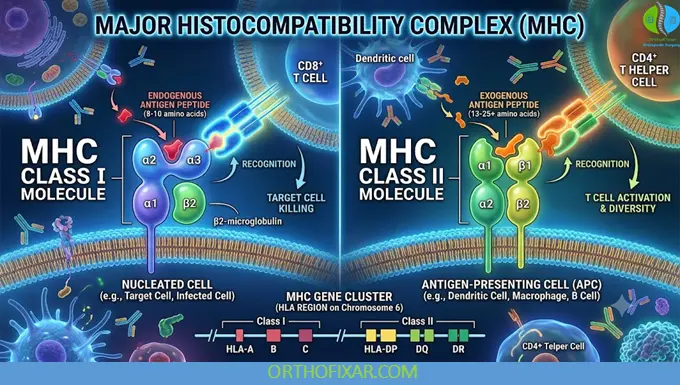
Major histocompatibility complex molecules of Class I are expressed on nearly all nucleated cells in the body.
Main Human Class I Genes
- HLA-A
- HLA-B
- HLA-C
Structure of MHC Class I
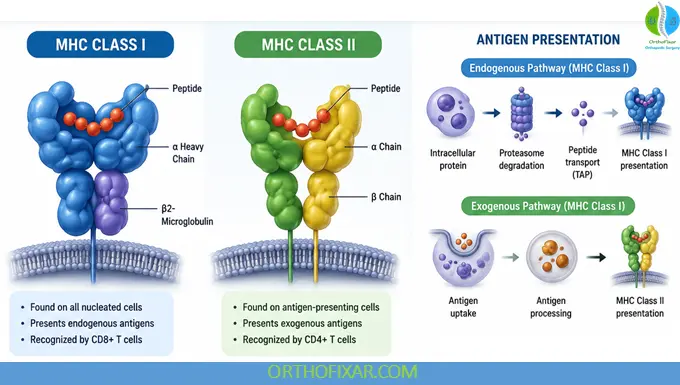
MHC Class I molecules consist of:
- One heavy α chain
- One β2-microglobulin molecule
- A peptide-binding groove
The peptide-binding groove accommodates peptides typically 8–10 amino acids long.
Function of MHC Class I
Class I molecules present endogenous antigens derived from:
- Viral proteins
- Intracellular bacteria
- Tumor-associated proteins
- Cellular proteins
These peptides are recognized by CD8+ cytotoxic T lymphocytes.
Clinical Importance
MHC Class I molecules are critical for:
- Antiviral immunity
- Tumor surveillance
- Transplant rejection
- Autoimmune disease development
MHC Class II Molecules
Class II major histocompatibility complex molecules are primarily expressed on professional antigen-presenting cells.
Cells Expressing MHC Class II
- Dendritic cells
- Macrophages
- B lymphocytes
- Activated T cells
Main Human Class II Genes
- HLA-DP
- HLA-DQ
- HLA-DR
Structure of MHC Class II
MHC Class II molecules consist of:
- One α chain
- One β chain
Together they form a peptide-binding groove capable of accommodating larger peptides than Class I molecules.
Function of MHC Class II
Class II molecules present exogenous antigens derived from:
- Bacteria
- Parasites
- Extracellular pathogens
The resulting antigen MHC complex is recognized by CD4+ helper T cells.
Clinical Importance
MHC Class II molecules are involved in:
- Activation of helper T cells
- Antibody production
- Autoimmune disease susceptibility
- Vaccine-induced immunity
MHC Class III Region
Unlike Class I and Class II genes, the Class III region does not encode antigen-presenting proteins.
Instead, it contains genes involved in inflammation and immunity.
Examples of Class III Gene Products
- Complement proteins C2, C4, and Factor B
- Tumor necrosis factor (TNF)
- Heat shock proteins
These proteins support immune defense and inflammatory responses.
Structure of the Antigen MHC Complex
The antigen MHC complex forms when a peptide antigen binds to an MHC molecule.
This complex is displayed on the cell surface and serves as the signal recognized by T-cell receptors (TCRs).
Components of the Antigen MHC Complex
- Antigenic peptide
- MHC molecule
- T-cell receptor
- Co-receptors (CD4 or CD8)
Without formation of the antigen MHC complex, effective T-cell activation cannot occur.
Antigen Processing Pathways
Endogenous Pathway (MHC Class I)
This pathway processes intracellular antigens.
Steps
- Protein degradation by proteasomes
- Peptide transport into the endoplasmic reticulum by TAP proteins
- Binding to MHC Class I molecules
- Transport to the cell surface
- Recognition by CD8+ T cells
Exogenous Pathway (MHC Class II)
This pathway processes extracellular antigens.
Steps
- Antigen uptake by endocytosis or phagocytosis
- Processing within endosomes
- Binding to MHC Class II molecules
- Surface expression
- Recognition by CD4+ T cells
MHC Restriction
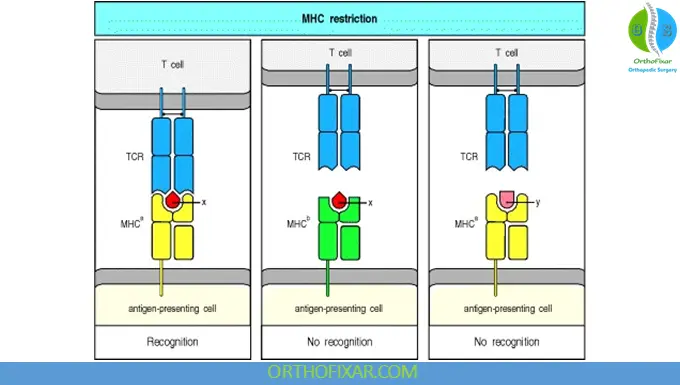
MHC restriction refers to the requirement that T cells recognize antigens only when presented by self-MHC molecules.
For example:
- CD8+ T cells recognize peptides presented by MHC Class I
- CD4+ T cells recognize peptides presented by MHC Class II
This concept was first described by immunologists Peter Doherty and Rolf Zinkernagel.
Genetic Diversity of the MHC Complex
The MHC complex is among the most polymorphic regions of the human genome.
Why Is MHC Diversity Important?
Genetic diversity allows populations to:
- Recognize diverse pathogens
- Resist infectious diseases
- Improve survival during epidemics
Each individual inherits one set of HLA genes from each parent, creating unique combinations of major histocompatibility complex molecules.
Major Histocompatibility Complex and Organ Transplantation
MHC compatibility is a major determinant of transplant success.
Types of Transplants Affected
- Kidney transplantation
- Heart transplantation
- Liver transplantation
- Bone marrow transplantation
Consequences of Mismatch
When donor MHC molecules differ significantly from recipient MHC molecules, the immune system may initiate:
- Hyperacute rejection
- Acute rejection
- Chronic rejection
Therefore, HLA typing is routinely performed before transplantation.
Major Histocompatibility Complex and Autoimmune Diseases
Certain MHC alleles are strongly associated with autoimmune disorders.
Examples
| HLA Type | Associated Disease |
|---|---|
| HLA-B27 | Ankylosing spondylitis |
| HLA-DR4 | Rheumatoid arthritis |
| HLA-DQ2/DQ8 | Celiac disease |
| HLA-DR3 | Type 1 diabetes mellitus |
| HLA-DR2 | Multiple sclerosis |
These associations suggest that specific major histocompatibility complex molecules influence immune tolerance.
Major Histocompatibility Complex and Infectious Diseases
MHC variation affects susceptibility to infections.
Research has shown associations between specific HLA alleles and outcomes in:
- HIV infection
- Hepatitis B
- Hepatitis C
- Tuberculosis
- Malaria
- COVID-19
Different MHC molecules present different pathogen-derived peptides, influencing immune effectiveness.
Major Histocompatibility Complex and Cancer
The immune system relies on MHC Class I molecules to detect tumor-associated antigens.
Many cancers evade immune surveillance by reducing MHC expression.
Examples include:
- Melanoma
- Lung cancer
- Colorectal cancer
- Cervical cancer
Modern cancer immunotherapies often depend on effective antigen presentation through MHC pathways.
MHC and Vaccine Responses
Vaccines stimulate immune responses by generating peptide antigens that are presented by MHC molecules.
Variation within the MHC complex can influence:
- Antibody production
- T-cell activation
- Long-term immunity
- Vaccine effectiveness
This explains why vaccine responses vary among individuals.
Comparison Between MHC Class I and Class II
| Feature | MHC Class I | MHC Class II |
|---|---|---|
| Expression | All nucleated cells | Antigen-presenting cells |
| Peptide Source | Endogenous | Exogenous |
| Recognized By | CD8+ T cells | CD4+ T cells |
| Main Genes | HLA-A, HLA-B, HLA-C | HLA-DP, HLA-DQ, HLA-DR |
| Function | Cytotoxic immunity | Helper T-cell activation |
Clinical Applications of MHC Testing
MHC and HLA testing are used in:
Transplant Medicine
- Donor-recipient matching
- Graft monitoring
Disease Prediction
- Identifying genetic predisposition
- Screening high-risk populations
Pharmacogenomics
Certain HLA alleles predict adverse drug reactions.
Immunotherapy
MHC profiling helps personalize cancer treatments and vaccine strategies.
Future Directions in MHC Research
Emerging research focuses on:
- Personalized immunotherapy
- Cancer vaccines
- Precision medicine
- Autoimmune disease prevention
- Improved transplant matching
- Novel infectious disease treatments
Advances in genomics and immunology continue to reveal new roles for the major histocompatibility complex in human health and disease.
Key Points
- The major histocompatibility complex is a group of genes responsible for antigen presentation.
- Human MHC genes are known as the HLA system.
- Major histocompatibility complex molecules present peptide antigens to T cells.
- The antigen MHC complex is essential for immune recognition.
- MHC Class I interacts with CD8+ T cells, whereas MHC Class II interacts with CD4+ T cells.
- MHC polymorphism influences transplantation outcomes, autoimmune diseases, infections, and cancer immunity.
- Understanding the MHC complex is fundamental to modern immunology and clinical medicine.
References & More
- Tumer G, Simpson B, Roberts TK. Genetics, Human Major Histocompatibility Complex (MHC) [Updated 2023 Aug 14]. In: StatPearls [Internet]. Treasure Island (FL): StatPearls Publishing; 2026 Jan-. Available from: https://www.ncbi.nlm.nih.gov/books/NBK538218/
- Janeway CA Jr, Travers P, Walport M, et al. Immunobiology: The Immune System in Health and Disease. 5th edition. New York: Garland Science; 2001. The major histocompatibility complex and its functions. Available from: https://www.ncbi.nlm.nih.gov/books/NBK27156/
- Cruz-Tapias P, Castiblanco J, Anaya JM. Major histocompatibility complex: Antigen processing and presentation. In: Anaya JM, Shoenfeld Y, Rojas-Villarraga A, et al., editors. Autoimmunity: From Bench to Bedside [Internet]. Bogota (Colombia): El Rosario University Press; 2013 Jul 18. Chapter 10. Available from: https://www.ncbi.nlm.nih.gov/books/NBK459467/
- Sumitran-Holgersson S. Beyond ABO and human histocompatibility antigen: other histocompatibility antigens with a role in transplantation. Curr Opin Organ Transplant. 2008 Aug;13(4):425-9. [PubMed]