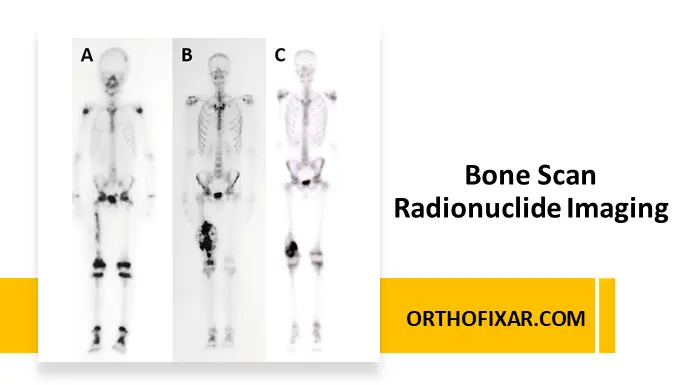
Bone scan radionuclide imaging, also known as bone scintigraphy, is a nuclear medicine imaging technique that provides valuable information about skeletal physiology and bone metabolism. Unlike conventional radiography, which primarily demonstrates anatomical changes, radionuclide imaging evaluates biological activity within bone tissue, making it highly sensitive for detecting abnormalities before structural changes become visible on X-rays.
The technique plays an important role in diagnosing fractures, infections, tumors, prosthetic complications, and metabolic bone disorders. Although modern imaging modalities such as MRI and CT have replaced bone scintigraphy in many situations, radionuclide imaging remains an important diagnostic tool because of its ability to assess the entire skeleton and detect multifocal disease.
What is Radionuclide Bone Scan Imaging?
Bone scan radionuclide imaging is a nuclear medicine procedure that uses a radioactive tracer to visualize physiological activity within the skeleton. After intravenous administration, the radiopharmaceutical accumulates in areas of active bone remodeling and increased blood flow.
A gamma camera detects the emitted radiation and generates images that reflect the metabolic activity of bone tissue rather than its anatomical structure.
The radiopharmaceutical consists of two components:
- A bone-seeking chemical compound
- A radioactive isotope that emits detectable gamma photons
This combination allows visualization of skeletal metabolism and identification of abnormal bone activity.
See Also: Arthrography: Indications, Technique, Uses & Interpretation
Principles of Bone Scintigraphy
Radiopharmaceuticals Used in Bone Scans
The most commonly used tracer is Technetium-99m hydroxymethylene diphosphonate (99mTc-HDP) or similar diphosphonate compounds such as 99mTc-MDP.
Technetium-99m is considered ideal because:
- It emits gamma photons suitable for imaging.
- It has a short half-life of approximately 6 hours.
- It exposes patients to relatively low radiation compared with older radionuclides.
- It is rapidly excreted by the kidneys.
After injection, the tracer binds to hydroxyapatite crystals in bone, particularly in areas of increased osteoblastic activity.
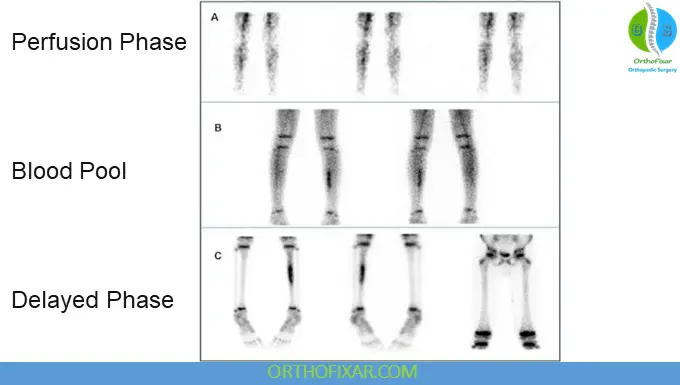
Phases of Bone Scan Imaging
1. Perfusion (Blood Flow) Phase
Images are obtained immediately after tracer injection.
This phase reflects:
- Regional blood flow
- Tissue vascularity
- Soft tissue inflammation
Increased uptake during this phase may indicate:
- Acute inflammation
- Synovitis
- Fracture
- Highly vascular tumors
- Complex regional pain syndrome
2. Delayed Bone Phase
Images are usually acquired approximately three hours after injection.
By this time:
- Most background soft-tissue activity has cleared.
- The tracer has concentrated within bone tissue.
- Skeletal structures become clearly visible.
This phase primarily reflects osteoblastic activity and bone turnover.
Mechanism of Abnormal Uptake
Bone scintigraphy detects abnormalities through changes in radionuclide accumulation.
Increased Uptake (“Hot Spots”)
Areas of increased activity may occur due to:
- Fractures
- Stress fractures
- Osteomyelitis
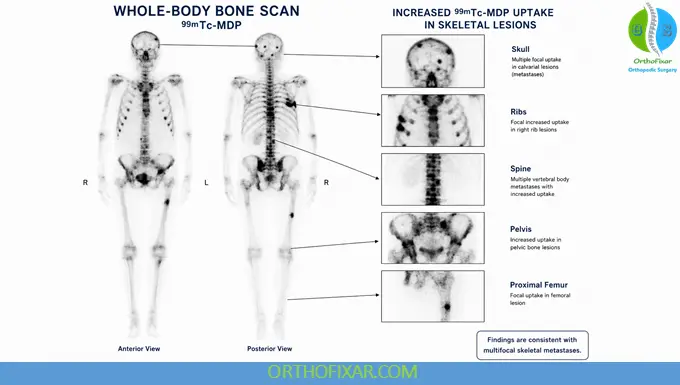
- Bone metastases
- Osteoid osteoma
- Prosthetic loosening
- Healing bone
- Degenerative joint disease
These lesions appear as focal areas of increased tracer concentration.
Decreased Uptake (“Cold Spots”)
Reduced activity may occur when blood supply is absent or severely impaired.
Examples include:
- Avascular necrosis
- Bone infarction
- Certain aggressive tumors
- Areas where normal bone has been replaced by pathological tissue
Clinical Applications of Bone Scan Radionuclide Imaging
Detection of Occult and Stress Fractures
One of the most important uses of bone scan radionuclide imaging is identifying fractures that are not visible on conventional radiographs.
Bone scintigraphy is highly sensitive for:
- Stress fractures
- Insufficiency fractures
- Occult hip fractures
- Early fracture healing
Abnormal uptake often appears within days after injury.
Evaluation of Bone Infection
Bone scans are frequently used in the investigation of:
- Osteomyelitis
- Septic arthritis
- Prosthetic joint infection
Infection typically demonstrates increased blood flow and increased delayed skeletal uptake.
Because bone scintigraphy is sensitive but not highly specific, findings are often correlated with MRI, laboratory tests, and clinical examination.
Assessment of Prosthetic Joint Complications
Bone scintigraphy may help evaluate painful joint replacements.
Potential causes include:
- Mechanical loosening
- Periprosthetic infection
- Stress reactions
Although increased uptake may indicate abnormality, additional imaging studies are often required to distinguish infection from aseptic loosening.
Diagnosis of Avascular Necrosis
Bone scans can detect altered blood supply to bone before radiographic changes become evident.
Conditions evaluated include:
- Femoral head osteonecrosis
- Perthes disease
- Bone infarction
Early lesions may appear as photopenic (cold) areas due to loss of perfusion.
Detection of Bone Metastases
One of the most common indications for bone scintigraphy is screening for skeletal metastases.
The examination is highly sensitive for metastatic disease arising from:
- Prostate cancer
- Breast cancer
- Lung cancer
- Thyroid cancer
Whole-body imaging enables identification of multiple metastatic sites in a single examination.
Evaluation of Bone Tumors
Bone scans help determine:
- Extent of primary bone tumors
- Multifocal involvement
- Response to treatment
However, the technique cannot reliably distinguish benign from malignant lesions without additional imaging and biopsy.
Whole-Body Bone Scintigraphy
A major advantage of radionuclide imaging is the ability to evaluate the entire skeleton in one examination.
This is particularly useful for:
- Metastatic disease
- Multifocal osteomyelitis
- Polyostotic disorders
- Multiple occult fractures
Whole-body assessment often reveals clinically unsuspected lesions.
Other Radionuclide Imaging Agents
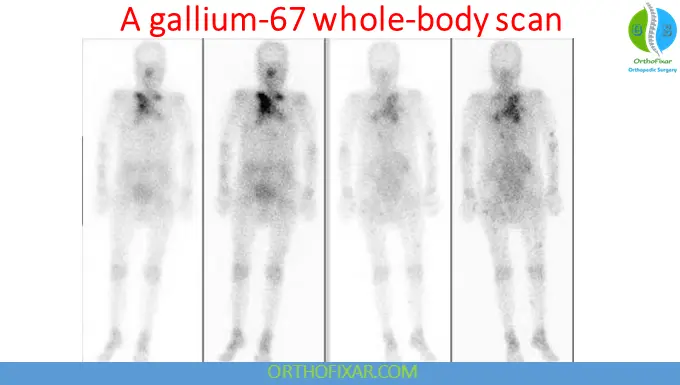
Gallium-67 Imaging
Gallium-67 accumulates within inflammatory tissues and has historically been used to detect:
- Hidden infections
- Chronic inflammation
- Prosthetic joint infections
However, its use has declined because newer techniques provide better accuracy.
Indium-111 Labeled Leukocyte Imaging
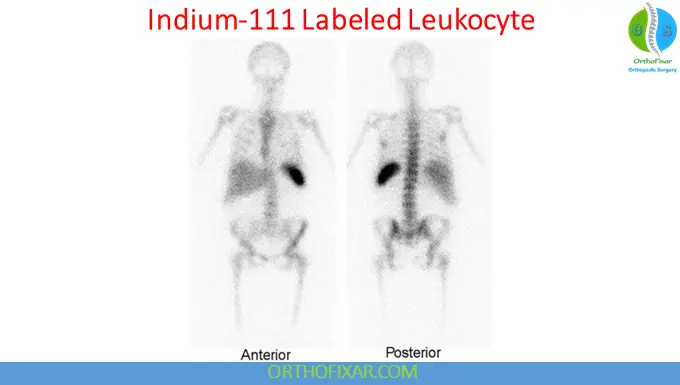
This technique involves:
- Collecting the patient’s white blood cells.
- Labeling them with Indium-111.
- Reinjecting the cells intravenously.
Accumulation of labeled leukocytes suggests active infection.
Applications include:
- Prosthetic joint infection
- Osteomyelitis
- Occult inflammatory processes
Advantages of Bone Scan Radionuclide Imaging
Important advantages include:
- Extremely sensitive for detecting skeletal abnormalities
- Ability to image the entire skeleton
- Detection of disease before radiographic changes occur
- Evaluation of physiological activity
- Useful for identifying multifocal pathology
Limitations of Bone Scintigraphy
Despite its sensitivity, several limitations exist:
- Poor specificity
- Limited anatomical detail
- Reduced spatial resolution compared with MRI and CT
- Radiation exposure
- Difficulty distinguishing different pathological processes solely from scan appearance
For localized musculoskeletal disorders, MRI often provides greater diagnostic specificity.
Bone Scan Versus MRI
| Feature | Bone Scan | MRI |
|---|---|---|
| Physiological activity assessment | Excellent | Moderate |
| Anatomical detail | Limited | Excellent |
| Detection of occult fractures | Excellent | Excellent |
| Detection of metastases | Excellent for whole-body screening | Limited to scanned region |
| Soft tissue evaluation | Limited | Excellent |
| Specificity | Lower | Higher |
MRI has largely replaced bone scintigraphy for many focal orthopedic problems, while bone scans remain valuable for whole-body screening and assessment of multifocal disease.
Patient Preparation and Procedure
The typical procedure includes:
- Intravenous injection of a technetium-labeled tracer.
- Hydration to facilitate tracer clearance.
- Waiting period of approximately 2–4 hours.
- Imaging using a gamma camera.
- Additional SPECT or SPECT/CT imaging when indicated.
The examination is generally safe, noninvasive, and well tolerated.
Safety and Radiation Considerations
Radiation exposure from modern bone scintigraphy is relatively low and generally considered acceptable when clinically justified.
Contraindications are limited but include:
- Pregnancy (unless benefits outweigh risks)
- Certain situations requiring radiation minimization
Breastfeeding recommendations vary depending on the tracer used and institutional protocols.
Future Developments
Hybrid imaging technologies have significantly improved radionuclide imaging.
Current advances include:
- SPECT/CT
- PET/CT
- PET/MRI
- Novel bone-targeting radiotracers
These techniques combine physiological and anatomical information, improving diagnostic accuracy.
Key Points
- Bone scan radionuclide imaging evaluates skeletal physiology and osteoblastic activity.
- Technetium-99m-labeled diphosphonates are the most commonly used tracers.
- Bone scintigraphy is highly sensitive for fractures, infection, metastases, and prosthetic complications.
- Increased uptake indicates increased bone turnover or blood flow.
- Whole-body imaging is a major advantage over many other imaging modalities.
- MRI provides superior anatomical detail and specificity for localized lesions.
- Hybrid techniques such as SPECT/CT continue to enhance diagnostic performance.
References & More
- Love C, Din AS, Tomas MB, Kalapparambath TP, Palestro CJ. Radionuclide bone imaging: an illustrative review. Radiographics. 2003. Pubmed
- Even-Sapir E. Imaging of malignant bone involvement by morphologic, scintigraphic and hybrid modalities. Journal of Nuclear Medicine. 2005. Pubmed
- Cook GJR, Azad GK, Goh V. Imaging bone metastases in breast cancer: staging and response assessment. Journal of Nuclear Medicine. 2016. Pubmed
- Blom, A., Warwick, D., & Whitehouse, M. R. (2018). Apley & Solomon’s system of orthopaedics and trauma (10th ed.). CRC Press