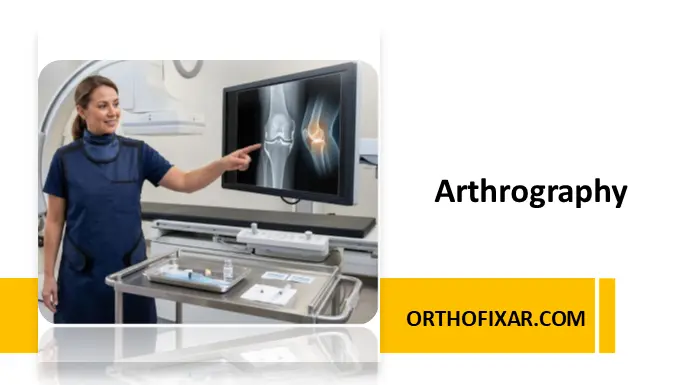
Arthrography is a specialized diagnostic imaging procedure in which contrast material is injected directly into a joint space to improve visualization of intra-articular structures. The technique enhances the assessment of cartilage, ligaments, labrum, menisci, joint capsules, and loose bodies that may not be adequately visualized on conventional radiographs.
Although magnetic resonance imaging (MRI) has become the primary imaging modality for many joint disorders, arthrography remains an important diagnostic tool, especially when combined with MRI or computed tomography (CT). Modern MR arthrography is considered the gold standard for evaluating many intra-articular soft tissue abnormalities.
What Is Arthrography?
Arthrography is a form of contrast radiography that involves injecting a contrast agent directly into a joint under sterile conditions. The injected contrast outlines intra-articular structures, allowing detailed evaluation of:
- Articular cartilage
- Joint capsule
- Ligaments
- Labrum
- Menisci
- Synovial recesses
- Intra-articular loose bodies
The procedure may be performed using:
- Conventional fluoroscopy
- CT arthrogram
- MR arthrogram
The choice depends on the clinical indication and the anatomical region being examined.
Historical Development of Arthrography
Traditional arthrography was originally performed using fluoroscopic imaging after injection of iodinated contrast media. Advances in cross-sectional imaging led to the development of:
- CT arthrogram, providing excellent spatial resolution of cartilage and bone.
- MR arthrogram, offering superior soft-tissue contrast and detailed visualization of intra-articular structures.
Today, MR arthrogram is widely used in orthopedic and sports medicine imaging.
Principles of Arthrography
The procedure relies on introducing contrast medium into the joint cavity.
The contrast agent:
- Distends the joint capsule.
- Separates intra-articular structures.
- Outlines cartilage surfaces.
- Demonstrates tears and defects through contrast leakage.
- Reveals filling defects caused by loose bodies or soft tissue lesions.
Abnormal structures become more visible because contrast enters spaces created by injury or pathology.
Types of Arthrography
Direct Arthrography
Direct arthrography involves injection of contrast directly into the joint space.
Advantages include:
- Excellent joint distension
- High diagnostic accuracy
- Precise visualization of intra-articular pathology
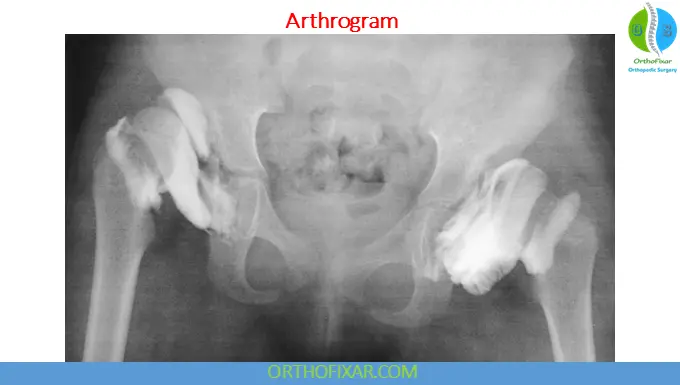
Indirect Arthrography
Indirect arthrography involves intravenous contrast administration followed by imaging after contrast diffuses into the joint.
Although less invasive, it generally provides lower diagnostic accuracy than direct arthrography.
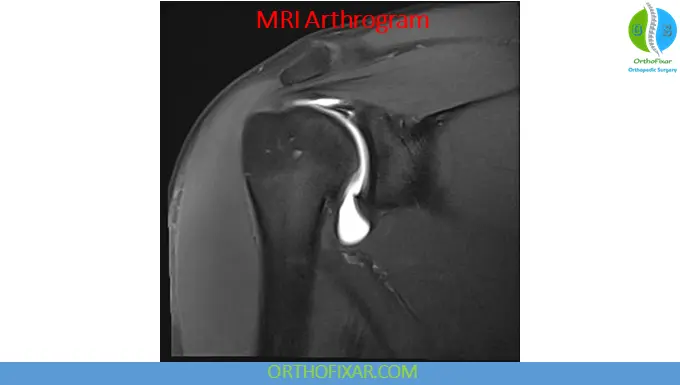
MRI Arthrogram
MRI Arthrogram combines intra-articular contrast injection with MRI.
Benefits include:
- Superior soft tissue visualization
- Excellent detection of labral tears
- Assessment of cartilage injuries
- Evaluation of ligament pathology
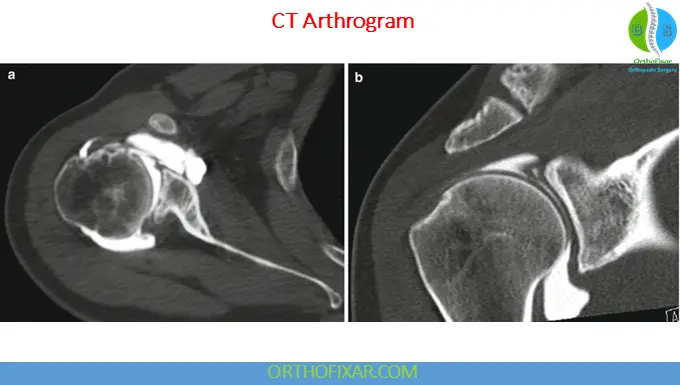
CT Arthrogram
CT Arthrogram combines contrast injection with CT imaging.
It is particularly useful for:
- Cartilage assessment
- Postoperative imaging
- Patients unable to undergo MRI
- Evaluation of prosthetic joints
Arthrography Procedure
Patient Preparation
Before the procedure:
- Medical history is reviewed.
- Allergies to contrast agents are assessed.
- Anticoagulant medications are evaluated.
- Informed consent is obtained.
Contrast Injection
Under fluoroscopic, ultrasound, or CT guidance:
- The skin is sterilized.
- Local anesthesia is administered.
- A needle is inserted into the joint.
- Contrast material is injected.
- Imaging is performed immediately.
Imaging Acquisition
Depending on the indication, imaging may include:
- Fluoroscopy
- Radiography
- CT
- MRI
Clinical Indications for Arthrography
Shoulder Arthrography
The shoulder is among the most commonly examined joints.
Arthrography can identify:
- Labral tears
- Rotator cuff tears
- Capsular injuries
- Glenohumeral instability
- Postoperative complications
MR arthrography is particularly sensitive for detecting subtle labral pathology.
Hip Arthrography
Hip arthrography remains valuable in both pediatric and adult orthopedic practice.
Applications include:
- Evaluation of developmental dysplasia of the hip
- Assessment of femoral head cartilage
- Detection of acetabular labral tears
- Diagnosis of femoroacetabular impingement
- Investigation of avascular necrosis
In children, arthrography can outline the cartilaginous femoral head, which is radiolucent on standard radiographs.
In adults with avascular necrosis, arthrography may demonstrate cartilage flap formation and articular surface abnormalities.
Knee Arthrography
Before MRI became widely available, arthrography was commonly used to diagnose meniscal injuries.
Current indications include:
- Meniscal tears
- Ligament injuries
- Cartilage defects
- Synovial disorders
- Intra-articular loose bodies
Contrast filling defects may indicate free fragments within the joint.
Wrist Arthrography
Wrist arthrography is useful for detecting:
- Triangular fibrocartilage complex (TFCC) tears
- Intercarpal ligament injuries
- Cartilage defects
- Chronic wrist pain
Ankle Arthrography
Common indications include:
- Chronic ankle instability
- Osteochondral lesions
- Ligament injuries
- Capsular defects
Elbow Arthrography
Although less common, elbow arthrography can help evaluate:
- Osteochondral injuries
- Ligament disruptions
- Loose bodies
Arthrography in Pediatric Orthopedics
Pediatric hip disorders represent one of the classic indications for arthrography.
Applications include:
- Developmental dysplasia of the hip (DDH)
- Congenital hip dislocation
- Legg-Calvé-Perthes disease
- Assessment during reduction procedures
Because cartilage is not visible on standard radiographs, arthrography can clearly outline cartilaginous structures.
Arthrography in Sports Medicine
Sports-related injuries frequently involve structures that are difficult to assess using conventional radiographs.
Arthrography can detect:
- Labral tears
- Ligament ruptures
- Cartilage injuries
- Capsular tears
- Joint instability
Athletes commonly undergo shoulder, hip, and wrist MR arthrography for diagnostic evaluation.
Arthrography and Prosthetic Joint Evaluation
Following joint replacement surgery, arthrography may assist in identifying:
- Prosthetic loosening
- Cement-bone interface failure
- Periprosthetic defects
- Communication with abnormal fluid collections
Contrast seepage along the bone-cement interface may suggest loosening of the prosthesis.
Arthrographic Findings
Loose Bodies
Intra-articular loose bodies appear as:
- Filling defects
- Contrast displacement areas
- Mobile defects on dynamic imaging
Cartilage Lesions
Findings include:
- Irregular articular surfaces
- Contrast penetration into defects
- Cartilage flap formation
Labral Tears
Typical findings include:
- Contrast extending into the labrum
- Detachment from the bony rim
- Irregular labral contours
Ligament Tears
Signs include:
- Contrast leakage
- Abnormal joint communication
- Capsular disruption
Capsular Ruptures
Capsular injuries may demonstrate:
- Extravasation of contrast
- Abnormal contrast tracking
- Joint instability patterns
Discography and Facetography
Contrast radiography is also used in spinal imaging.
Discography
Discography involves contrast injection into intervertebral discs.
It may help evaluate:
- Disc degeneration
- Disc disruption
- Discogenic pain
Facetography
Facetography assesses facet joints and can demonstrate:
- Degenerative changes
- Joint pathology
- Sources of spinal pain
Advantages of Arthrography
Major advantages include:
- Excellent visualization of intra-articular structures
- High sensitivity for labral tears
- Detection of subtle cartilage abnormalities
- Evaluation of prosthetic loosening
- Improved assessment of pediatric cartilage
Limitations of Arthrography
Limitations include:
- Invasive procedure
- Exposure to contrast agents
- Potential discomfort
- Small risk of infection
- Limited value for extra-articular pathology
Risks and Complications
Complications are uncommon but may include:
- Infection
- Bleeding
- Allergic reaction
- Temporary pain
- Contrast extravasation
- Vasovagal reactions
Serious complications are rare when proper sterile technique is used.
Arthrography VS MRI
| Feature | Arthrography | MRI |
|---|---|---|
| Invasive | Yes | No |
| Contrast Injection | Intra-articular | Usually none |
| Labral Tear Detection | Excellent | Good |
| Cartilage Assessment | Excellent | Good to excellent |
| Soft Tissue Visualization | Good | Excellent |
| Joint Distension | Yes | No |
MR arthrography often combines the strengths of both techniques.
Future Directions
Advances in imaging technology continue to improve arthrographic evaluation through:
- High-field MRI
- Three-dimensional imaging
- Quantitative cartilage assessment
- Enhanced contrast agents
- Image-guided interventions
These developments may further increase diagnostic accuracy in musculoskeletal disorders.
Key Points
- Arthrography is a contrast-enhanced imaging technique used to evaluate joints.
- It is particularly useful for detecting labral tears, cartilage defects, ligament injuries, and loose bodies.
- MR arthrography provides excellent visualization of intra-articular structures.
- Hip arthrography remains valuable in pediatric orthopedics and avascular necrosis assessment.
- Contrast leakage can reveal capsular ruptures and prosthetic loosening.
- Discography and facetography are specialized spinal applications of contrast radiography.
References & More
- Awasthi P, Dwivedi A, Choudhary SS. Role of Magnetic Resonance Arthrography (MRA) in the Diagnosis of Shoulder Injuries. Adv Biomed Res. 2025 Jul 21;14:55. doi: 10.4103/abr.abr_347_23. PMID: 40862170; PMCID: PMC12373060. Pubmed
- Roberts CC, Escobar E. Shoulder Arthrogram. 2025 Sep 14. In: StatPearls [Internet]. Treasure Island (FL): StatPearls Publishing; 2026 Jan–. PMID: 35593869. Pubmed
- Lungu E, Moser TP. A practical guide for performing arthrography under fluoroscopic or ultrasound guidance. Insights Imaging. 2015 Dec;6(6):601-10. doi: 10.1007/s13244-015-0442-9. Epub 2015 Oct 22. PMID: 26493836; PMCID: PMC4656236. Pubmed
- Palmer WE. MR arthrography: is it worthwhile? Top Magn Reson Imaging. 1996 Feb;8(1):24-43. PMID: 8820092. Pubmed
- Setiawati R. Arthrography for Sports Injuries. Orthop J Sports Med. 2024 Oct 24;12(10 suppl3):2325967124S00389. doi: 10.1177/2325967124S00389. PMCID: PMC11529662. Pubmed