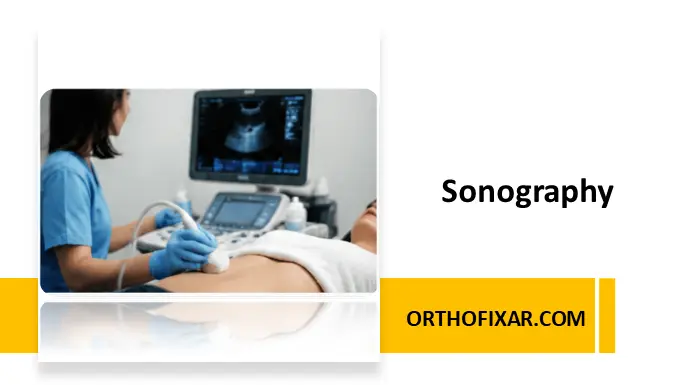
Sonography, also known as ultrasound or diagnostic sonography, is a non-invasive imaging technique widely used in medical practice. It utilizes high-frequency sound waves to visualize soft tissues, organs, and vascular structures without exposing patients to ionizing radiation.
How Sonography Works
Ultrasound waves are generated by a transducer, which emits sound waves that penetrate soft tissues. As these waves encounter tissue interfaces, some are reflected back as echoes. The transducer captures these echoes, converting them into electrical signals that are displayed as real-time images on a monitor. Unlike X-rays, which rely on tissue density, sonography depends on reflective surfaces and tissue interfaces, similar to sonar detection used in ships and submarines.
Different tissues exhibit varying degrees of echogenicity. For example:
- Fluid-filled cysts: echo-free
- Fat: highly echogenic
- Semi-solid organs: varying echogenicity
These differences allow precise differentiation between tissue types. Real-time imaging also enables dynamic assessment of structures, providing functional information that static imaging cannot.
See Also: MRI Scan Imaging: Principles, Safety & Limitations
Clinical Applications of Diagnostic Sonography
Sonography is invaluable in identifying cystic and solid lesions due to its excellent echogenic contrast. Some common clinical applications include:
- Detection of haematomas, abscesses, popliteal cysts, and arterial aneurysms
- Assessment of intra-articular fluid for conditions like synovial effusion or irritable hip
- Evaluation of tendons for tendinitis or partial/complete tears (e.g., rotator cuff, patellar ligament, Achilles tendon)
- Guiding needle placement for diagnostic or therapeutic joint and soft-tissue injections
- Screening newborns for congenital hip dislocation or dysplasia, visualizing cartilaginous femoral heads and acetabula that are invisible on X-ray
Ultrasound is fast, cost-effective, portable, and entirely safe, making it an essential tool in modern medicine. However, image quality and diagnostic accuracy heavily depend on operator experience.
Doppler Sonography
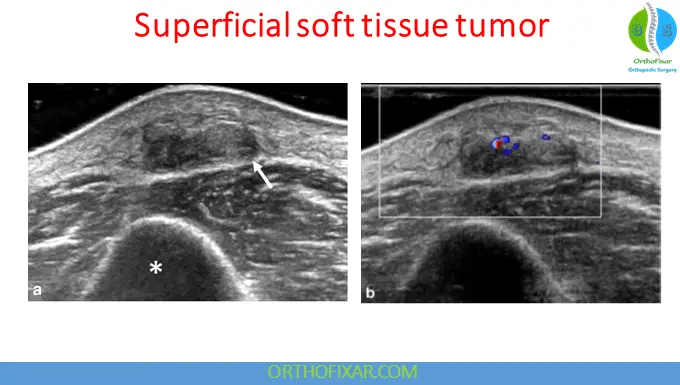
Doppler ultrasound uses the change in frequency of sound waves when they reflect off moving objects, such as blood cells, to detect flow. This technique can identify:
- Increased blood flow in areas of inflammation or aggressive tumors
- Different flow velocities, often represented in color using color Doppler
Doppler sonography is widely used in vascular assessment, cardiac evaluation, and monitoring of organ perfusion.
Advantages of Sonography
- Non-invasive and radiation-free
- Portable and widely available
- Provides real-time dynamic imaging
- Cost-effective compared to other imaging modalities
- Highly versatile, with applications in musculoskeletal, vascular, neonatal, and soft-tissue imaging
Limitations
- Operator-dependent; image quality varies with technician skill
- Limited penetration in obese patients or when imaging structures behind bone or air-filled organs
Conclusion
Sonography is a cornerstone of modern diagnostic imaging. Its safety, accessibility, and versatility make it invaluable for assessing a wide range of clinical conditions. Understanding its principles, applications, and limitations ensures optimal patient care and effective use of this diagnostic tool.
References & More
- Borowy CS, Mukhdomi T. Sonography Physical Principles And Instrumentation. [Updated 2023 Mar 20]. In: StatPearls [Internet]. Treasure Island (FL): StatPearls Publishing; 2026 Jan-. Available from: https://www.ncbi.nlm.nih.gov/books/NBK567710/
- Schmitz G, Dencks S. Ultrasound Imaging. Recent Results Cancer Res. 2020;216:135-154. doi: 10.1007/978-3-030-42618-7_4. PMID: 32594386. Pubmed
- Wells PN. Ultrasound imaging. Phys Med Biol. 2006 Jul 7;51(13):R83-98. doi: 10.1088/0031-9155/51/13/R06. Epub 2006 Jun 20. PMID: 16790922. Pubemd
- Blom, A., Warwick, D., & Whitehouse, M. R. (2018). Apley & Solomon’s system of orthopaedics and trauma (10th ed.). CRC Press