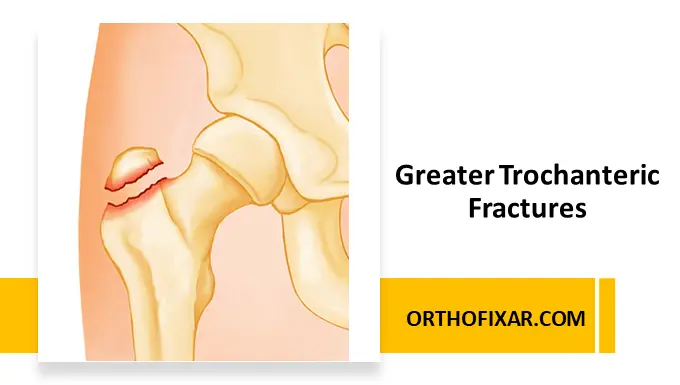
Greater trochanteric fractures are relatively rare injuries, typically affecting older adults. They involve the bony prominence of the proximal femur where the gluteus medius and minimus muscles attach. Unlike intertrochanteric or femoral neck fractures, isolated greater trochanteric fractures are uncommon and are often the result of:
- Eccentric muscle contraction (most common in elderly patients)
- Direct trauma or impact
These fractures can significantly affect hip function due to disruption of the abductor mechanism, potentially leading to gait disturbances if not appropriately managed.
Epidemiology
- Greater trochanteric fractures account for a small fraction of all proximal femur fractures.
- Predominantly occur in older adults with osteoporotic bone.
- Less frequent in younger populations unless associated with high-energy trauma.
See Also: Hip Joint Anatomy
Mechanism of Injury
- Eccentric Muscle Contraction:
Sudden contraction of the gluteus medius or minimus during a fall or twisting motion can avulse the greater trochanter, particularly in osteoporotic bone. - Direct Blow:
Trauma directly over the lateral hip, such as falls from standing height, can cause isolated fractures.
Clinical Presentation
Patients typically present with:
- Lateral hip pain localized over the greater trochanter
- Pain aggravated by abduction or weight-bearing
- Possible limping or Trendelenburg gait in cases of abductor dysfunction
- Swelling or ecchymosis over the lateral hip
See Also: Hip Intertrochanteric Fractures
Diagnosis
Imaging
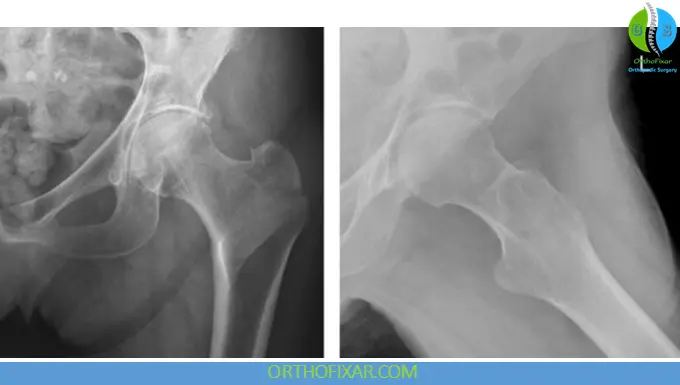
- X-rays: First-line imaging; may demonstrate displacement of the greater trochanter fragment.
- CT scan: Useful for better visualization of fracture pattern and displacement.
- MRI: Rarely indicated but may help assess soft tissue involvement, particularly in occult fractures.
Greater Trochanteric Fractures Treatment
Nonoperative Treatment
The mainstay for most isolated greater trochanteric fractures, especially in elderly, low-demand patients, includes:
- Protected weight-bearing using crutches
- Analgesia and anti-inflammatory medications
- Physical therapy focusing on abductor strengthening once pain allows
Most patients achieve good functional outcomes without surgery.
Operative Management
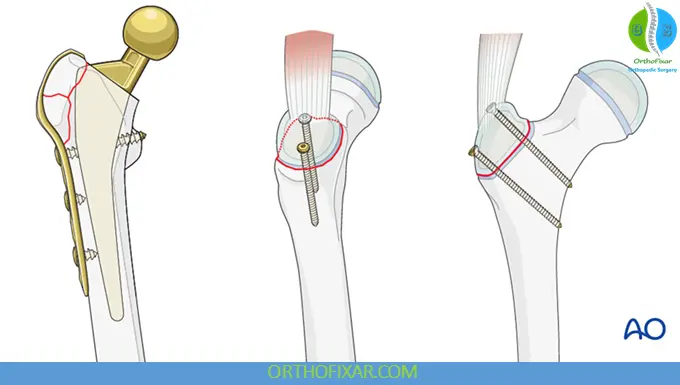
Surgery is considered for younger, active patients or those with widely displaced fragments, to restore the abductor mechanism and prevent gait abnormalities.
Preferred techniques:
- Open Reduction and Internal Fixation (ORIF) with Tension Band Wiring
- Ideal for fragments attached to the gluteus medius and minimus
- Converts tensile forces into compressive forces, promoting bone healing
- Plate and Screw Fixation with Hook Plate
- Provides rigid fixation for large or comminuted fragments
- Useful when multiple abductor insertions are involved
Postoperative care typically includes limited weight-bearing followed by gradual rehabilitation.
Prognosis
- Nonoperative management generally results in satisfactory outcomes, with most patients regaining normal ambulation.
- Operative intervention offers excellent results in young, active individuals with displaced fractures.
- Complications are rare but may include persistent abductor weakness or lateral hip pain.
Key Points
- Greater trochanteric fractures are rare and usually low-energy injuries in the elderly.
- Nonoperative treatment is effective in most cases.
- Surgery is reserved for displaced fragments in younger patients to restore abductor function.
- Early mobilization and rehabilitation are crucial for functional recovery.
References & More
- Aprato A, Cipolla A, D’Amelio A, Branca Vergano L, Giaretta S, Massè A. Isolated greater trochanter fractures. Acta Biomed. 2023 Jun 23;94(S2):e2023094. doi: 10.23750/abm.v94iS2.13815. PMID: 37366186. Pubmed
- Emmerson BR, Varacallo MA, Inman D. Hip Fracture Overview. [Updated 2023 Aug 8]. In: StatPearls [Internet]. Treasure Island (FL): StatPearls Publishing; 2026 Jan-. Available from: Pubmed
- Egol KA. Handbook of fractures. 6th ed. Philadelphia: Lippincott Williams & Wilkins; 2019.