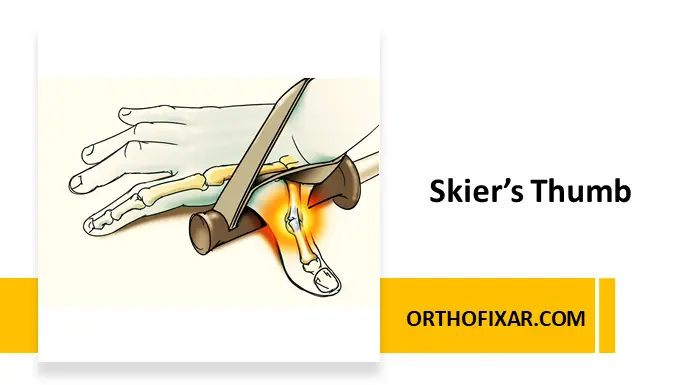
Skier’s thumb is an acute injury to the ulnar collateral ligament (UCL) of the thumb at the metacarpophalangeal (MCP) joint. This ligament is essential for thumb stability during pinch and grip activities.
The injury typically occurs when a valgus (abduction) force is applied to the thumb—classically during a fall while holding a ski pole, hence the name skier thumb injury.
Anatomy: Why the UCL Matters
The ulnar collateral ligament of the thumb stabilizes the MCP joint against radial deviation. Damage to this ligament compromises:
- Pinch strength
- Grip stability
- Fine motor function
If ulnar collateral ligament of the thumb injury is untreated, it can lead to chronic instability and functional impairment.
See Also: Hand Anatomy: Bones & Muscles
Mechanism of Injury
Common mechanisms include:
- Fall on an abducted or hyperextended thumb
- Skiing accidents with pole retention
- Sports injuries (football, baseball, cycling)
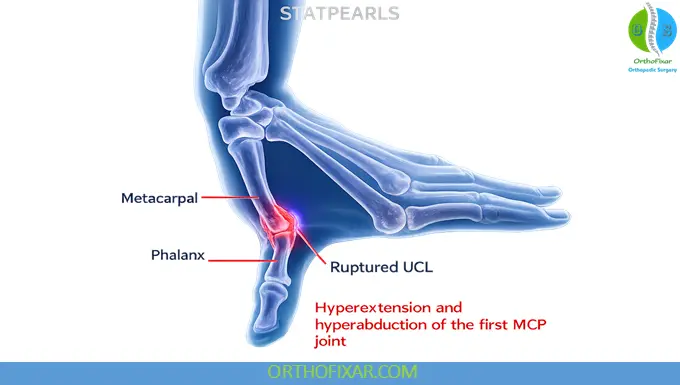
Types of Skier Thumb Injury
- Partial UCL tear (Grade I–II)
- Ligament stretched or partially torn
- Joint remains stable
- Complete UCL rupture (Grade III)
- Full tear with instability
- Often requires surgery
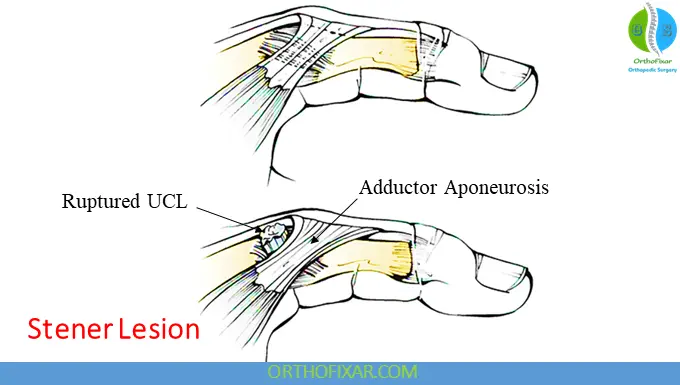
- Stener Lesion
- The torn ligament becomes displaced above the adductor aponeurosis
- Stener Lesion prevents natural healing
- This case is an absolute indication for surgery repair of the UCL.
Signs & Symptoms
Typical clinical features include:
- Pain and swelling at the thumb MCP joint
- Weak grip or pinch
- Instability during stress testing
- Bruising or tenderness along the ulnar side
Delayed diagnosis can lead to chronic pain and instability.
Diagnosis
Clinical Examination
- Skier’s Thumb Test
- Increased laxity (>30° or >20° vs contralateral thumb suggests rupture)
Imaging
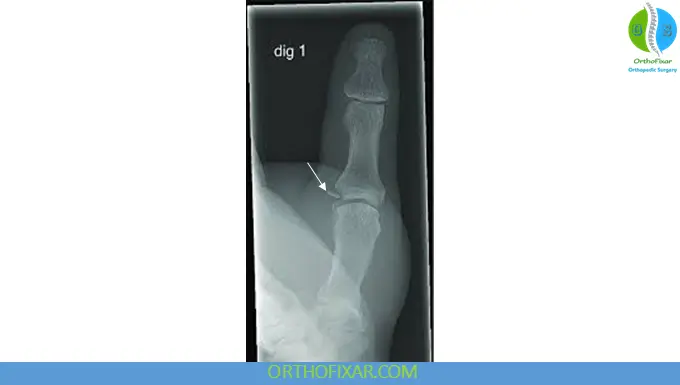
- X-ray: Detects avulsion fractures
- Ultrasound or MRI: Confirms ligament tear and detects Stener lesion
Skier’s Thumb Treatment
1. Conservative Treatment (Non-Surgical)
Indicated for:
- Partial tears
- Stable joints
- Non-displaced avulsion fractures
Management includes:
- Thumb spica splint or cast (4–6 weeks)
- Early controlled motion after immobilization
- Gradual return to activity
Recovery timeline:
- Functional recovery in ~6–12 weeks
2. Surgical Treatment
Indicated for:
- Complete UCL rupture
- Stener lesion
- Significant instability
Surgical repair aims to:
- Restore ligament continuity
- Re-establish joint stability
Outcomes:
- Excellent results in ~90% of cases with early repair
Rehabilitation
- Immobilization initially
- Controlled range-of-motion at 3–4 weeks
- Strengthening exercises after 6 weeks
- Full activity by ~12 weeks
Complications
If untreated or mismanaged:
- Chronic instability
- Weak grip strength
- Persistent pain
- Early osteoarthritis
Prevention Tips
- Release ski poles during falls
- Use proper sports techniques
- Strengthen hand muscles
- Protective bracing in high-risk sports
Prognosis
With appropriate skier’s thumb treatment:
- Most patients regain full function
- Surgical cases have high success rates
- Delayed treatment worsens outcomes
Key Takeaways
- Skier’s thumb = acute UCL injury of the thumb MCP joint
- Early diagnosis is critical to avoid long-term disability
- Stener lesion always requires surgery
- Treatment depends on injury severity (splint vs surgery)
References & More
- Mohseni M, Sina RE, Graham C. Ulnar Collateral Ligament Injury (Gamekeeper’s Thumb) [Updated 2024 Feb 1]. In: StatPearls [Internet]. Treasure Island (FL): StatPearls Publishing; 2026 Jan-. Available from: Pubmed
- Fricker R, Hintermann B. Skier’s thumb. Treatment, prevention and recommendations. Sports Med. 1995 Jan;19(1):73-9. doi: 10.2165/00007256-199519010-00006. PMID: 7740248. Pubmed
- Mahajan M, Rhemrev SJ. De skiduim [Skier’s thumb]. Ned Tijdschr Geneeskd. 2013;157(49):A6398. Dutch. PMID: 24299625. Pubmed
- Gerber C, Senn E, Matter P. Skier’s thumb. Surgical treatment of recent injuries to the ulnar collateral ligament of the thumb’s metacarpophalangeal joint. Am J Sports Med. 1981 May-Jun;9(3):171-7. doi: 10.1177/036354658100900308. PMID: 7235114. Pubmed
- Egol KA. Handbook of fractures. 6th ed. Philadelphia: Lippincott Williams & Wilkins; 2019.