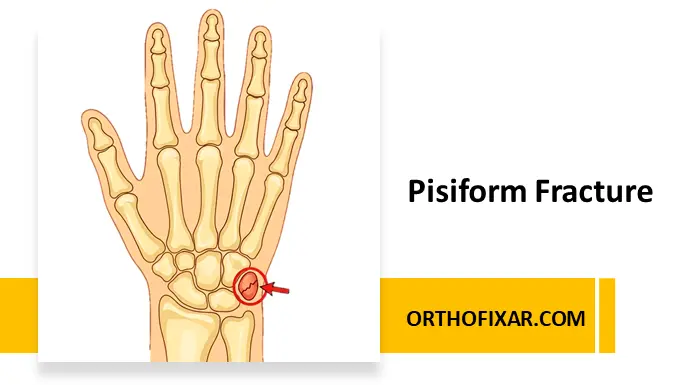
A pisiform fracture is an uncommon injury of the wrist that is frequently overlooked due to its subtle presentation and the complexity of carpal anatomy. Despite its rarity, timely recognition is essential to prevent chronic pain, ulnar nerve complications, and long-term functional impairment.
Anatomy and Function of the Pisiform
The pisiform is a small, pea-shaped sesamoid bone located within the tendon of the flexor carpi ulnaris (FCU) muscle on the ulnar side of the wrist. It articulates solely with the triquetrum and serves as an important biomechanical structure by enhancing the leverage of the FCU during wrist flexion. Additionally, it forms part of the Guyon’s canal, through which the ulnar nerve and artery pass.
See Also: Wrist Anatomy
Epidemiology and Mechanism of Injury
Pisiform fractures account for less than 2% of all carpal fractures, making them significantly rarer than scaphoid or distal radius fractures. According to peer-reviewed literature indexed in PubMed, these injuries most commonly occur due to:
- Direct trauma to the hypothenar eminence (e.g., falls onto an outstretched hand)
- Repetitive stress in athletes (such as cyclists or racquet sport players)
- Avulsion injuries caused by sudden, forceful contraction of the FCU tendon
Clinical Presentation
Patients with a pisiform fracture typically present with localized pain on the ulnar side of the wrist. Key clinical features include:
- Tenderness directly over the pisiform
- Pain exacerbated by wrist flexion or ulnar deviation
- Reduced grip strength
- Possible paresthesia in the ulnar nerve distribution if Guyon’s canal is involved
Due to overlapping symptoms with other wrist injuries, misdiagnosis is common.
See Also: Scaphoid Fractures
Diagnostic Evaluation
Physical Examination
A focused examination should include palpation of the pisiform and assessment of ulnar nerve function. The pisiform grind test may reproduce pain.
Imaging
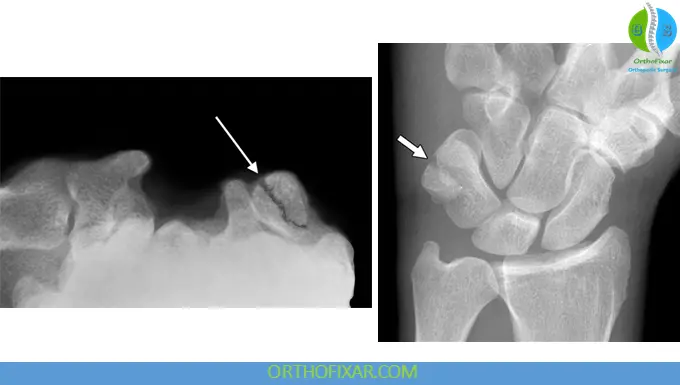
Standard wrist radiographs often fail to clearly visualize the pisiform due to overlapping structures. Therefore:
- Carpal tunnel view or supinated oblique views improve detection
- CT scans provide high sensitivity for detecting fractures and displacement
- MRI may be useful in identifying associated soft tissue or ligamentous injuries
Evidence from radiologic studies highlights CT imaging as the gold standard when plain films are inconclusive.
Classification
Pisiform fractures are generally classified as:
- Non-displaced fractures
- Displaced fractures
- Comminuted fractures
This classification guides treatment decisions and prognosis.
Treatment
Conservative Treatment
Most non-displaced pisiform fractures can be managed non-operatively:
- Immobilization in a short arm cast or splint for 3–6 weeks
- Activity modification
- Analgesia with NSAIDs
Clinical studies demonstrate favorable outcomes with conservative management in uncomplicated cases.
Surgical Intervention
Surgery is indicated in cases of:
- Displaced or comminuted fractures
- Persistent pain despite conservative treatment
- Ulnar nerve compression
The most common surgical procedure is pisiform excision (pisiformectomy), which has been shown in orthopedic literature to provide reliable pain relief without significant loss of wrist function.
Complications
Untreated or misdiagnosed pisiform fractures can lead to:
- Chronic ulnar-sided wrist pain
- Nonunion
- Ulnar nerve entrapment (Guyon’s canal syndrome)
- Decreased grip strength
Early diagnosis significantly reduces the risk of these complications.
Prognosis
With appropriate treatment, the prognosis for pisiform fractures is generally excellent. Most patients regain full wrist function and return to normal activities within a few months. Surgical outcomes are also favorable when indicated, particularly in resolving nerve-related symptoms.
Conclusion
Although rare, pisiform fractures require a high index of suspicion, particularly in patients presenting with ulnar-sided wrist pain following trauma. Advanced imaging plays a critical role in diagnosis, and management should be tailored based on fracture type and symptom severity. Evidence from peer-reviewed medical literature supports both conservative and surgical approaches, with overall excellent functional outcomes when appropriately managed.
References & More
- Boyce SH, Harden JL. Pisiform fracture: an uncommon wrist injury. BMJ Case Rep. 2010 Apr 20;2010:2132. doi: 10.1136/bcr.07.2009.2132. PMID: 22736214; PMCID: PMC3047175. Pubmed
- Amer AF, Alrehaili TM, Alrehailiy MM. Isolated Non-displaced Pisiform Fracture: A Diagnostic Challenge in Ulnar-Sided Wrist Trauma Managed Conservatively. Cureus. 2025 Jul 9;17(7):e87637. doi: 10.7759/cureus.87637. PMID: 40786272; PMCID: PMC12334856. Pubmed
- Egol KA. Handbook of fractures. 6th ed. Philadelphia: Lippincott Williams & Wilkins; 2019.