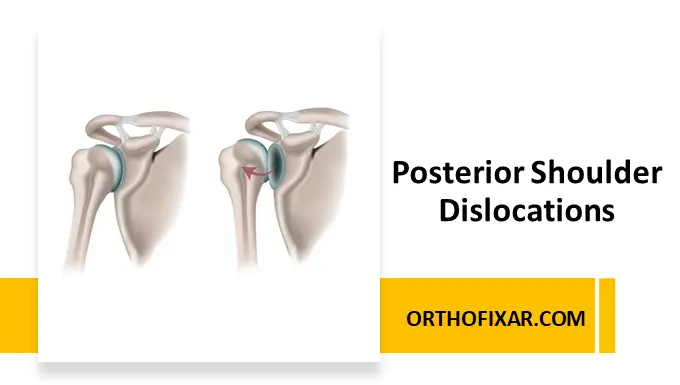
Posterior shoulder dislocations are rare (2-4% of all dislocations) but are frequently missed (60-80% initially). They often result from indirect trauma like seizures, causing the arm to be held in adduction and internal rotation. Diagnosis requires a high suspicion and proper imaging, including an axillary view. Treatment involves closed reduction under sedation, with surgery needed for large bone defects or instability. Key complications include fractures and recurrent dislocation.
Posterior Shoulder Dislocations is an uncommon but clinically important shoulder injury. Despite its rarity, it carries a high risk of missed diagnosis, particularly in acute care settings. This condition demands a high index of suspicion and careful radiographic evaluation to avoid missed diagnosis and long-term morbidity.
Incidence
Posterior Shoulder Dislocations:
- Account for 2%–4% of all shoulder dislocations
- Represent about 2% of shoulder injuries overall
- Are missed in 60%–80% of initial evaluations, making them one of the most frequently overlooked joint dislocations
Mechanism of Injury
Indirect Trauma (Most Common)
- Posterior Shoulder Dislocation Occurs when the shoulder is positioned in:
- Adduction
- Flexion
- Internal rotation
- Common scenarios:
- Seizures
- Electrical shock
- Pathophysiology:
- Powerful contraction of internal rotators (latissimus dorsi, pectoralis major, subscapularis)
- These overpower weaker external rotators (infraspinatus, teres minor), forcing the humeral head posteriorly
Direct Trauma
- Force applied to the anterior shoulder
- Results in posterior translation of the humeral head
See Also: Anterior Glenohumeral Dislocation
Clinical Evaluation
Posterior shoulder dislocations are often subtle in presentation:
Typical Findings
- Arm held in:
- Adduction
- Internal rotation
- Limited external rotation (often < 0°)
- Limited forward elevation (often < 90°)
Physical Examination Signs
- Flattened anterior shoulder contour
- Prominent coracoid process
- Palpable posterior mass (displaced humeral head)
Neurovascular Assessment
- Essential to evaluate:
- Axillary nerve function
- Neurovascular injuries are less common than in anterior dislocations but still possible
Radiographic Evaluation
A complete trauma series is mandatory:
- AP view
- Scapular-Y view
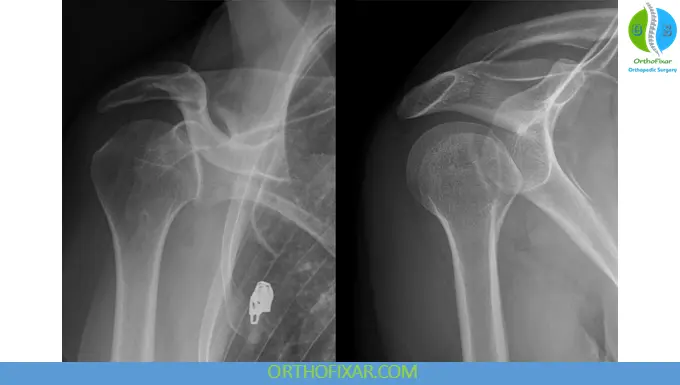
- Axillary view (most diagnostic)
If standard axillary view is not feasible:
- Use Velpeau axillary view
Key Radiographic Signs (AP View)
- Loss of normal humeral head–glenoid overlap
- Vacant glenoid sign (>6 mm space)
- Trough sign (reverse Hill-Sachs lesion; seen in ~75%)
- Internal rotation appearance (“light bulb sign”)
- Loss of humeral neck profile
Advanced Imaging
- CT scan:
- Essential for evaluating humeral head impaction defects
- Determines percentage of articular surface involvement
See Also: Shoulder X-ray Views
Classification
Etiologic Classification
- Traumatic: sprain, subluxation, dislocation (acute or recurrent)
- Atraumatic:
- Voluntary
- Congenital
- Acquired (microtrauma)
Anatomic Classification
- Subacromial (98%):
- Humeral head displaced posteriorly without gross displacement
- Often associated with reverse Hill-Sachs lesion
- Subglenoid (rare):
- Humeral head posterior and inferior to glenoid
- Subspinous (rare):
- Humeral head medial to acromion and below scapular spine
Posterior Shoulder Dislocation Treatment
Nonoperative Management
Closed Reduction
- Requires:
- Adequate sedation and analgesia
- Often general anesthesia
- Technique:
- Traction applied to adducted arm
- Gentle anterior repositioning of humeral head
⚠️ Important Precaution
- Avoid forced external rotation → risk of fracture if humeral head is locked
Special Consideration
- If impaction fracture is locked:
- Combine axial traction + lateral traction
Post-reduction Care
- Immobilization:
- Sling and swathe
- External rotation positioning for large defects
- Early rehab:
- Deltoid isometrics
- Gradual strengthening of rotator cuff
See Also: Shoulder Reduction Techniques
Operative Management
Indications
- Irreducible posterior shoulder dislocation
- Large humeral head defect (reverse Hill-Sachs lesion)
- Significant fractures:
- Lesser tuberosity
- Posterior glenoid rim
- Recurrent instability
- Open dislocation
Surgical Options
- Modified McLaughlin procedure (20%–40% defect)
- Hemiarthroplasty (>40% defect)
- Open reduction and stabilization
- Tendon transfers:
- Subscapularis
- Biceps (Boyd-Sisk procedure)
- Capsulorrhaphy or osteotomies
Special Case
- Voluntary dislocators:
- Managed nonoperatively with rehabilitation and counseling
Complications
Fractures
- Posterior glenoid rim
- Humeral head
- Tuberosities
- Humeral shaft
Recurrent Instability
- More common in:
- Atraumatic cases
- Large humeral head defects
- Glenoid fractures
Neurovascular Injury
- Less frequent than anterior dislocation
- Possible injuries:
- Axillary nerve
- Suprascapular nerve (infraspinatus branch)
Iatrogenic Anterior Subluxation
- Caused by overtightening posterior structures
- Leads to:
- Limited flexion
- Restricted internal rotation
Key Clinical Pearls
- Always suspect posterior shoulder dislocation in:
- Seizure patients
- Electrical injuries
- Do not rely on AP X-ray alone
- Loss of external rotation is a critical clinical clue
- Early diagnosis prevents chronic instability and joint damage
References & More
- Kammel KR, El Bitar Y, Leber EH. Posterior Shoulder Dislocations. [Updated 2022 Sep 12]. In: StatPearls [Internet]. Treasure Island (FL): StatPearls Publishing; 2026 Jan-. Available from: Pubmed
- Egol KA. Handbook of fractures. 6th ed. Philadelphia: Lippincott Williams & Wilkins; 2019.