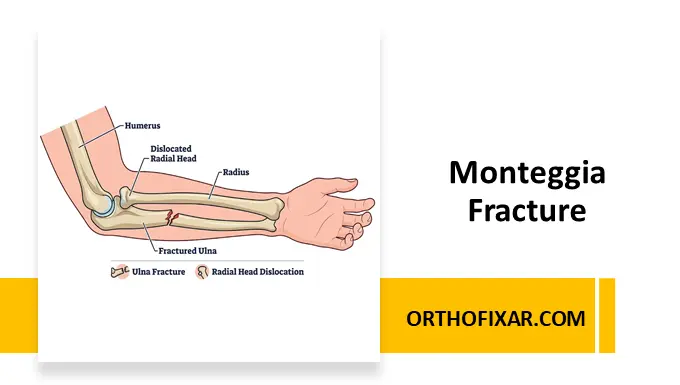
A Monteggia fracture is a fracture of the proximal ulna with a dislocation of the radial head at the elbow. It is a complex injury, more common in children, often from a fall. Diagnosis requires X-rays to check that the radial head aligns with the capitellum. The key treatment principle is to restore ulnar alignment, which typically allows the radial head to reduce. In children, closed reduction is often sufficient, while adults usually require surgical fixation. Early and correct treatment is crucial to avoid complications like chronic instability or nerve injury.
A Monteggia fracture is defined as a fracture of the proximal ulna associated with dislocation of the radial head at the elbow. It represents a complex injury involving both bony and ligamentous structures, requiring prompt recognition and appropriate management to prevent long-term dysfunction.
Epidemiology
- Monteggia Fracture accounts for approximately 1–2% of all forearm fractures
- It’s more common in children than adults
- It’s frequently associated with high-energy trauma in adults and falls in children
Anatomy & Pathophysiology
The Monteggia Fracture injury involves disruption of the proximal ulna and the radiocapitellar joint. Stability of the radial head depends on:
- Annular ligament
- Interosseous membrane
- Alignment of the ulna
When the ulna is fractured and angulated, the radial head dislocates due to loss of normal forearm alignment.
See Also: Radial Head Fractures
Mechanism of Injury
Common mechanisms of Monteggia Fracture include:
- Fall on an outstretched hand (FOOSH) with forearm in pronation
- Direct trauma to the forearm
- Hyperpronation or hyperextension forces
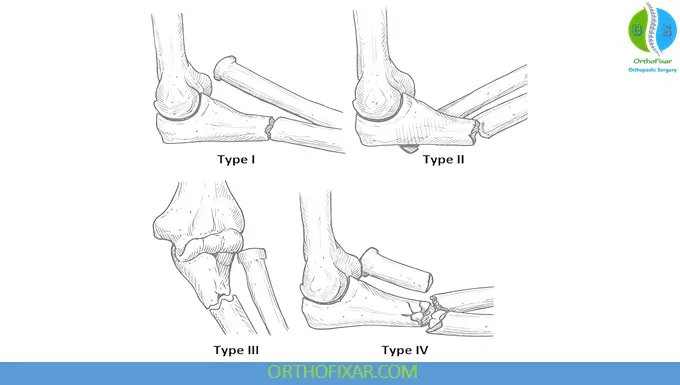
Monteggia Fracture Classification (Bado Classification)
Type I (Most Common)
- Anterior dislocation of radial head
- Fracture of ulna with anterior angulation
Type II
- Posterior or posterolateral dislocation of radial head
- Ulna fracture with posterior angulation
Type III
- Lateral dislocation of radial head
- Metaphyseal fracture of ulna
Type IV
- Fractures of both radius and ulna
- Radial head dislocation
Clinical Presentation
- Pain and swelling in the forearm and elbow
- Visible deformity
- Limited range of motion at the elbow
- Tenderness over ulna and radial head
- Possible posterior interosseous nerve (PIN) palsy, presenting as:
- Weak finger and thumb extension
See Also: Elbow Anatomy
Diagnosis
Clinical Examination
- Assess deformity and neurovascular status
- Always examine wrist and elbow
Imaging
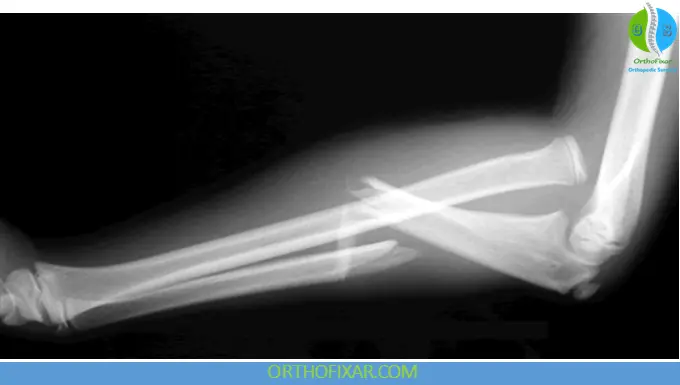
- X-rays (AP and lateral views) of forearm including elbow and wrist
- Key diagnostic sign:
- The radial head does not align with the capitellum on all views
Monteggia Fracture Treatment
General Principle
Restore ulnar alignment → radial head reduces spontaneously
In Children
- Closed reduction and casting is usually sufficient
- Ensure stable reduction of radial head
In Adults
- Surgical management is standard
- Open reduction and internal fixation (ORIF) of ulna
- Radial head usually reduces after ulnar fixation
- If not:
- Check for soft tissue interposition
- Annular ligament reconstruction may be required
Complications
- Missed radial head dislocation
- Chronic instability
- Limited range of motion
- Posterior interosseous nerve injury
- Malunion or nonunion of ulna
Prognosis
- Good outcomes with early diagnosis and proper treatment
- Delayed or missed diagnosis can lead to poor functional results
Key Clinical Pearls
- Always check radiocapitellar alignment in forearm fractures
- A proximal ulna fracture should raise suspicion for Monteggia injury
- Missing the radial head dislocation is a common and serious error
References & More
- Johnson NP, Silberman M. Monteggia Fractures. [Updated 2023 Jul 31]. In: StatPearls [Internet]. Treasure Island (FL): StatPearls Publishing; 2026 Jan-. Available from: Pubmed
- Johnson NP, Silberman M. Monteggia Fractures. 2023 Jul 31. In: StatPearls [Internet]. Treasure Island (FL): StatPearls Publishing; 2026 Jan–. PMID: 29262187. Pubmed
- Soderlund T, Zipperstein J, Athwal GS, Hoekzema N. Monteggia Fracture Dislocation. J Orthop Trauma. 2024 Sep 1;38(9S):S26-S30. doi: 10.1097/BOT.0000000000002854. PMID: 39150291. Pubmed
- Egol KA. Handbook of fractures. 6th ed. Philadelphia: Lippincott Williams & Wilkins; 2019.