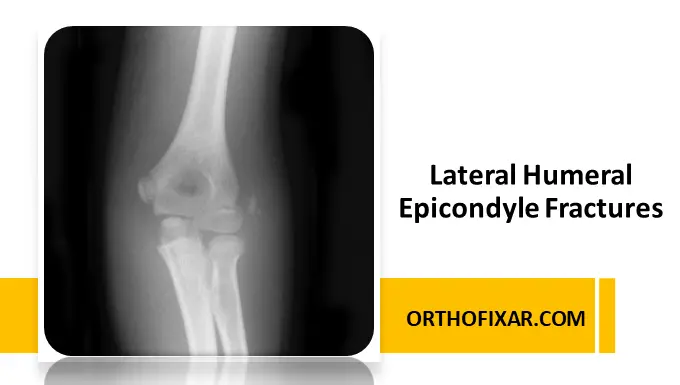
Lateral humeral epicondyle fractures are extremely rare pediatric elbow injuries involving the lateral epicondylar apophysis of the distal humerus. These injuries are important because they may mimic normal ossification centers on radiographs and can occasionally lead to fragment incarceration or symptomatic nonunion.
Unlike the more common pediatric supracondylar or lateral condyle fractures, lateral epicondyle fractures are typically avulsion-type injuries caused by traction from the common extensor musculature.
Epidemiology
- The lateral epicondyle fractures are extremely rare injury in children.
- Usually occur in older children and adolescents because the ossification center appears later in development
- Can be associated with sports injuries or direct trauma to the elbow
Anatomy
The lateral epicondyle serves as the origin of several wrist and forearm extensor muscles, including the common extensor tendon.
Key anatomical points include:
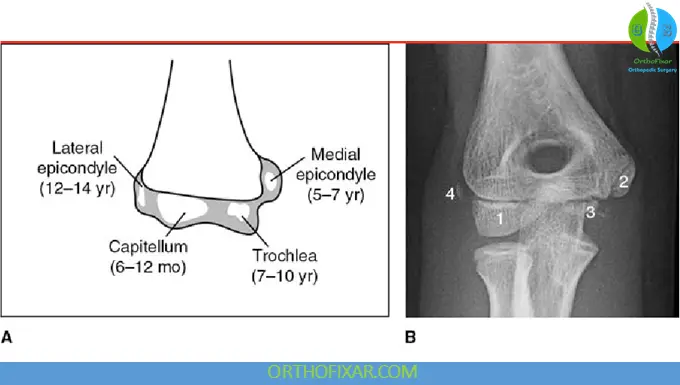
- The lateral epicondylar ossification center appears at approximately 10 to 11 years of age
- Ossification is not fully completed until the second decade of life
- The strong attachment of the extensor musculature predisposes the fragment to avulsion and distal displacement after injury
Because of delayed ossification, radiographic interpretation can be challenging in younger patients.
See Also: Elbow Anatomy
Mechanism of Injury
Lateral humeral epicondyle fractures may result from either direct or indirect trauma.
Direct Trauma
A direct blow to the lateral elbow may produce:
- Isolated fractures
- Comminuted fracture patterns
- Associated soft tissue injury
Indirect Trauma
Indirect injuries commonly occur through:
- Forced volar flexion of an extended wrist
- Sudden traction from the forearm extensor muscles
- Avulsion of the lateral epicondylar apophysis
The extensor musculature may pull the fragment distally, resulting in significant displacement.
See Also: Pediatric Elbow – Lateral Condyle Fractures
Clinical Evaluation
Patients with a lateral epicondyle fracture usually present with:
- Lateral elbow swelling
- Painful elbow motion
- Wrist pain with movement
- Tenderness over the lateral epicondyle
- Decreased wrist or finger extension strength
Loss of extensor strength may indicate substantial displacement or soft tissue involvement.
A careful neurovascular examination should always be performed.
See Also: Elbow X-Ray Views
Radiographic Evaluation
Standard imaging includes:
- Anteroposterior (AP) elbow radiograph
- Lateral elbow radiograph
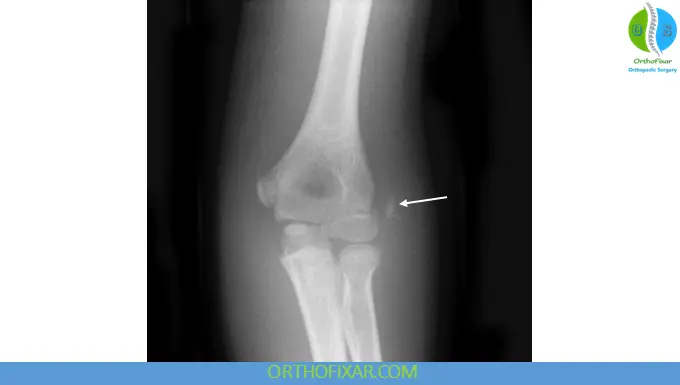
The diagnosis is most commonly visible on the AP view.
Important Radiographic Considerations
The lateral epicondylar physis normally appears as a linear radiolucency along the lateral distal humerus and may be mistaken for a fracture.
Features favoring fracture include:
- Overlying soft tissue swelling
- Cortical disruption
- Fragment displacement
- Correlation with focal tenderness on examination
The lateral radiograph is important to identify:
- Associated elbow injuries
- Intra-articular fragment incarceration
- Elbow instability
Classification
There is no universally accepted classification system for lateral epicondylar fractures. These injuries are generally described according to:
Descriptive Classification
Avulsion Fractures
Produced by traction from the extensor origin.
Comminuted Fractures
Usually associated with direct trauma.
Displaced Fractures
Fragment displacement may occur because of muscular pull.
Lateral Epicondyle Fractures Treatment
Nonoperative Management
Most pediatric lateral epicondyle fracture can be managed conservatively.
Indications
- Nondisplaced fractures
- Minimally displaced avulsion injuries
- No intra-articular incarceration
Treatment Method
- Immobilization with the elbow flexed and forearm supinated
- Long arm cast or splint
Duration
- Typically 2 to 3 weeks
- Continued until pain and tenderness improve
Outcomes are generally excellent with conservative treatment.
Operative Management
Surgical treatment is uncommon but indicated in select cases.
Indications
- Incarcerated fragment within the elbow joint
- Large displaced fragments
- Persistent mechanical symptoms
- Symptomatic instability
Surgical Options
Fragment Excision
Small incarcerated fragments may be excised.
Internal Fixation
Large fragments with attached tendinous origins may be repaired using:
- Screws
- Kirschner wires (K-wires)
Postoperative immobilization is generally maintained for:
- 2 to 3 weeks
- Followed by gradual mobilization
Complications
Nonunion
Fibrous nonunion is relatively common radiographically but rarely symptomatic.
Most patients maintain:
- Normal elbow function
- Full activity
- Minimal pain
Symptomatic nonunion is uncommon.
Incarcerated Fragments
Fragments trapped within the joint may produce:
- Mechanical block to motion
- Painful range of motion
- Limited extension
The radiocapitellar joint is the most common location for incarceration, although fragments may migrate into the olecranon fossa.
Prognosis
The prognosis for pediatric lateral humeral epicondyle fractures is generally favorable.
Most children:
- Heal uneventfully
- Recover normal elbow function
- Return to sports and activities without limitation
Poor outcomes are uncommon and are usually related to:
- Missed diagnosis
- Persistent intra-articular fragments
- Mechanical restriction of motion
Differential Diagnosis
Conditions that may mimic lateral epicondylar fractures include:
- Normal lateral epicondylar ossification center
- Lateral condyle fractures
- Elbow sprain
- Osteochondral injuries
- Capitellar fractures
Careful clinical-radiographic correlation is essential.
Key Clinical Pearls
- Lateral humeral epicondyle fractures are extremely rare in children.
- The injury is commonly an avulsion fracture caused by extensor muscle traction.
- The normal ossification center can mimic a fracture on radiographs.
- Most injuries are treated successfully with immobilization alone.
- Intra-articular incarceration is the main indication for surgery.
- Fibrous nonunion is common radiographically but rarely clinically significant.
Conclusion
Lateral humeral epicondyle fractures are rare pediatric elbow injuries that require careful radiographic interpretation and clinical assessment. Most fractures are stable avulsion injuries that respond well to conservative treatment with short-term immobilization. Surgical intervention is reserved for incarcerated or significantly displaced fragments. Early recognition and appropriate management usually lead to excellent functional outcomes.
References & More
- Higashi T, Takase F, Kanatani T. Lateral epicondyle fracture presenting severe elbow instability in adolescence: a case report. JSES Int. 2025 Mar 27;9(4):1396-1399. doi: 10.1016/j.jseint.2025.02.024. PMID: 40959027; PMCID: PMC12434976. Pubmed
- Higashi T, Takase F, Kanatani T. Lateral epicondyle fracture presenting severe elbow instability in adolescence: a case report. JSES Int. 2025 Mar 27;9(4):1396-1399. doi: 10.1016/j.jseint.2025.02.024. PMID: 40959027; PMCID: PMC12434976. Pubmed
- Murnaghan JM, Thompson NS, Taylor TC, Cosgrove A, Ballard J. Fractured lateral epicondyle with associated elbow dislocation. Int J Clin Pract. 2002 Jul-Aug;56(6):475-7. PMID: 12166547. Pubmed
- Egol KA. Handbook of fractures. 6th ed. Philadelphia: Lippincott Williams & Wilkins; 2019.