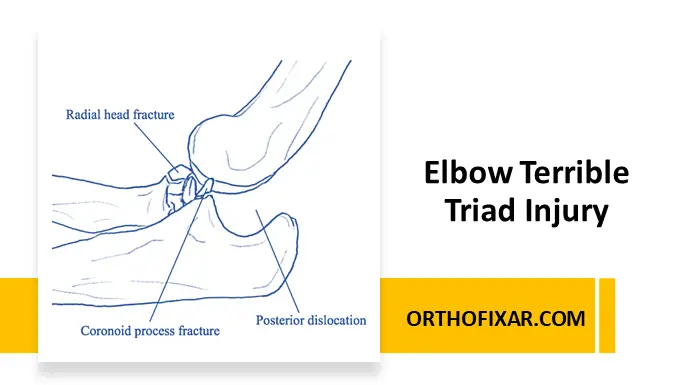
The elbow terrible triad injury is a severe and unstable fracture–dislocation pattern consisting of three key components:
- Elbow dislocation
- Radial head (or neck) fracture
- Coronoid process fracture
This injury pattern was described by Hotchkiss in 1996 and is termed “terrible” due to its historically poor outcomes and high complication rates.
Epidemiology & Clinical Significance
- Represents a complex elbow instability pattern
- Frequently associated with significant soft tissue injury (capsule and ligaments)
- Often leads to functional impairment if not treated appropriately
The elbow is inherently a stable joint; therefore, disruption of both bony and ligamentous stabilizers results in marked instability.
See Also: Elbow Joint Anatomy
Mechanism of Injury
Typically caused by:
- Fall on an outstretched hand (FOOSH)
- Axial load applied to an extended elbow
- Combined valgus stress + forearm rotation + axial compression
This leads to sequential failure of stabilizing structures:
- Lateral collateral ligament complex
- Radial head
- Coronoid process
Pathoanatomy
The Elbow Terrible Triad Injury disrupts both:
1. Primary bony stabilizers
- Radial head → resists valgus and axial load
- Coronoid process → prevents posterior displacement
2. Soft tissue stabilizers
- Lateral collateral ligament (LCL)
- Medial collateral ligament (MCL)
- Joint capsule
Loss of these structures results in gross elbow instability.
Clinical Presentation
Patients typically present with:
- Severe elbow pain and swelling
- Visible deformity (due to dislocation)
- Limited range of motion
- Possible neurovascular symptoms (e.g., ulnar nerve involvement)
Diagnosis
Imaging
- X-ray: confirms dislocation and fractures
- CT scan: essential for detailed fracture assessment and surgical planning
Clinical assessment
- Evaluate joint stability after reduction
- Assess neurovascular status
See Also: Elbow X-Ray Views
Elbow Terrible Triad Injury Treatment
Initial Treatment
- Urgent closed reduction of dislocated elbow
- Immobilization in flexion
See Also: Nursemaid Elbow reduction
Definitive treatment
Most Terrible Triad Injury cases require surgical management due to instability:
- Open reduction and internal fixation (ORIF) of coronoid
- Radial head fixation or replacement
- LCL repair (essential step)
- MCL repair if instability persists
Non-operative management (selected cases)
Only considered when:
- Joint is stable after reduction
- Fractures are small and non-displaced
- Early motion is possible
Rehabilitation
- Early range of motion (ROM) is critical
- Avoid prolonged immobilization to prevent stiffness
- Progressive strengthening begins after ~6 weeks
Complications
Elbow Terrible triad injuries are associated with high complication rates, including:
- Elbow stiffness (most common)
- Post-traumatic arthritis
- Recurrent instability
- Heterotopic ossification
- Ulnar neuropathy
- Nonunion or fixation failure
- Infection
Reoperation rates can be significant, reported up to ~22–30% or higher in some series.
Prognosis
- Outcomes have improved with modern surgical protocols.
- However, residual stiffness and functional limitation are common after Elbow Terrible Triad Injury.
- Early diagnosis, anatomical repair, and early mobilization are key to better outcomes.
Key Clinical Takeaways
- Despite advances, complications remain frequent, requiring careful follow-up
- The elbow terrible triad is a highly unstable elbow injury requiring urgent attention
- Surgical stabilization is the mainstay of treatment in most cases
- Early mobilization is crucial to avoid stiffness
References & More
- Stevens KA, Tiwari V. Terrible Triad of the Elbow. [Updated 2023 Aug 3]. In: StatPearls [Internet]. Treasure Island (FL): StatPearls Publishing; 2026 Jan-. Available from: Pubmed
- Fahs A, Waldron J, Afsari A, Best B. Management of Elbow Terrible Triad Injuries: A Comprehensive Review and Update. J Am Acad Orthop Surg. 2024 Oct 1;32(19):e982-e995. doi: 10.5435/JAAOS-D-24-00310. Epub 2024 Aug 13. PMID: 39151182. Pubmed
- Egol KA. Handbook of fractures. 6th ed. Philadelphia: Lippincott Williams & Wilkins; 2019.