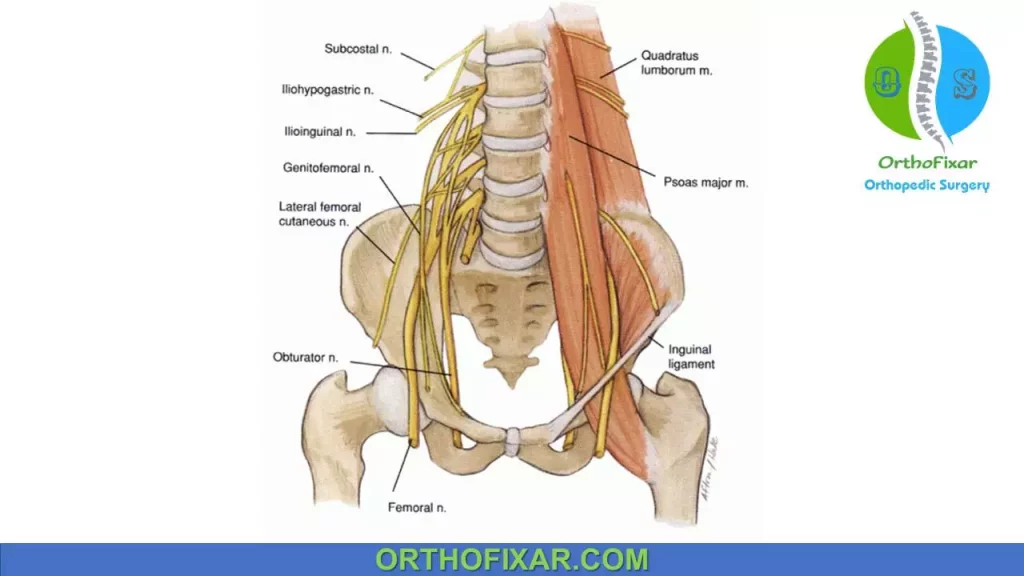
Prone Knee Bending Test (known as reversed Lasegue test) is used to evaluate the nerve roots of the upper lumbar spine (L2 to L4) especially the femoral nerve.
How to Perform the Prone Knee Bending Test?
- The patient is positioned prone, and the clinician stabilizes the ischium to prevent an anterior rotation of the pelvis.
- The clinician then gently moves the lower extremity into knee flexion, bending the knee until the onset of symptoms. If the examiner is unable to flex the patient’s knee past 90° because of a pathological condition in the knee, the test may be performed by passive extension of the hip while the knee is flexed as much as possible.
- The flexed knee position should be maintained for 45 to 60 seconds.
- This maneuver is likely to produce a stretching sensation on the anterior aspect of the patient’s thigh.
See Also: Lasegue Test
Prone knee bending test can also be carried out with the patient in the lateral position. The patient lies on the unaffected side with the affected extremity slightly flexed at the hip and knee. The examiner fixes the pelvis with one hand and grasps the patient’s knee with the other and move the hip into a hyperextended position while increasingly flexing the knee.
The zone at which the dura is stretched is 80–100 degrees of knee flexion. Knee flexion greater than 100% introduces both a rectus femoris stretch and lumbar spine motion into the findings. A number of sensitizing maneuvers can be used including hip extension, plantar flexion, dorsiflexion, or head movements.
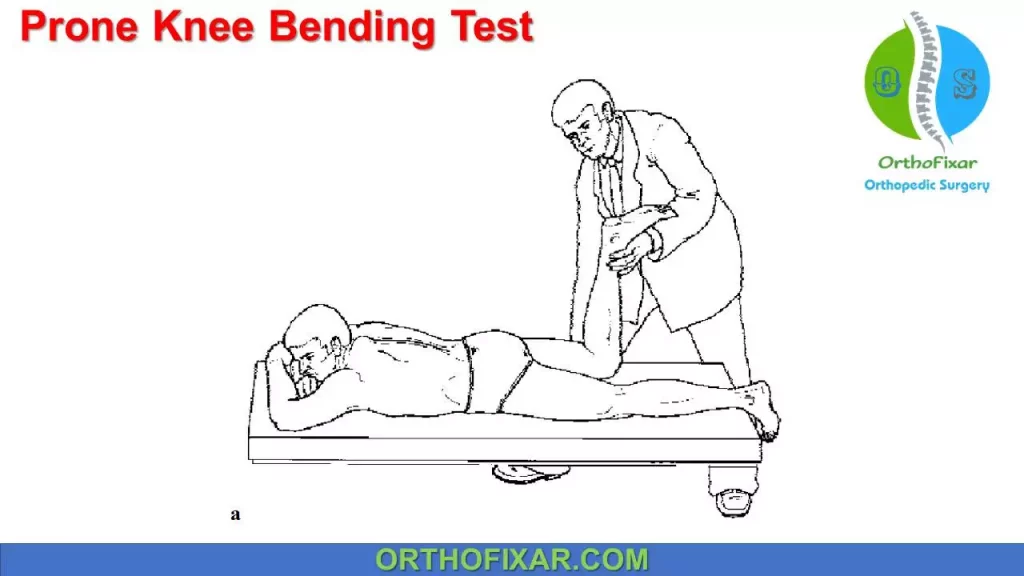
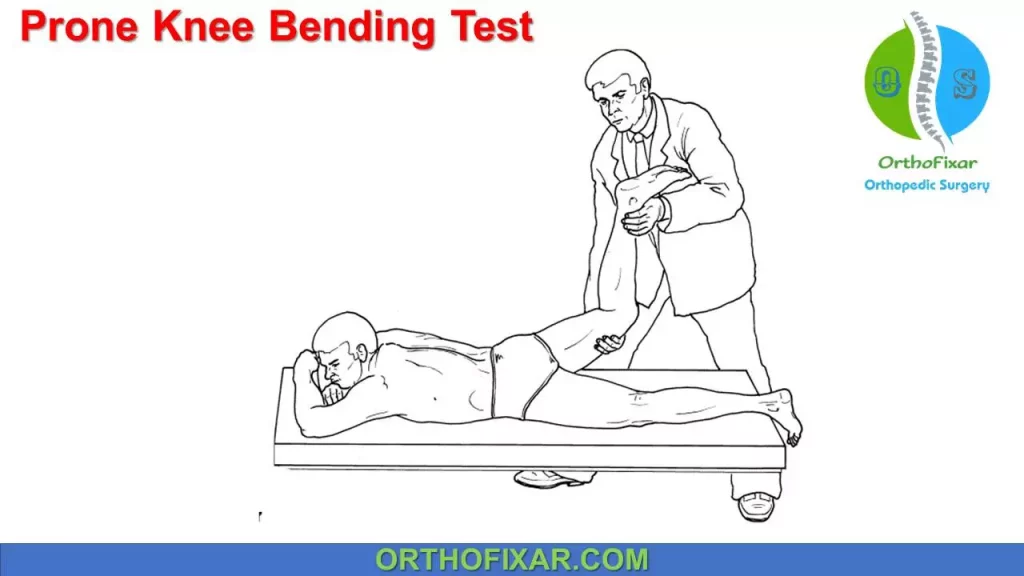
What does a positive Prone Knee Bending Test mean?
- Hyperextension of the hip with the knee flexed places traction on the femoral nerve.
- Prone Knee Bending Test is positive if there is unilateral or bilateral radicular pain in the sacrum or anterior thigh and rarely in the lower leg is a sign of nerve root irritation, such as a herniated disk, in the L3/L4 spinal column segment.
- Pain in the anterior thigh indicates tight quadriceps muscles or stretching of the femoral nerve. A careful history and pain differentiation can help to delineate the problem. If the rectus femoris is tight, the examiner should remember that taking the heel to the buttock may cause anterior torsion to the ilium, which could lead to sacroiliac or lumbar pain.
See Also: Thomas Test
Prone Knee Bending Test Accuracy
The reliability and validity of the Prone Knee Bending Test is not known.
Porchet and colleagues found the test to have:
- Sensitivity: 84%
Crossed Prone Knee Bending Test
This is a variation of the Prone Knee Bending Test except that the uninvolved lower extremity is moved into knee flexion. A positive test is the reproduction of the patient’s symptoms in the untested (opposite) leg.
No diagnostic accuracy studies have been performed to determine the sensitivity and specificity of this test.
Notes
- As with the Lasegue test, symptoms may also occur on the opposite side, which is then referred to as a crossed femoral stretching test.
- Pain in the groin and hip region radiating along the medial side of the thigh suggests an L3 origin, while pain over the anterior lower leg indicates an L4 problem.
- Prone Knee Bending Test is similar to the Ober test used to evaluate a contracted, shortened iliotibial band. A tight iliotibial band does not allow the leg to adduct to any significant degree, and is often pain free. If pain is present, it is localized over the greater trochanter proximally and the lateral condyle distally.
- Femoral nerve pain usually has a different history and is normally more distinct and dermatome-related.
- In the case of a disk herniation at the L3/L4 level, there is weakness of the quadriceps muscle combined with an absent or weakened patellar tendon reflex.
- The femoral nerve travels anteriorly to both the hip and the knee (as does the rectus femoris). Therefore, the nerve roots and the rectus femoris are stretched with a combination of knee flexion and hip extension. The lateral cutaneous nerve of the thigh and the hip flexors travel anterior to the thigh and may be stressed with the hip extension component of this maneuver.
See Also: Ober test
Reference
- Davis DS, Anderson IB, Carson MG, Elkins CL, Stuckey LB. Upper Limb Neural Tension and Seated Slump Tests: The False Positive Rate among Healthy Young Adults without Cervical or Lumbar Symptoms. J Man Manip Ther. 2008;16(3):136-41. doi: 10.1179/jmt.2008.16.3.136. PMID: 19119402; PMCID: PMC2582423. PubMed
- Herron LD, Pheasant HC. Prone knee-flexion provocative testing for lumbar disc protrusion. Spine. 1980;5:65–67. PubMed
- Deyo RA, Rainville J, Kent DL: What can the history and physical examination tell us about low back pain? JAMA 268:760–765, 1992. PMID: 1386391. PubMed
- Postacchini F, Cinotti G, Gumina S. The knee flexion test: a new test for lumbosacral root tension. J Bone Joint Surg Br. 1993;75:834–835.
- Clinical Tests for the Musculoskeletal System, Third Edition book.
- Mark Dutton, Pt . Dutton’s Orthopaedic Examination, Evaluation, And Intervention, 3rd Edition Book.