The Slocum Test is a specialized clinical examination used to assess anterior rotary instability of the knee, particularly differentiating between anterolateral rotary instability (ALRI) and anteromedial rotary instability (AMRI). It is an extension of the anterior drawer concept, with controlled tibial rotation allowing more precise localization of ligamentous injury.
The Slocum test evaluates:
- Combined anterior translation and rotational instability
- Integrity of the ACL in conjunction with capsuloligamentous structures
- Direction-specific instability (medial vs lateral compartment)
It is especially useful in patients with suspected complex knee instability rather than isolated ligament injury.
How to Perform the Slocum Test?
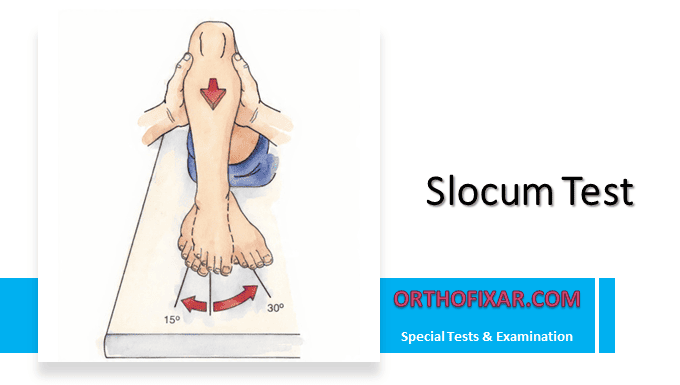
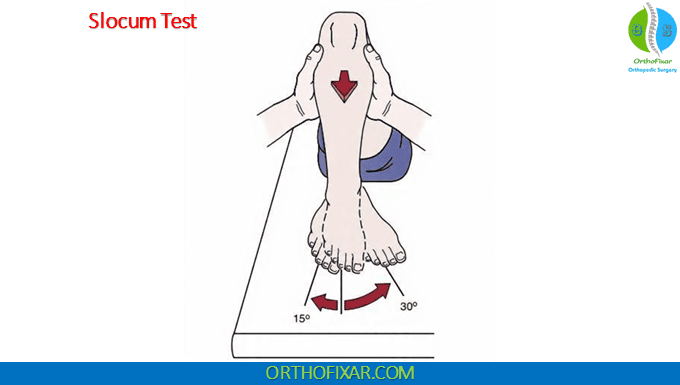
The patient lies supine with the knee is flexed to 80–90 degrees and the hip is flexed to approximately 45 degrees while the examiner stabilizes the foot by sitting on the forefoot.
Slocum Test for Anterolateral Rotary Instability (ALRI):
Position the foot in 30 degrees of medial (internal) rotation and stabilize the foot firmly then apply an anterior force to the proximal tibia.
The test is positive when excessive anterior movement occurs primarily on the lateral side of the knee. Movement is increased compared to the contralateral, uninjured knee.
A positive ALRI suggests injury to one or more of the following:
- Anterior cruciate ligament (ACL)
- Posterolateral capsule
- Arcuate–popliteus complex
- Lateral collateral ligament (LCL)
- Posterior cruciate ligament (PCL)
- Iliotibial band (IT band)
If ALRI is clearly present during this first phase, the diagnostic value of the second phase (AMRI assessment) is reduced.
Slocum Test for Anteromedial Rotary Instability (AMRI)
This is also known as Lemaire’s T Drawer Test: Position the foot in 15 degrees of lateral (external) rotation and apply an anterior force to the tibia.
The test is positive when excessive anterior movement occurs primarily on the medial side of the knee. Movement is greater than on the unaffected side.
A positive AMRI indicates possible injury to:
- Medial collateral ligament (MCL): Particularly the superficial fibers
- Posterior oblique ligament
- Posteromedial capsule
- Anterior cruciate ligament (ACL)
For the Slocum test to be valid, tibial rotation must be precisely controlled.
- Over-rotation tightens remaining intact structures
- Excessive rotation may produce a false-negative test
- The foot must be rotated only to the specified degrees
Stress Radiographic Interpretation
When stress radiographs are obtained during the Slocum test, injury severity may be graded as follows:
- Minimal or no movement → Negative test
- ≤ 1 mm translation → Grade I injury
- 1–2 mm translation → Grade II injury
- > 2 mm translation → Grade III injury
Alternative Sitting Position Technique
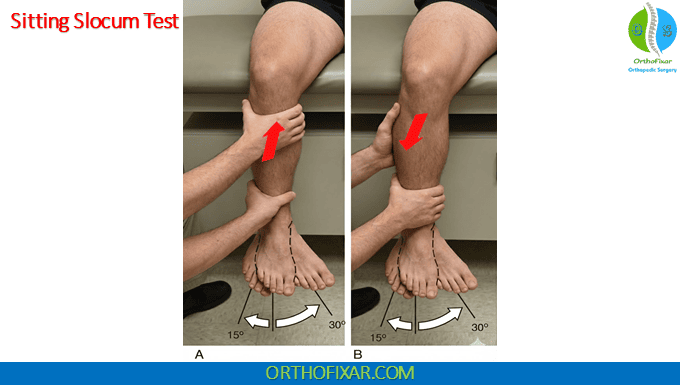
- The Slocum test may also be performed with the patient sitting and Knees is flexed over the edge of the examination table.
- Examiner apply anterior force → tests anterior rotary instability
- Apply posterior force → tests posterior rotary instability (related to the Hughston posteromedial and posterolateral drawer signs)
- Compare medial vs lateral compartment movement: Excessive side-specific movement compared to the normal knee indicates a positive test.
The Slocum test should always be interpreted in conjunction with:
- Lachman test
- Pivot shift test
- Valgus stress tests
- Varus stress tests
- Imaging studies when indicated
References & More
- Slocum DB, Larson RL. Rotary instability of the knee. J Bone Joint Surg Am. 1968;50:211–225. PubMed
- Slocum DB, James SL, Larson RL, et al. A clinical test for anterolateral rotary instability of the knee. Clin Orthop. 1976;118:63–69. PubMed
- Kennedy JC. The Injured Adolescent Knee. Baltimore: Williams & Wilkins; 1979.
- Muller W. The Knee: Form, Function and Ligament Reconstruction. New York: Springer-Verlag; 1983.
- Orthopedic Physical Assessment by David J. Magee, 7th Edition.