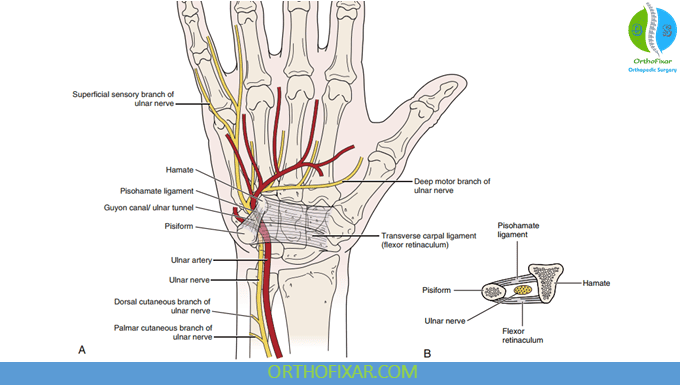
The Guyon canal (also called the pisohamate canal) is a fibro-osseous tunnel at the wrist where the ulnar nerve passes between the pisiform and the hook of hamate. Compression of the ulnar nerve in this space is known as Guyon canal syndrome or ulnar tunnel syndrome.
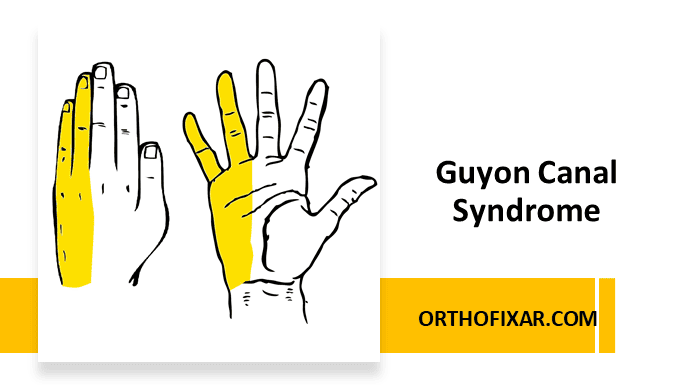
The Guyon canal is a fibro-osseous tunnel bounded medially by the pisiform bone and laterally by the hook of the hamate bone, creating a confined space through which both the ulnar nerve and ulnar artery must traverse. Within the canal, the ulnar nerve divides into its terminal superficial sensory branch, which supplies the fourth and fifth digits, and the deep motor branch, which innervates the intrinsic muscles of the hand.
See Also: Ulnar Nerve Anatomy
Causes of Guyon canal syndrome
Ulnar nerve compression at the wrist can occur due to:
- Trauma: such as fracture of the hook of hamate (common in racquet sports).
- Chronic pressure: for example, long-distance cycling with pressure on handlebars (cyclist’s palsy) or prolonged crutch use.
- Repetitive activities: e.g., pneumatic jackhammer operation.
- Space-occupying lesions: ganglion cysts, tumors, or vascular abnormalities.
Clinical Features
Sensory Symptoms
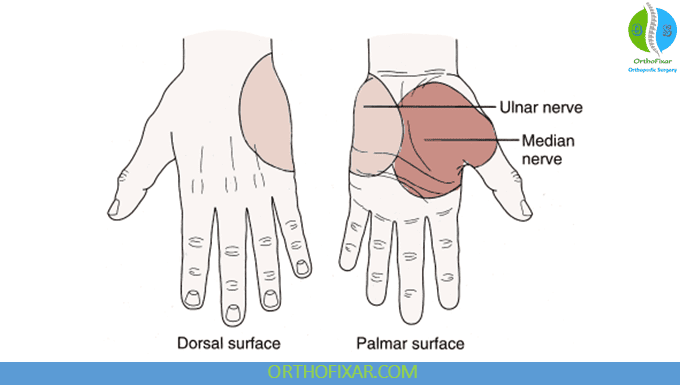
The ulnar nerve branches to the palm and dorsum arise before the canal. Therefore, sensation loss in Guyon canal syndrome affects only the fingers (ring and little finger). Pure sensory symptoms without finger involvement suggest compression proximal to the canal.
Motor Symptoms
Primary findings are motor deficits due to compression inside the Guyon Canal:
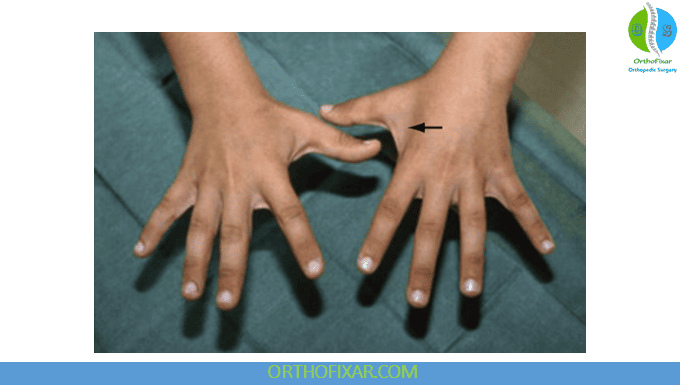
- Weakness of the hypothenar muscles (flexor digiti minimi, abductor digiti minimi, opponens digiti minimi).
- Weakness of adductor pollicis.
- Weakness of interossei muscles.
- Weakness of the medial two lumbricals.
- Weakness of palmaris brevis.
Diagnostic Test
Direct pressure over the Guyon canal may reproduce or worsen symptoms, known as the Guyon canal compression test (also referred to as cyclist’s palsy test).
Testing grip strength, pinch strength, and specific intrinsic muscle function helps quantify the degree of motor impairment. The presence of Froment’s sign, indicating weakness of the adductor pollicis muscle, provides additional diagnostic confirmation.
Electrodiagnostic studies remain essential for definitive diagnosis and localization of the compression site. Nerve conduction studies can demonstrate slowing of conduction velocity across the canal, while electromyography may reveal evidence of muscle denervation in the distribution of the deep motor branch of the ulnar nerve. These studies also help differentiate Guyon canal syndrome from more proximal ulnar nerve compression at the elbow or cervical spine.
Imaging studies complement the clinical and electrodiagnostic evaluation. Ultrasound provides excellent visualization of soft tissue structures and can identify space-occupying lesions or swelling within the canal. MRI offers superior detail for complex cases and can evaluate for subtle structural abnormalities. When bony trauma is suspected, particularly hook of hamate fractures, CT scanning provides optimal bony detail.
Treatment of Guyon Canal Syndrome
Non-Surgical Management
- Activity modification: Avoid prolonged pressure on the wrist (cycling handlebars, crutch use, repetitive tools).
- Wrist splinting: To reduce compression and allow nerve recovery.
- NSAIDs: For pain and inflammation.
- Ergonomic adjustments: Use padded gloves, cushioned grips, or modify hand position.
Surgical Management
Indicated for persistent or severe cases, or when caused by a structural lesion:
- Surgical decompression of the Guyon canal.
- Removal of space-occupying lesions (ganglion cyst, tumor, vascular lesion).
- Fracture fixation or excision (e.g., excision of fractured hook of hamate if compressing the nerve).
FAQ
What is Guyon canal syndrome?
Guyon canal syndrome, also known as ulnar tunnel syndrome, is compression of the ulnar nerve as it passes through the pisohamate (Guyon) canal at the wrist.
What causes Guyon canal syndrome?
Common causes include trauma (fractured hook of hamate), prolonged wrist pressure (cycling, crutches), repetitive vibration tools (jackhammers), and space-occupying lesions such as ganglion cysts or tumors.
What are the symptoms of ulnar tunnel syndrome?
Symptoms include numbness and tingling of the ring and little fingers, and weakness of ulnar-innervated hand muscles such as the hypothenar muscles, interossei, and adductor pollicis.
How is Guyon canal syndrome treated?
Treatment includes activity modification, splinting, NSAIDs, and ergonomic adjustments. In severe or persistent cases, surgical decompression or removal of space-occupying lesions may be required.
References & More
- Bachoura A, Jacoby SM. Ulnar tunnel syndrome. Orthop Clin North Am. 2012;43:467–474. PubMed
- Strohl AB, Zelouf DS. Ulnar tunnel syndrome, radial tunnel syndrome, anterior interosseous nerve syndrome and pronator syndrome. J Am Acad Orthop Surg. 2017;25(1):e1–e10. PubMed
- Popinchalk SP, Schaffer AA. Physical examination of upper extremity compressive neuropathies. Orthop Clin North Am. 2012;43:417–430. PubMed
- Xing SG, Tang JB. Entrapment neuropathy of the wrist, forearm and elbow. Clin Plast Surg. 2014;41(3):561–588. PubMed
- Orthopedic Physical Assessment by David J. Magee, 7th Edition.