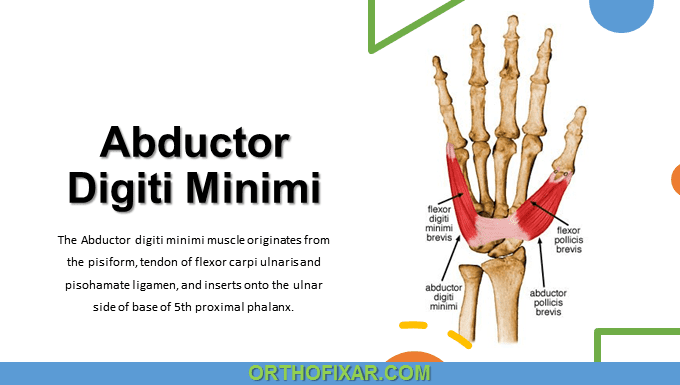
The abductor digiti minimi (ADM) is a key intrinsic muscle of the hand located in the hypothenar compartment, responsible for movements of the little finger. It plays an essential role in grip, dexterity, and fine motor coordination, particularly in actions requiring stabilization and spreading of the fingers.
Anatomical Location and Classification
The abductor digiti minimi belongs to the hypothenar muscle group, which includes:
- Abductor digiti minimi
- Flexor digiti minimi brevis
- Opponens digiti minimi
It forms the most medial (ulnar) muscle of the hand and is superficial, making it clinically and surgically relevant.
Abductor Digiti Minimi Muscle Anatomy
The Abductor digiti minimi muscle originates from the pisiform, tendon of flexor carpi ulnaris and pisohamate ligament, and inserts onto the ulnar side of base of 5th proximal phalanx.
The Abductor Digiti Minimi of the hand often presents anatomical variations, including accessory slips or fusion with adjacent hypothenar muscles—important in surgical anatomy.
Innervation and Blood Supply
Innervation
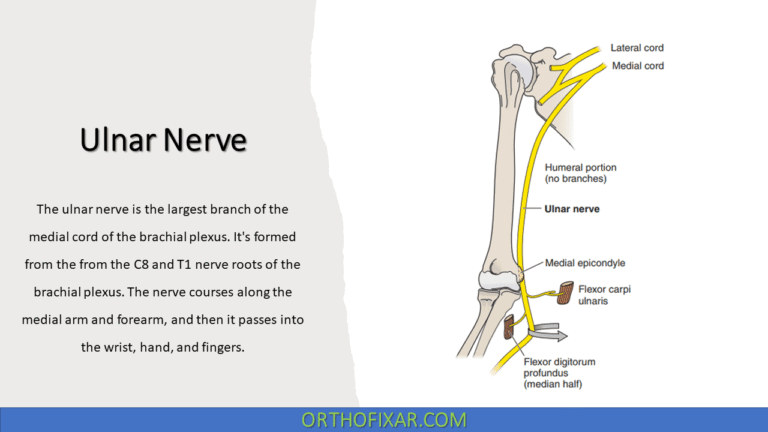
- Deep branch of the ulnar nerve (C8–T1)
Blood Supply
- Ulnar artery, particularly via:
- Deep palmar arch
- Ulnar recurrent branches
Function
The primary actions of the abductor digiti minimi include:
- Abduction of the little finger at the metacarpophalangeal (MCP) joint
- Assists in flexion of the 5th digit
- Contributes to ulnar deviation of the hand during complex grip patterns
Functional Significance
- Plays a role in precision grip and opposition movements
- Enhances power grip (e.g., holding tools)
- Stabilizes the ulnar side of the hand
See Also: Hand Anatomy, Bones & Muscles

| Origin | Pisiform, tendon of flexor carpi ulnaris and pisohamate ligamen |
| Insertion | Medial side of base of proximal phalanx of little finger |
| Innervation | Deep branch of ulnar nerve (C8 and T1) |
| Blood Supply | Ulnar artery |
| Action | Abducts little (5th) finger at the MCP joint |
Clinical Relevance
1. Ulnar Nerve Injury
Damage to the ulnar nerve (e.g., at Guyon’s canal) can lead to:
- Weakness or loss of abduction of the little finger
- Hypothenar muscle atrophy
- Clawing of the 4th and 5th digits
2. Guyon’s Canal Syndrome
Compression of the ulnar nerve at the wrist results in:
- Sensory loss in the ulnar digits
- Weak ADM function
- Reduced grip strength
3. ADM Hypertrophy or Variation
Rarely, hypertrophy or accessory ADM muscles may cause:
- Nerve compression syndromes
- Diagnostic confusion on imaging (MRI/ultrasound)
4. Surgical Importance
- Landmark for ulnar nerve decompression procedures
- Relevant in hand reconstructive surgery
References & More
- Cael, C. (2010). Functional anatomy: Musculoskeletal anatomy, kinesiology, and palpation for manual therapists. Philadelphia, PA: Wolters Kluwer Health/Lippincott, Williams & Wilkins.
- Moore, K. L., Dalley, A. F., & Agur, A. M. R. (2014). Clinically Oriented Anatomy (7th ed.). Philadelphia, PA: Lippincott Williams & Wilkins.
- Physiopedia – Abductor Digiti Minimi