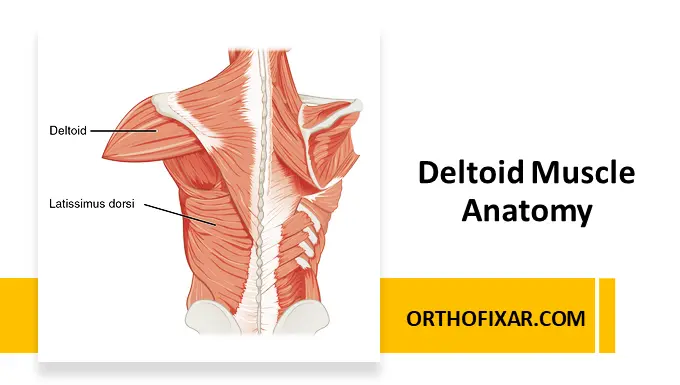
The deltoid muscle is a large triangular-shaped muscle located in the proximal upper extremity. It forms the rounded contour of the human shoulder. The borders of the deltoid are visible when the arm is abducted against resistance. The distal attachment of the deltoid can be palpated on the lateral surface of the humerus. Its name come from its shape, where it looks like the inverted Greek letter delta (Δ).
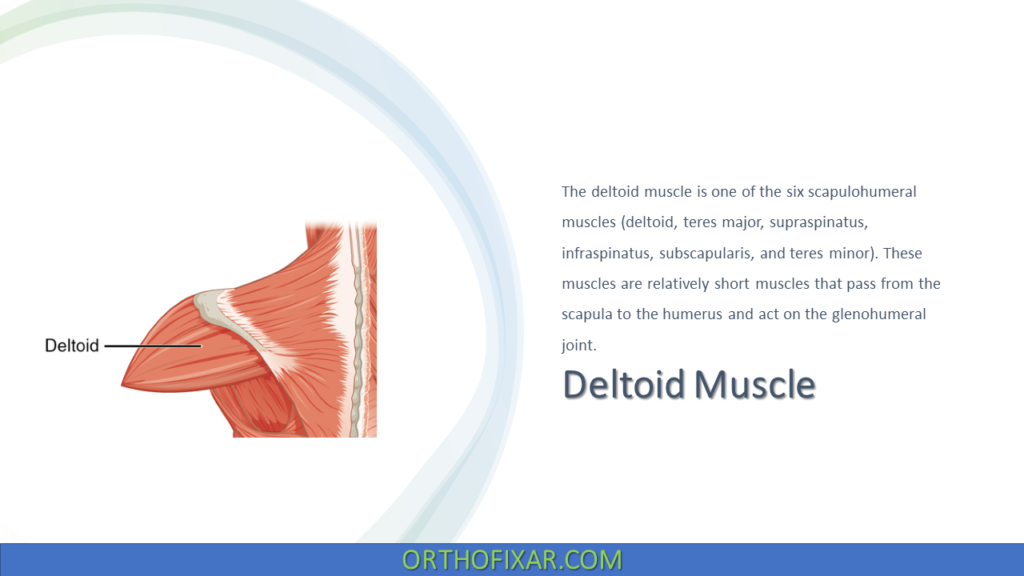
The deltoid muscle is one of the six scapulohumeral muscles (deltoid, teres major, supraspinatus, infraspinatus, subscapularis, and teres minor). These muscles are relatively short muscles that pass from the scapula to the humerus and act on the glenohumeral joint.
See Also: Scapula Anatomy
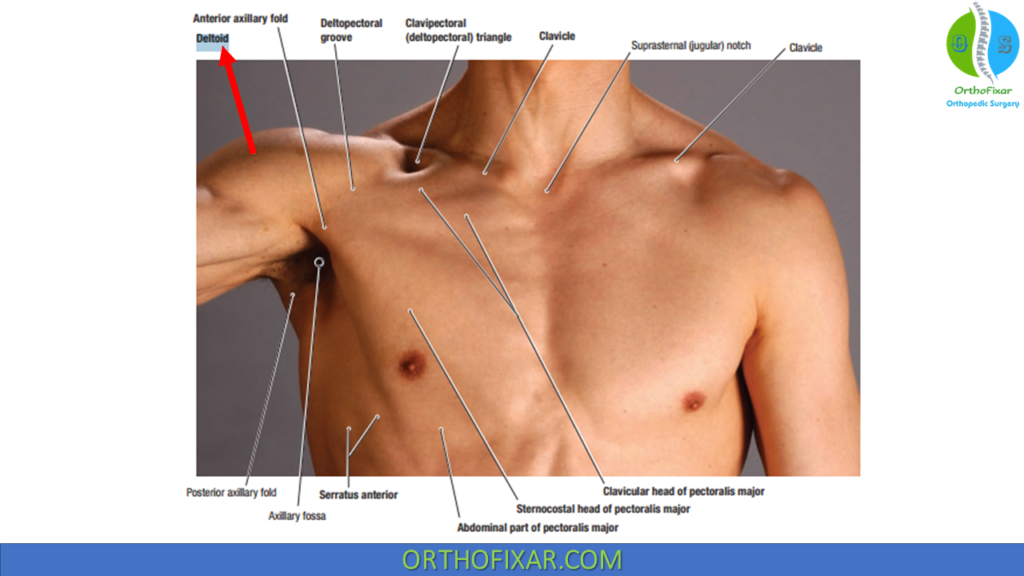
Deltoid Muscle Anatomy
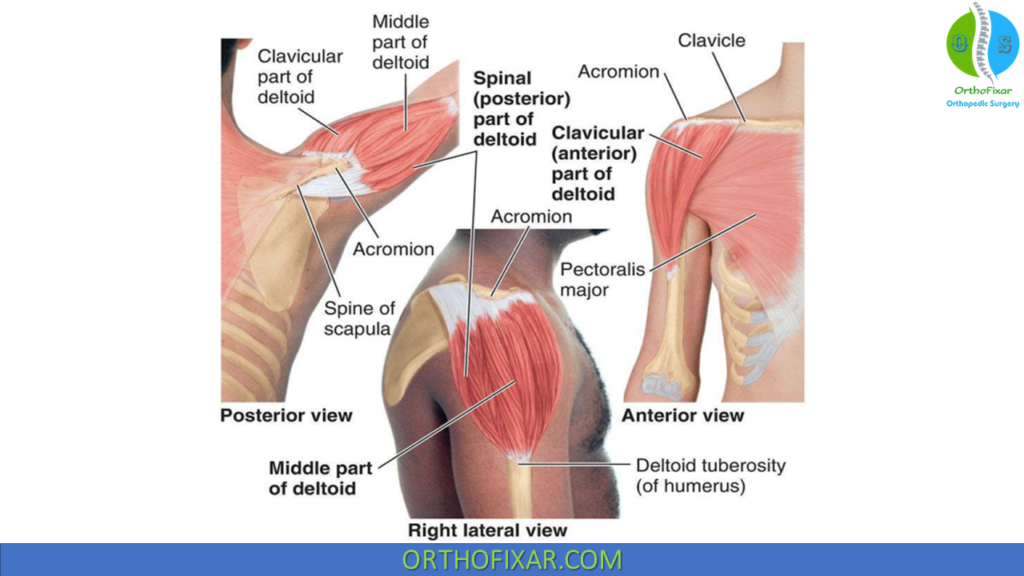
The deltoid muscle is divided into three segments, each with unique origins and actions:
1. Anterior (Clavicular) Part
- Located at the front of the shoulder
- Unipennate structure
- Responsible mainly for flexion and medial rotation
2. Middle (Acromial) Part
- The largest and strongest component
- Multipennate architecture
- Primary abductor of the arm
3. Posterior (Spinal) Part
- Located at the back of the shoulder
- Unipennate structure
- Responsible for extension and lateral rotation
These segments converge into a common tendon, giving the deltoid its characteristic triangular shape.
Deltoid Muscle Origin and Insertion
The Deltoid muscle has multiple origin based on its parts:
- Anterior part originates form the lateral third of clavicle,
- Middle part originates from the acromion,
- Posterior part originates from spine of scapula.
The three parts join together to insert on deltoid tuberosity of humerus.
See Also: Clavicle Anatomy | Bone & Muscles
Deltoid Muscle Function
The parts of the deltoid muscle can act separately or as a whole. When all three parts of the deltoid contract simultaneously, the arm is abducted.
Where when every part act separately, the actions are:
- Anterior part: flexes and medially rotates arm.
- Middle part: abducts arm.
- Posterior part: extends and laterally rotates arm.
To initiate movement during the first 15° of shoulder abduction, the deltoid muscle is assisted by the supraspinatus.
When the arm is fully adducted, the line of pull of the deltoid muscle coincides with the axis of the humerus; thus, it pulls directly upward on the bone and cannot initiate or produce abduction. It is, however, able to act as a shunt muscle, resisting inferior displacement of the head of the humerus from the glenoid cavity, as when lifting and carrying suitcases.
From the fully adducted position, abduction must be initiated by the supraspinatus, or by leaning to the side, allowing gravity to initiate the movement. The deltoid muscle becomes fully effective as an abductor after the initial 15° of abduction.
The anterior and posterior parts of the deltoids are used to swing the limbs during walking. The anterior part assists the pectoralis major in flexing the arm, and the posterior part assists the latissimus dorsi in extending the arm. The deltoid muscle also helps stabilize the glenohumeral joint and hold the head of the humerus in the glenoid cavity during movements of the upper limb.
| Segment | Primary Actions |
|---|---|
| Anterior | Flexion, medial rotation |
| Middle | Abduction |
| Posterior | Extension, lateral rotation |
Innervation & Blood Supply
The deltoid is innervated by the axillary nerve (C5 and C6) (C5, C6). The blood supply to deltoid comes from the deltoid branch of thoracoacromial artery.
See Also: Brachial Plexus Anatomy
| Origin | Lateral third of clavicle, acromion, and spine of scapula |
| Insertion | Deltoid tuberosity of humerus |
| Innervation | Axillary nerve (C5 and C6) |
| Blood Supply | Deltoid branch of thoracoacromial artery |
| Action | Anterior part: flexes and medially rotates arm Middle part: abducts arm Posterior part: extends and laterally rotates arm |
Clinical Significance
1. Deltoid Muscle Injuries
- Strains from overuse or trauma
- Often associated with rotator cuff pathology
2. Axillary Nerve Injury
- Can occur in shoulder dislocations or fractures
- Leads to impaired abduction and sensory loss over the lateral shoulder
3. Surgical Relevance
- The deltoid is commonly encountered in shoulder surgeries, including arthroplasty
- Its insertion anatomy is critical for surgical approaches and fixation techniques
4. Intramuscular Injection Site
- The deltoid is a preferred site for vaccinations due to:
- Easy accessibility
- Adequate muscle mass
Muscle Testing
To test the deltoid muscle (or the function of the axillary nerve that supplies it), the arm is abducted, starting from approximately 15°, against resistance. If acting normally, the deltoid can easily be seen and palpated.

Summary
The deltoid muscle is a multifunctional, tri-segmented muscle essential for shoulder mobility and stability. Its:
- Broad origin (clavicle and scapula)
- Strong insertion (humerus)
- Distinct functional segments
make it one of the most important muscles in upper limb biomechanics.
References & More
- Elzanie A, Varacallo M. Anatomy, Shoulder and Upper Limb, Deltoid Muscle. [Updated 2023 May 8]. In: StatPearls [Internet]. Treasure Island (FL): StatPearls Publishing; 2023 Jan-. Available from: https://www.ncbi.nlm.nih.gov/books/NBK537056/
- Clinically Oriented Anatomy – 8th Edition