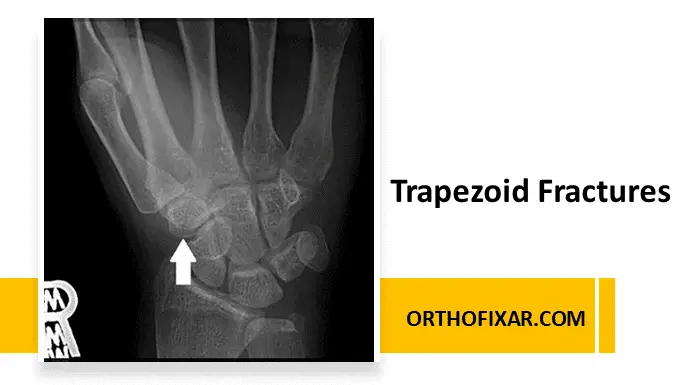
Trapezoid fractures are among the rarest injuries of the wrist, yet they require careful recognition and management to prevent long-term dysfunction.
The trapezoid is one of the eight carpal bones of the wrist, located in the distal row between the trapezium and capitate. Due to its protected position and strong ligamentous attachments, it is the least commonly fractured carpal bone.
However, when injury does occur, it is often associated with significant force or concurrent trauma to surrounding structures.
Mechanism of Injury
The trapezoid’s wedge-like shape and its deep “nesting” between the trapezium, capitate, and the second metacarpal provide significant stability. Most fractures occur through two primary mechanisms:
- Axial Loading: A force transmitted through the second metacarpal (often from a hard impact or fall) can drive the trapezoid out of its position. This frequently results in a dorsal dislocation accompanied by capsular ligament disruption.
- Direct Trauma: High-energy impacts, such as crush injuries or blast trauma, can cause fractures. These are rarely isolated and are often seen alongside other carpal or metacarpal injuries.
See Also: Scaphoid Fractures
Clinical Presentation
Patients with a trapezoid fracture typically present with localized symptoms at the base of the hand. Key clinical indicators include:
- Point Tenderness: Significant pain located just proximal to the base of the second metacarpal.
- Deformity: A variable dorsal prominence may be visible or palpable if the trapezoid has been dislocated.
- Functional Limitations: Range of motion at the second carpometacarpal (CMC) joint is usually painful and severely limited.
Diagnostic Imaging
Identifying a trapezoid fracture on standard imaging can be challenging due to the overlapping nature of the carpal bones.
- PA Radiographs: Diagnosis often relies on identifying a loss of the normal anatomical relationship between the second metacarpal base and the trapezoid. Comparing the injured wrist to the uninjured side is a critical diagnostic step.
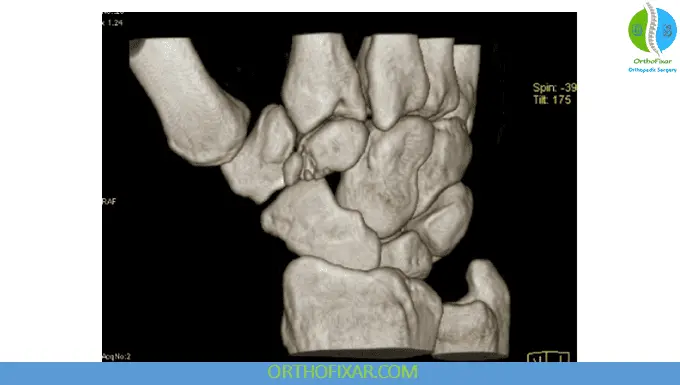
- Signs of Displacement: The second metacarpal may appear proximally and dorsally displaced, while trapezoid fragments may be superimposed over the capitate or trapezium.
- Advanced Imaging: If osseous details are obscured, Oblique views or a CT scan are highly recommended to visualize fracture lines and articular involvement clearly.
Treatment Options
The goal of treatment is to restore the articular congruity of the second CMC joint to prevent long-term functional loss.
Non-Surgical Management
For nondisplaced fractures, conservative treatment is often successful. This typically involves:
- Application of a splint or short arm cast.
- Immobilization for a period of 6 weeks.
Surgical Intervention
Open Reduction and Internal Fixation (ORIF) is indicated for displaced fractures, particularly those involving subluxation of the CMC joint. Surgical techniques include:
- Closed reduction with percutaneous pinning: Using Kirschner wires (K-wires) to stabilize the bone without a large incision.
- Open reduction: Using a standard dorsal approach to manually realign the fragments, followed by stabilization with K-wires or screws.
Potential Complications
The primary concern following a trapezoid fracture is the development of posttraumatic osteoarthritis. If the joint surface is not perfectly restored, the resulting friction at the second carpometacarpal articulation can lead to chronic pain and decreased grip strength over time.
Key Takeaways
- Trapezoid fractures are rare but clinically significant
- Often result from high-energy trauma or axial loading
- Diagnosis may be challenging due to overlapping anatomy
- CT imaging is frequently helpful
- Proper treatment is essential to prevent long-term joint degeneration
References & More
- Sadowski RM, Montilla RD. Rare isolated trapezoid fracture: a case report. Hand (N Y). 2008 Dec;3(4):372-4. doi: 10.1007/s11552-008-9100-8. Epub 2008 May 8. PMID: 18780025; PMCID: PMC2584218. Pubmed
- Nammour M, Desai B, Warren M, Godshaw B, Suri M. Approach to Isolated Trapezoid Fractures. Ochsner J. 2019 Fall;19(3):271-275. doi: 10.31486/toj.18.0157. PMID: 31528141; PMCID: PMC6735605. Pubmed
- Egol KA. Handbook of fractures. 6th ed. Philadelphia: Lippincott Williams & Wilkins; 2019.