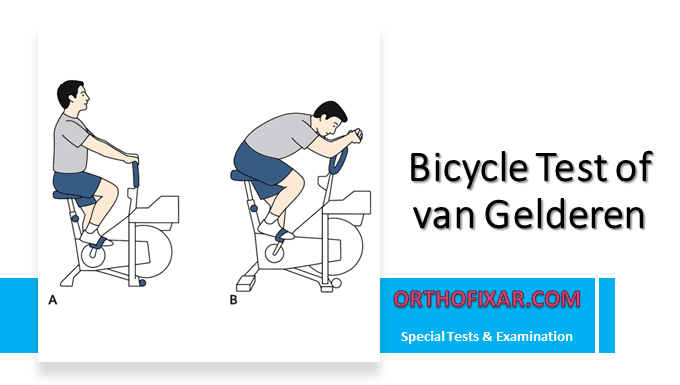
The Bicycle Test of van Gelderen is a valuable clinical tool used to differentiate neurogenic intermittent claudication from vascular claudication in patients presenting with lower limb pain during activity. It’s usefull in distinguishing between different causes of leg pain, particularly when evaluating patients with suspected spinal stenosis.
The key point of this test is that the lumbar extension narrows the spinal canal and increases nerve root compression, whereas lumbar flexion enlarges it—hence, symptom relief when leaning forward.
How to Perform the Bicycle Test?
The Bicycle Test is done with two phases:
Phase 1:
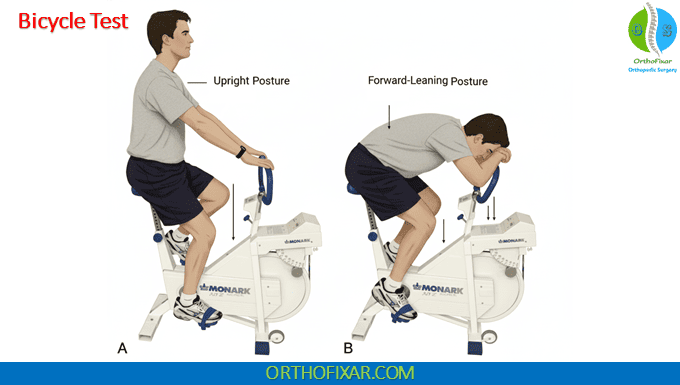
The patient is seated on an exercise bicycle and asked to pedal against resistance. They begin pedaling while leaning backward, thereby accentuating lumbar lordosis (spinal extension), in this position, the spinal canal diameter decreases, potentially compressing neural structures.
If pain develops in the buttock and posterior thigh, possibly followed by tingling in the affected limb, this phase is considered positive indicating neural compression in the extended spinal position.
Phase 2:
Without stopping pedaling, the patient is asked to lean forward, reducing the lumbar lordosis while continuing to pedal. This position increases the spinal canal diameter, relieving pressure on neural structures.
If the pain subsides within a short time, this phase is also positive. When the patient returns to an upright position, if the pain reappears, the test further supports the diagnosis.
See Also: Lasegue Test | Straight Leg Raise Test
What does a Positive Test Mean?
- Positive Test: A positive bicycle test (both phases) strongly suggests neurogenic intermittent claudication secondary to lumbar spinal stenosis. This condition occurs when narrowing of the spinal canal compresses nerve roots, particularly during activities that involve spinal extension.
- Negative Test: Pain persists regardless of posture, more consistent with vascular claudication (e.g., peripheral arterial disease).
This test is particularly valuable for distinguishing neurogenic claudication from vascular claudication:
- Neurogenic claudication: Position-dependent; relieved by forward flexion
- Vascular claudication: Position-independent; requires cessation of activity for relief
Patients with vascular insufficiency will experience pain regardless of spinal position and cannot obtain relief simply by changing posture while continuing to exercise.
Patients with lumbar spinal stenosis often report that walking uphill or leaning over a shopping cart is easier than walking upright—this functional pattern mirrors the principles demonstrated in the Bicycle Test of van Gelderen.
References & More
- Dyck P, Doyle JB. “Bicycle test” of van Gelderen in diagnosis of intermittent cauda equina compression syndrome. J Neurosurg. 1977;46:667–670. PubMed
- Orthopedic Physical Assessment by David J. Magee, 7th Edition.