The Wadsworth Elbow Flexion Test is a provocative clinical examination technique used to assess for cubital tunnel syndrome, which involves compression or irritation of the ulnar nerve at the elbow. This test reproduces the anatomical conditions that may compress the ulnar nerve within the cubital tunnel during elbow flexion.
How to Perform the Wadsworth Elbow Flexion Test?
The patient is instructed to:
- Fully flex the elbow to maximum comfortable range
- Extend the wrist (dorsiflexion)
- Abduct the shoulder to 90 degrees
- Depress the shoulder girdle
- Hold this position for 3 to 5 minutes

See Also: Ulnar Nerve Anatomy & Function
A modified Version by Ochi et al, also known as the Shoulder Internal Rotation Elbow Flexion Test, this modification includes:
- All components of the standard Wadsworth Elbow Flexion Test.
- Addition of medial (internal) rotation of the shoulder.
- Reduced holding time – symptoms should develop in less than 5 seconds.

Compression Variant
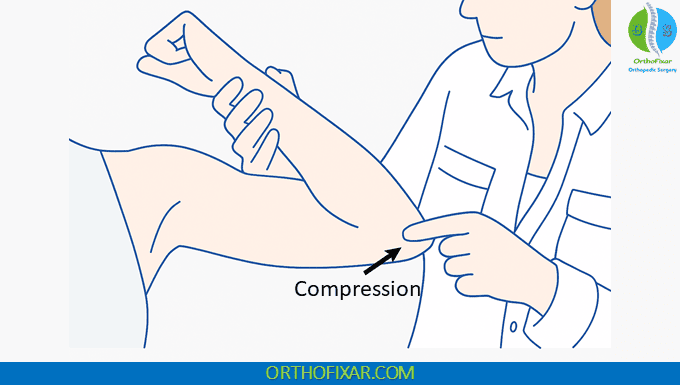
The test can be further modified by having the examiner apply:
- Direct pressure over the ulnar nerve using index and middle fingers
- Pressure applied between the posteromedial olecranon and medial epicondyle
- This variant is called the Elbow Flexion Compression Test or Cubital Tunnel Compression Test
See Also: Elbow Anatomy
Positive Test Interpretation
A positive Wadsworth Elbow Flexion Test is indicated by:
- Tingling or paresthesia in the ulnar nerve distribution
- Symptoms affecting the medial forearm and hand
- Specifically involving the little finger and medial half of the ring finger
Clinical Significance
What the Wadsworth Elbow Flexion Test Evaluates?
- Presence of cubital tunnel syndrome
- Ulnar nerve compression at the elbow
- Functional capacity of the ulnar nerve under stress
Anatomical Rationale
The Wadsworth Elbow Flexion Test position creates maximal stress on the ulnar nerve by:
- Stretching the nerve through elbow flexion
- Narrowing the cubital tunnel space
- Increasing pressure within the tunnel
- Creating conditions similar to those that occur during prolonged elbow flexion in daily activities
Clinical Application
When to Use
- Suspected ulnar nerve entrapment
- Complaints of medial elbow pain
- Numbness or tingling in ulnar nerve distribution
- Weakness in ulnar nerve-innervated muscles
Advantages of Different Versions
- Standard test: More specific, longer observation period
- Modified test (Ochi): Quicker results, may be more sensitive
- Compression variant: Increases diagnostic yield, more provocative
References & More
- Orthopedic Physical Assessment by David J. Magee, 7th Edition.
- Buehler MJ, Thayer DT. The elbow flexion test: a clinical test for the cubital tunnel syndrome. Clin Orthop. 1988;233:213–216. PubMed
- Butler DS. Mobilisation of the Nervous System.Melbourne: Churchill Livingstone; 1991
- Ochi K, Horiuchi Y, Tanabe A, et al. Shoulder internal rotation elbow flexion test for diagnosing cubital tunnel syndrome. J Shoulder Elbow Surg. 2012;21:777–781. PubMed
- Novak CB, Lee GW, Mackinnon SE, et al. Provocative testing for cubital tunnel syndrome. J Hand Surg Am. 1994;19:817–820. PubMed