Varus Test of the knee (or Varus Stress Test) is used to evaluate the integrity of the lateral collateral ligament injury. It’s the LCL sprain test.
Varus Stress Test is an assessment for one-plane lateral instability (i.e., the tibia moves away from the femur an excessive amount on the lateral aspect of the leg).
See Also: LCL Sprain
How do you perform the Varus Test of the knee?
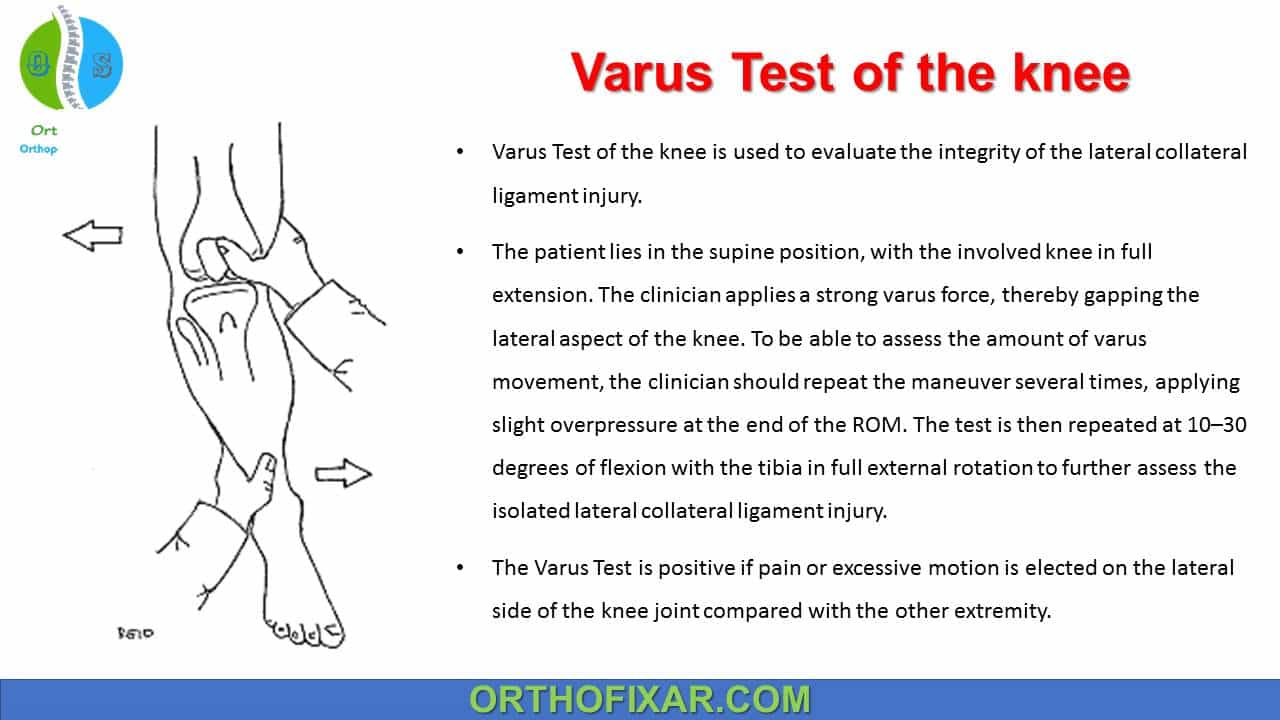
- The patient lies in the supine position, with the involved knee in full extension. The clinician applies a strong varus force, thereby gapping the lateral aspect of the knee.
- To be able to assess the amount of varus movement, the clinician should repeat the maneuver several times, applying slight overpressure at the end of the range of motion ROM.
- The test is then repeated at 10–30 degrees of flexion with the tibia in full external rotation to further assess the isolated lateral collateral ligament injury.
Avoid hip external rotation during the maneuver. The varus force must be applied perpendicular to the ligament in both testing positions.
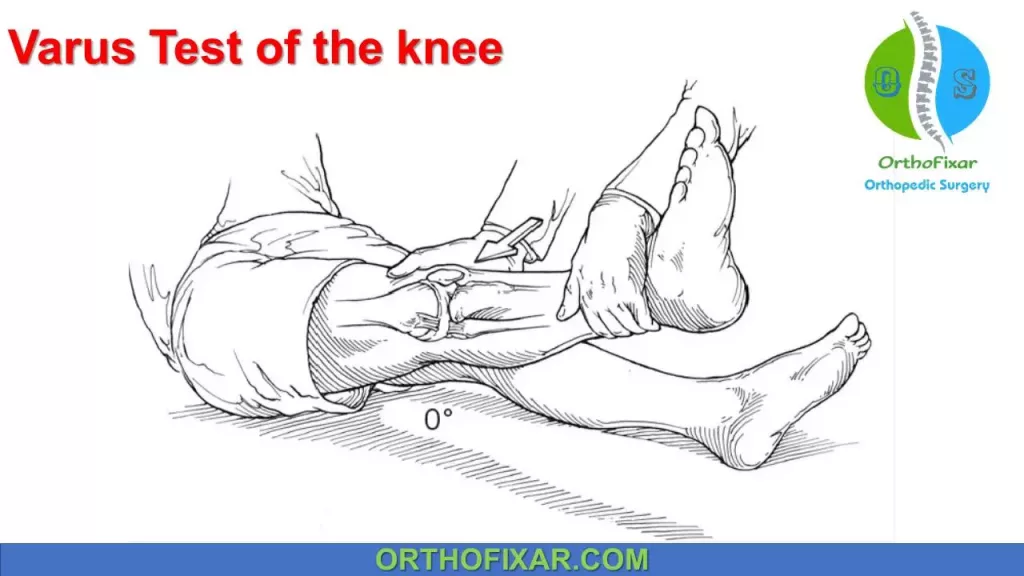

Hughston’s Varus Stress Test
In Hughston’s varus stress test, the examiner grasps the fifth and fourth toes and applies a varus stress to the knee in extension and slightly (20° to 30°) flexed.
What does a positive Varus Stress Test mean?
The Varus Stress Test of the knee is positive if pain or excessive motion is elected on the lateral side of the knee joint compared with the other extremity.
The following structures may be implicated if the test is positive in extension:
- Lateral collateral ligament LCL
- Lateral capsular ligament
- Posterolateral capsule
- Arcuate-popliteus complex
- Anterior cruciate ligament ACL
- Posterior cruciate ligament PCL.
- Biceps femoris tendon
- Lateral gastrocnemius muscle
- Iliotibial band.
If the test is positive when the knee is flexed 20° to 30° with lateral rotation of the tibia, the following structures may have been injured to some degree:
- Lateral collateral ligament
- Posterolateral capsule
- Arcuate-popliteus complex
- Iliotibial band
- Biceps femoris tendon
See Also: Knee Ligaments Anatomy
When testing lateral stability, the examiner assesses the degree of joint opening and the quality of the end point.
Valgus and Varus test of the knee can be graded by the following:
- Grade I: The joint space opening is within 2 mm of the contralateral side.
- Grade II: The joint space opens 3–5 mm more than the contralateral side in 20 degrees of knee flexion and less than 2 mm more than the normal knee in full extension.
- Grade III: The joint space opens 5–10 mm more than that of the normal knee in 20 degrees of flexion and full extension.
If the instability is gross, one or both cruciate ligaments as well as, occasionally, the biceps femoris tendon and the ilio tibial band may be involved, leading to a rotary instability if not in the short term, certainly over a period of time.
Notes
- To test the entire lateral joint capsule and other restraining structures, the knee is kept in complete extension. To isolate the LCL, flex the knee to 20-25°.
- In 20° of flexion, the primary lateral stabilizer is the lateral collateral ligament. The anterior cruciate ligament and popliteus tendon act as secondary stabilizers.
- Lateral stability is assessed in 20° of flexion and in full extension. Full extension prevents lateral opening as long as the posterior capsule and posterior cruciate ligament are intact, even if the medial collateral ligament is torn.
- In 20° of flexion, the posterior capsule is relaxed.
Related Anatomy
Lateral Collateral Ligament
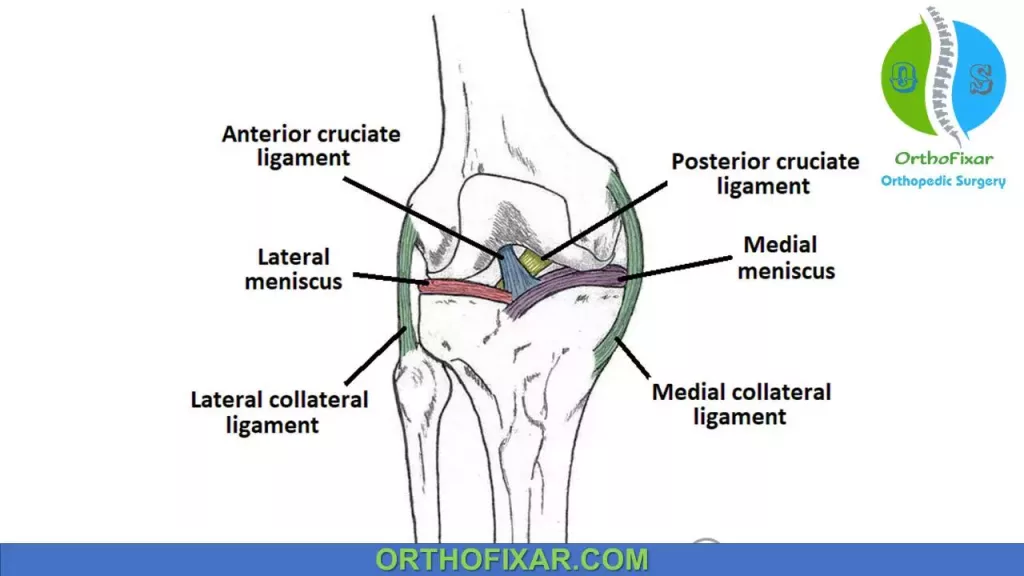
The LCL, or fibular collateral ligament, arises from the lateral femoral condyle and runs distally and posteriorly to insert into the head of the fibula.
The LCL forms part of the so-called arcuate-ligamentous complex. This complex also comprises the biceps femoris tendon, iliotibial tract, and the popliteus.
The cord-like LCL develops independently, and remains completely free from the joint capsule and the lateral meniscus. It is separated from these structures by the popliteus tendon, and straddled by the split tendon of the biceps femoris.
The LCL can be divided into three parts:
- Anterior: This part consists of the joint capsule.
- Middle: This part is considered to be part of the iliotibial band (ITB) and covers the capsular ligament.
- Posterior: This Y-shaped portion of the ligament is part of the arcuate-ligamentous complex, which supports the posterior capsule.
The main function of the LCL is to resist varus forces. It offers the majority of the varus restraint at 25 degrees of knee flexion, and in full extension.
Reference
- Reinold MM, Berkson EM, Asnis P, et al: Knee: Ligamentous and patella tendon injuries. In: Magee DJ, Zachazewski JE, Quillen WS, eds. Pathology and intervention in musculoskeletal rehabilitation. St. Louis, MI: Saunders, 2009:528–578.
- Youtube: Varus Stress Test of the Knee | Lateral Collateral Ligament – YouTube
- Clinical Tests for the Musculoskeletal System, Third Edition book.
- Mark Dutton, Pt . Dutton’s Orthopaedic Examination, Evaluation, And Intervention, 3rd Edition Book.