The Sorensen Test, also known as the Back Extensor Endurance Test, is used to evaluate the endurance of the hip and back extensor muscles. It was first described by Hansen in 1964 and later popularized by Biering-Sorensen in 1984, who demonstrated its ability to predict the development of low back pain in men over the following year.
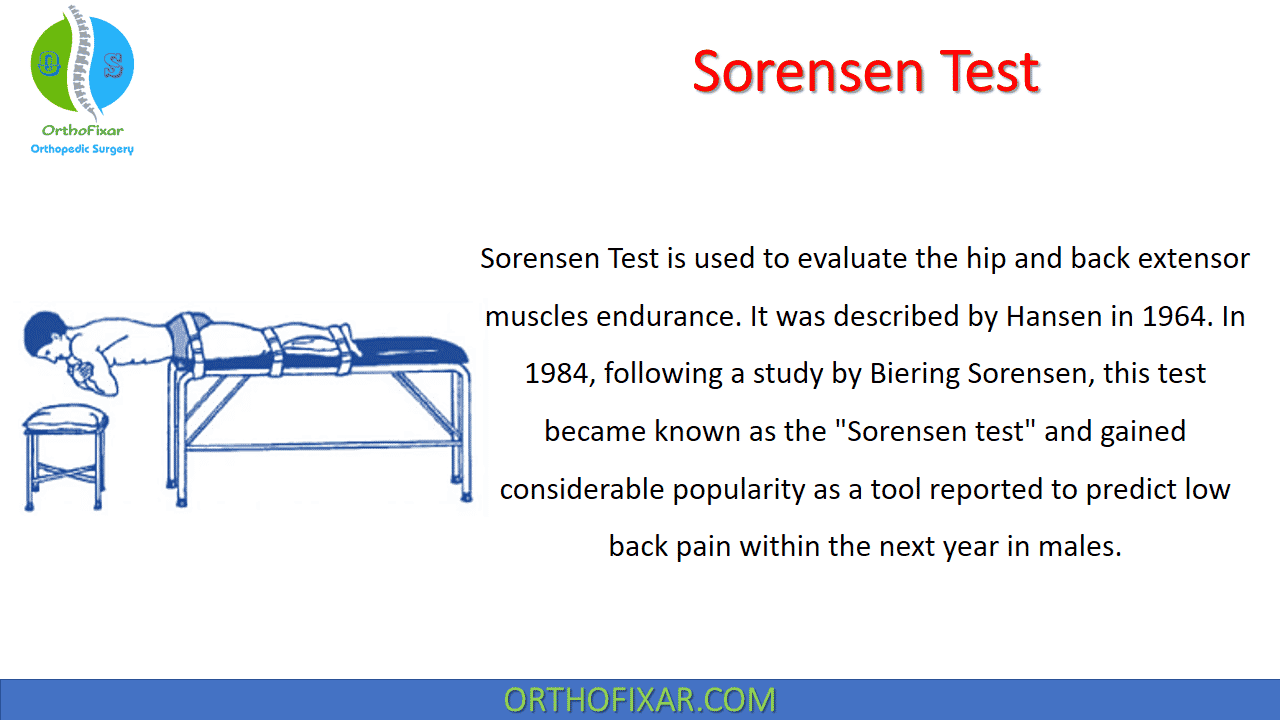
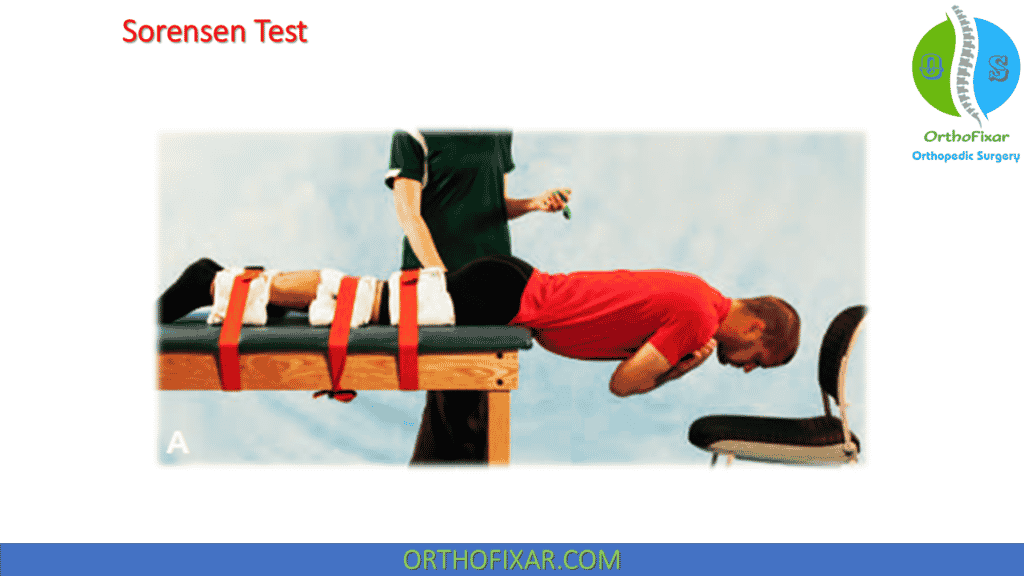
The Sorensen Test measures the amount of time a patient can hold the unsupported upper body in a horizontal prone position with the lower body fixed to the examining table.
The following muscles are primarily engaged during the Sorensen Test:
- Iliocostalis lumborum,
- iliocostalis thoracis,
- longissimus thoracis,
- spinalis thoracis,
- semispinalis thoracis,
- multifidus,
- rotatores,
- latissimus dorsi,
- quadratus lumborum.
See Also: Hip Muscles Anatomy
How do you perform the Sorensen Test?
- The patient lies prone on an examination table with the upper border of the iliac crests aligned with the table edge. The hips and legs are secured using straps to prevent movement. The arms are crossed over the chest.
- The patient lifts and maintains the upper body in a horizontal position, parallel to the ground.
- The examiner times how long the patient can hold this position before fatigue occurs.
🕐 Duration (endurance time) is the key outcome measure.
Tip: Make sure the patient’s body remains straight without compensatory extension or flexion at the lumbar spine.
See Also: Thomas Test

What does a positive Sorensen Test mean?
Decreased back extensor endurance is associated with development and persistence of low back pain.
The average duration for young, adult men and women is 146±51 seconds and 189±60 seconds, respectively. In another study with a broader age range, the average endurance time was 113±46 seconds, with decreasing endurance with increasing age.
Normal Values
| Population | Average Duration |
|---|---|
| Young adult men | 146 ± 51 seconds |
| Young adult women | 189 ± 60 seconds |
| Mixed adult sample | 113 ± 46 seconds |

Modified Sorensen Test
For the modified Sorensen test, the patient is prone, with the hands behind the back or by the sides. The patient is instructed to raise the chest off the table by extending the lumbar spine to approximately 30 degrees and holding the position.

Notes
- Individuals with a higher BMI tend to fatigue more quickly.
- Males with chronic low back pain demonstrate shorter endurance times.
- The Sorensen Test shows high test–retest reliability:
- Asymptomatic patients: r = 0.77
- Patients with nonspecific low back pain: r = 0.80
Lateral Abdominals Endurance
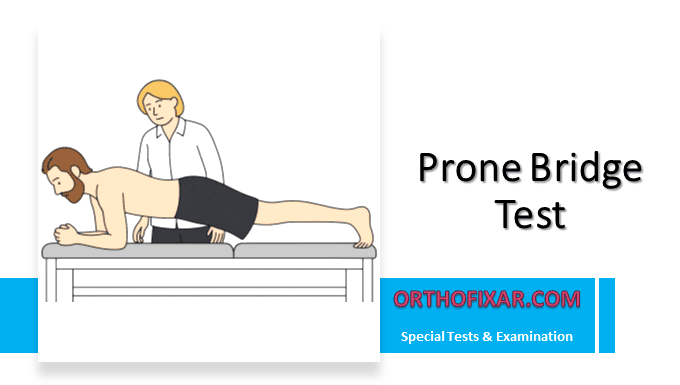
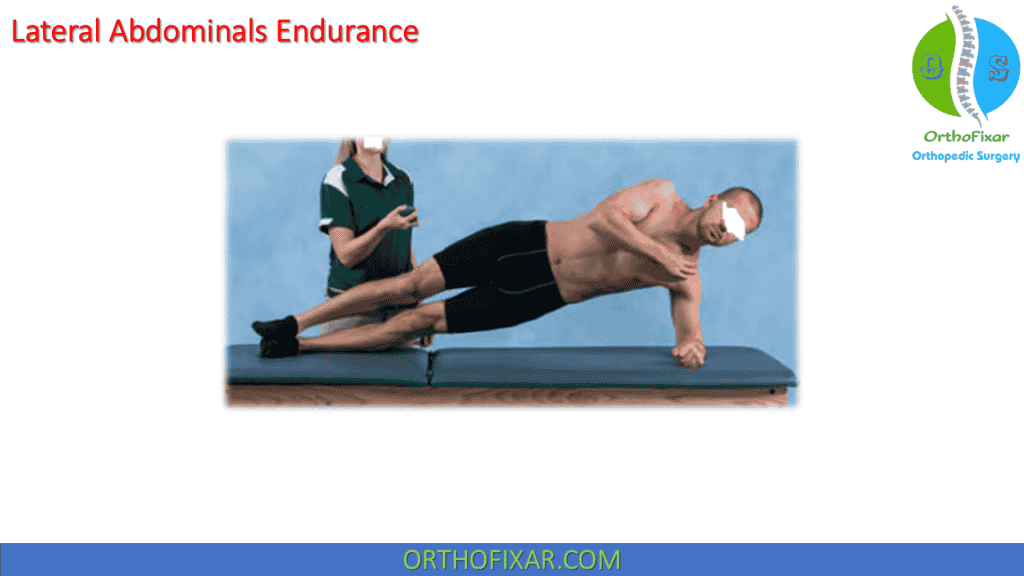
The patient is side-lying with the legs straight and the body resting on the flexed elbow. Alternatively, the patient’s knees are flexed. Muscles Assessed Internal oblique, external oblique, quadratus lumborum.
The patient lifts the pelvis off the table while maintaining the spine in a neutral (neither flexed nor extended) position a side bridge. The hand of the uninvolved arm crosses the chest to the opposite shoulder. The examiner times the duration that the patient can maintain the position. Repeat the test on the opposite side.
A right-to-left difference of greater than 5% suggests an imbalance. On average, healthy males can maintain the position for approximately 94±34 [R] and 97±35 [L] seconds, and females can maintain the position for 72±31 [R] and 77±35 [L] seconds.
FAQ
What is the purpose of the Sorensen Test?
To evaluate the endurance of the spinal and hip extensor muscles and identify risk factors for low back pain.
What does a positive Sorensen Test indicate?
Reduced endurance of the back extensors, often associated with chronic or recurrent low back pain.
How long should you hold the Sorensen Test?
Healthy adults can typically hold between 90–180 seconds depending on age, sex, and fitness level.
Is the Sorensen Test reliable?
Yes. Studies show high reliability in both healthy and symptomatic populations.
References
- Demoulin C, Vanderthommen M, Duysens C, Crielaard JM. Spinal muscle evaluation using the Sorensen test: a critical appraisal of the literature. Joint Bone Spine. 2006 Jan;73(1):43-50. doi: 10.1016/j.jbspin.2004.08.002. PMID: 16461206. PubMed
- McGill, SM, et al: Endurance times for low back stabilization exercises: clinical targets for testing and training from a normal database. Arch Phys Med Rehabil, 80:941, 1999. PubMed
- Reiman, MP, et al: Comparison of different trunk endurance testing methods in college-aged individuals. Int J Sports Phys Ther, 7:533, 2012. PubMed
- Handrakis, JP, et al: Key characteristics of low back pain and disability in college-aged adults: a pilot study. Arch Phys Med Rehabil, 93:1217, 2012. PubMed
- Adedoyin, RA, et al: Endurance of low back musculature: normative data for adults. J Back Musculoskelet Rehabil, 24:101, 2011. PubMed
- Süüden, E: Low back muscle fatigue during Sorensen endurance test in patients with chronic low back pain: relationship between electromyographic spectral compression and anthropometric characteristics. Electromyogr Clin Neurophysiol, 48:185, 2008. PubMed