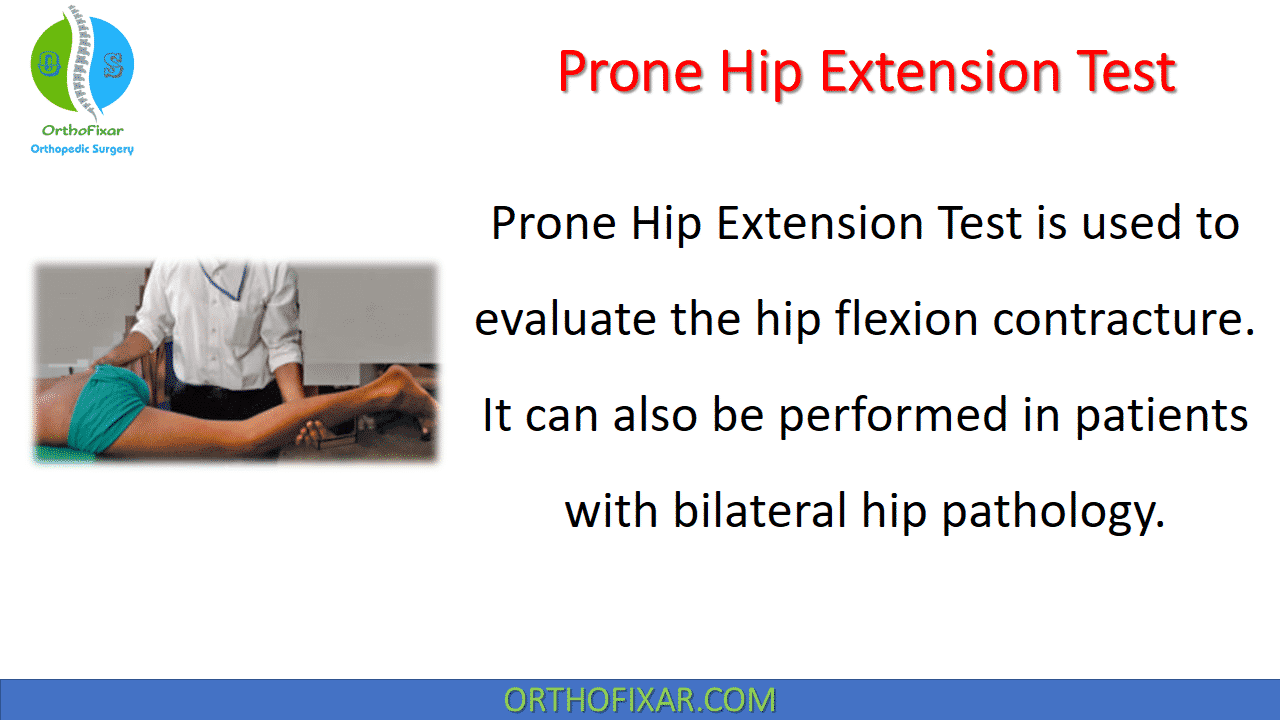
Prone Hip Extension Test is used to evaluate the hip flexion contracture. It can also be performed in patients with bilateral hip pathology. It’s sometimes called Staheli test.
How do you perform the Prone Hip Extension Test?
The prone hip extension test can be performed on a regular padded examination table.
The patient is positioned prone with both hips flexed comfortably over the end of the examination couch. The patient is adequately undressed to allow visualization of the back. The other limb can be held between the examiner’s knees, can be kept on a stool, or can be hung from the edge of the table. The examiner slowly extends the thigh while placing the other hand over the pelvis.
See Also:
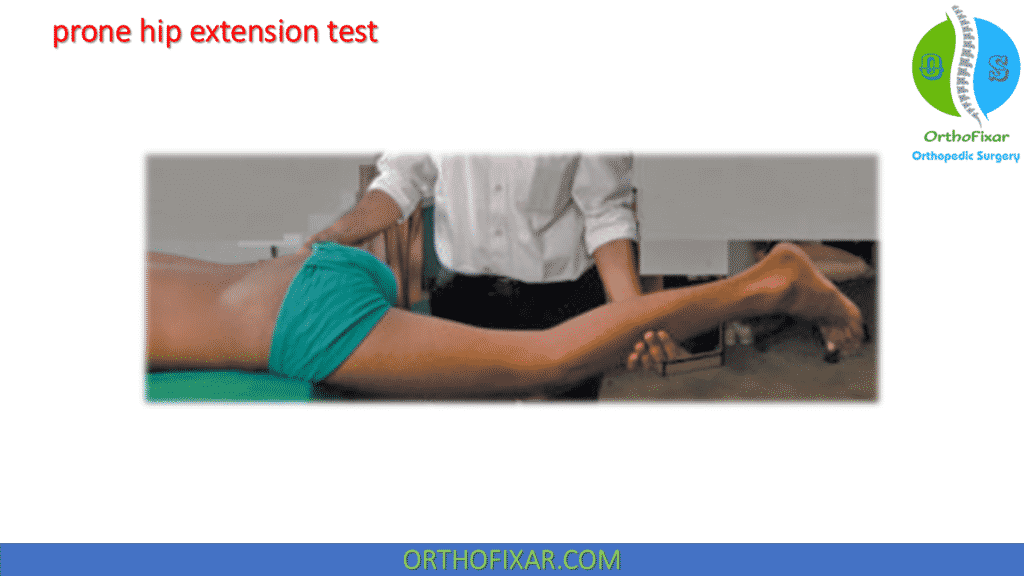
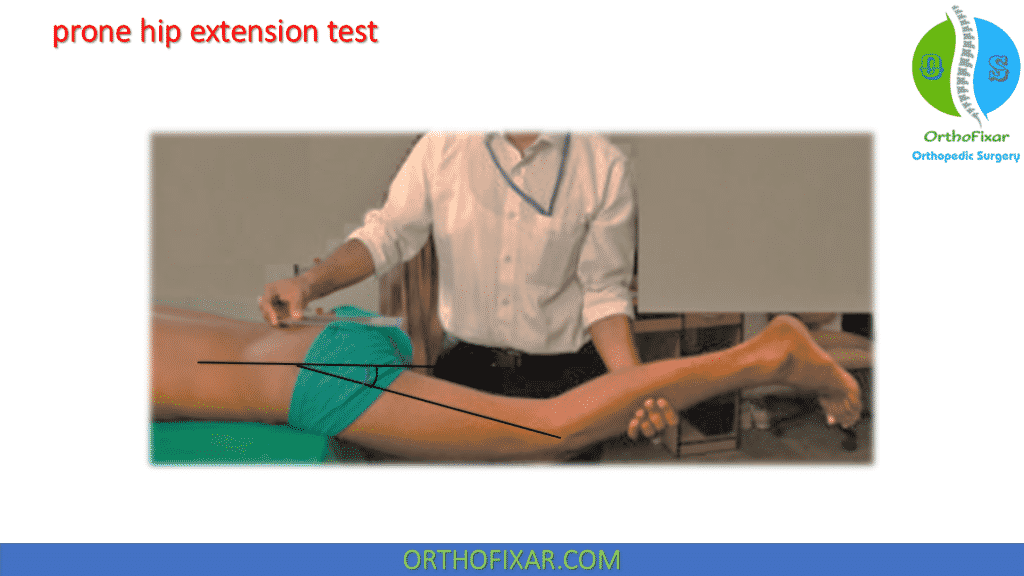
The point at which the pelvis begins to rise denotes the termination of extension at the hip joint and the beginning of movement at the spine. At this point, the angle between an imaginary horizontal line parallel to the trunk and thigh gives the value of hip flexion contracture.
This test provides a method of flattening the lumbar spine under visual control to avoid obtaining either a falsely high or low value. It, therefore, circumvents the problems commonly associated with the traditional “Thomas Test”.
Another way to perform the prone hip extension test is with the patient lies prone with the examiner by the side at the level of the patient’s hip. Starting with the “good” leg, the patient is asked to extend the hip about 20 cm (8 inches) off the table.
While the patient lifts the leg, the examiner observes (or palpates), watching for one of four abnormal lumbopelvic motion patterns:
- Rotation of the lumbar spine so that the spinous processes move toward the side of hip extension;
- Lateral shift of the lumbar spine toward the side of hip extension;
- Extension of the lumbar spine;
- The pelvic girdle raises off the table. The test is then repeated with the affected leg.
If the spine and pelvis do not move, the test is negative for abnormal lumbopelvic motion and microinstability in the lumbar spine
Fixed Flexion Deformity
The compensatory mechanism in flexion deformity of the hip is an exaggeration of lumbar lordosis, which needs to be obliterated to reveal the actual deformity for accurate measurement. The flexion deformity is quantified by the Tomas test and Prone Hip Extension Test as an alternative to Thomas test.
References
- Staheli LT. The prone hip extension test: a method of measuring hip flexion deformity. Clin Orthop Relat Res. 1977 Mar-Apr;(123):12-5. PMID: 852171.
- Rang M. Anthology of orthopaedics. Edinburgh and London: E & S. Livingstone Ltd, 1968. pp. 137–138.
- Moon, Seung & Choi, Young & Chung, Chin & Sung, Ki & Cho, Byung & Chung, Myung & Kim, Jaeyoung & Yoo, Mi & Lee, Hyung & Park, Moon Seok. (2017). Normative Values of Physical Examinations Commonly Used for Cerebral Palsy. Yonsei Medical Journal. 58. 1170. 10.3349/ymj.2017.58.6.1170. Link
- Bruno PA, Goertzen DA, Millar DP. Patient-reported perception of difficulty as a clinical indicator of dysfunctional neuromuscular control during the prone extension test and active straight leg raise test. Man Ther. 2014;19(6):602–607. Link