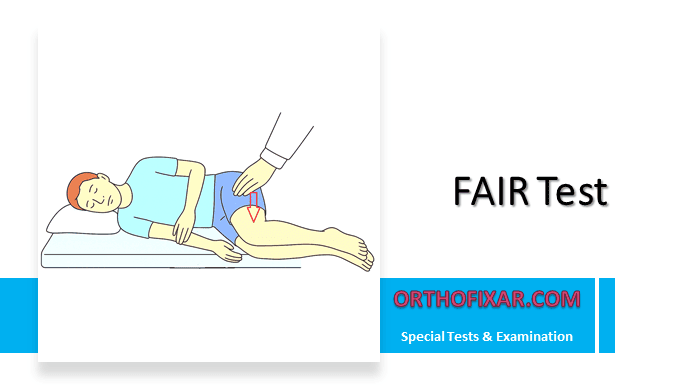
The FAIR Test is designed to identify irritation or compression of the sciatic nerve by the piriformis muscle. It assesses both muscular tightness and potential neural involvement. It’s also called Flexion, Adduction, and Internal Rotation Test.
Piriformis-related sciatic nerve entrapment is an important cause of buttock pain and sciatica. In approximately 15% of individuals, the sciatic nerve (or part of it) passes through the piriformis muscle instead of beneath it. This configuration increases the likelihood of irritation or compression of the nerve, leading to what has traditionally been called Piriformis Syndrome, now more accurately described as Deep Gluteal Syndrome (DGS).
The piriformis muscle originates from the anterior surface of the sacrum and inserts onto the greater trochanter of the femur. The sciatic nerve exits the pelvis inferior to the piriformis. However, in variants where the nerve pierces or splits around the muscle, mechanical compression during hip motion becomes more likely, particularly in positions involving flexion, adduction, and internal rotation.
See Also: Piriformis Muscle Anatomy
How to Perform the FAIR Test?
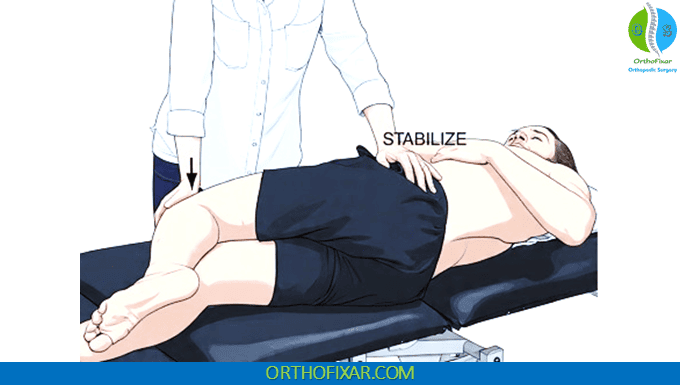
Side-Lying Technique (Original FAIR Position)
- Position the patient side-lying, with the test leg uppermost.
- Flex the hip to approximately 60°, keeping the knee flexed.
- Allow the hip to fall slightly into adduction and internal (medial) rotation—this is the FAIR position.
- The examiner stabilizes the pelvis with one hand.
- With the other hand, the examiner applies downward pressure on the patient’s knee.
Supine Variation
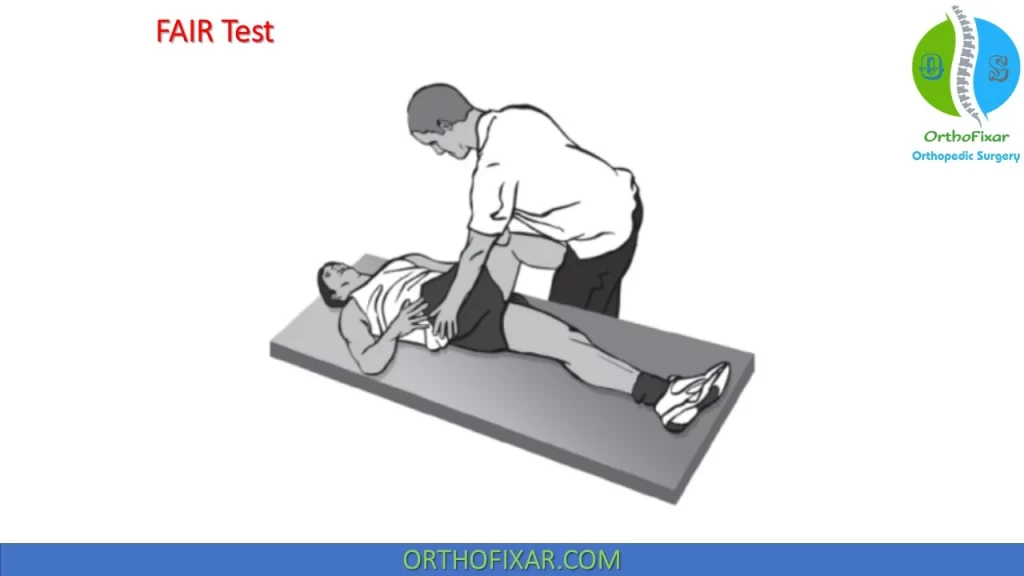
A commonly used clinical modification involves positioning the patient supine:
- While supporting the patient’s knee, the clinician brings the hip into flexion, adduction, and internal rotation.
- Pressure is applied to deepen the position.
See Also: Thomas Test
What does the Positive Sign FAIR Test Mean?
- Localized pain in the piriformis area indicates muscular tightness.
- Neurologic pain, including radiating buttock pain or sciatica, suggests compression of the sciatic nerve by the piriformis.
A positive FAIR test may indicate:
- Piriformis muscle tightness
- Sciatic nerve compression
- Deep gluteal syndrome
- Reproduction of symptoms associated with prolonged sitting, running, or climbing stairs
Because the piriformis contributes to external rotation, resisted lateral rotation with the hip in internal rotation may further provoke symptoms, reinforcing the diagnosis.
See Also: Piriformis Syndrome
Test Accuracy
The test has been shown to be clinically useful, with:
- Sensitivity: 88%
- Specificity: 83%
This makes it a valuable component of the physical examination when DGS is suspected.
References & More
- Hopayian K, Song F, Riera R, Sandbandan S. The clinical features of the piriformis syndrome: a systematic review. Eur Spine J. 2010;19(12):2095–2109. PubMed
- Pace JB, Nagle D. Piriform syndrome. West J Med. 1976;124(6):435–439. PubMed
- Fishman LM, Dombi GW, Michaelson C, et al. Piriformis syndrome: diagnosis, treatment, and outcome – a 10-year study. Arch Phys Med Rehabil. 2002;83(3):295–301. PubMed
- Boyajian-O’Neill LA, McClain RL, Coleman MK, Thomas PP. Diagnosis and management of piriformis syndrome: an osteopathic approach. J Am Osteopath Assoc. 2008;108(11):657–664. PubMed
- Carro LP, Hernando MF, Cerezal L, et al. Deep gluteal space problems: piriformis syndrome, ischiofemoral impingement and sciatic nerve release. Muscles Ligaments Tendons J. 2016;6(3):384–396. PubMed
- Orthopedic Physical Assessment by David J. Magee, 7th Edition.