Many physical fitness tests have been designed to evaluate the physical fitness of schoolchildren, armed services personnel, athletic teams, and countless others engaged in health and fitness programs.
In spite of long-standing and widespread use, three tests in particular need to be re-evaluated:
- Bent knee sit ups test.
- Push ups test.
- Sit and reach test.
The usefulness of these tests depends on their accuracy and their ability to detect deficiencies. Unfortunately, Physical Fitness Tests have become an evaluation of the performance rather than a measure of the physical fitness of the performer. Emphasis is on excesses speed of performance, number of repetitions, and extent of stretching rather than on quality and specificity of movement.
Bent knee sit ups test
The Bent knee sit ups test requires that a person perform as many sit-ups as possible in a period of 60 seconds.
The stated purpose of the test is to measure endurance and strength of the abdominal muscles. The test does not fulfill that purpose, however. Instead, it measures strength and endurance of the hip flexor muscles, aided in their performance by stabilization of the feet.
The sit-up movement requires flexion of the hip joints, and this movement can be performed only by hip flexors. Abdominal muscles do not cross the hip joint, so they cannot assist in the hip flexion movement. Abdominal muscles flex the spine (curl the trunk), and to test the strength of these muscles, the trunk must be curled. If these muscles can hold the trunk curled as the movement of hip flexion is performed, this indicates good upper abdominal muscle strength.
The problem with using the sit-up movement as a test or an exercise lies in the failure to differentiate between a “curled trunk sit-up” and an “arched back sit-up.” The former involves strong contraction of the abdominal muscles to hold the trunk curled; the latter puts a stretch on the abdominal muscles and a strain on the low back. This strain may be felt by both children and adults when they are required to perform as many sit-ups as possible in the time allotted.
Many will start the sit-up with the trunk curled. The endurance of the abdominal muscles will not be sufficient to maintain the curl, however, and as the test progresses, the back will arch increasingly. Some will not have the strength even to curl the trunk initially, and the test will be done with the back arched for the entire 60 seconds.
The problem is that those with weak abdominal muscles can pass this so-called “abdominal muscle test” with a high score. The test, as advocated, requires speed of performance. For accurate testing of abdominal muscle strength, however, the test must be done slowly, making sure that the trunk curls before hip flexion starts and that the curl is maintained both when hip flexion starts and while moving to the sitting position.
To have validity, the test should require that credit be given only for the number of sit-ups that can be performed with the trunk curled. Currently, the test has no such requirement. Furthermore, the test cannot be done rapidly if the position of the trunk is to be observed closely.
The people most in danger of being adversely affected by repeated sit-ups with the knees bent are children and youths because they start with more flexibility than adults. Those adults who have low back pain associated with excessive low back flexibility also may be adversely affected by this exercise.
An interesting phenomenon in some subjects who have done a great number of Bent knee sit ups is that they show excessive flexion in sitting or in forward bending but a lordosis in standing.
It is unfortunate that the ability to do a certain number of sit-ups, regardless of how they are performed, is used as a measure of physical fitness.
Along with pushups, these two exercises probably are stressed more than any others in fitness programs. Done to excess, however, these exercises tend to increase—or even produce—postural faults.

Push Ups Test
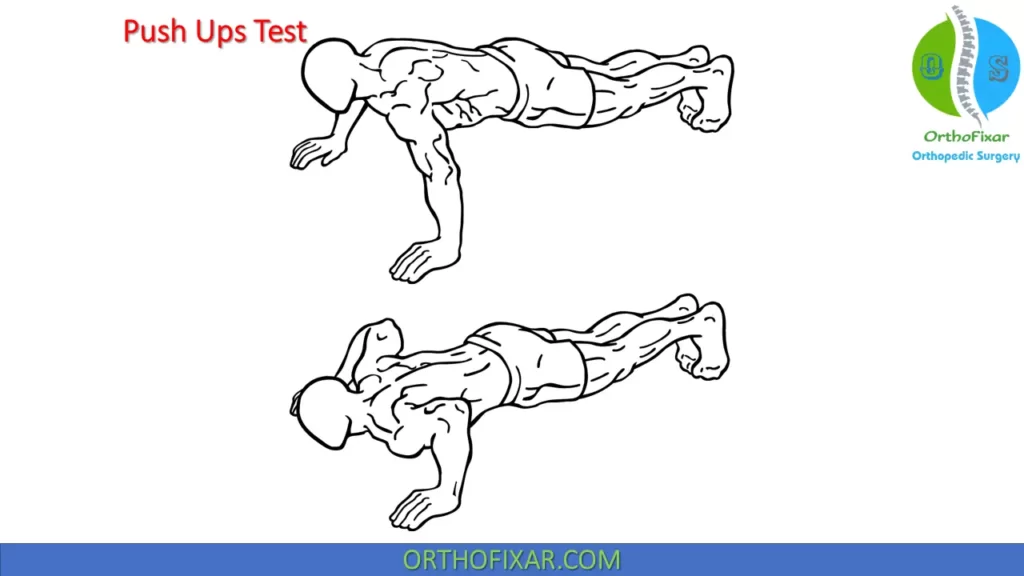
When a push-up is performed properly, the scapulae abduct as the trunk is pushed upward. The scapulae move forward to a position that is comparable to that of reaching the arms directly forward.
When the serratus anterior muscle is weak, the push-up movement still can be performed, but the scapulae do not move into the abducted position as in a properly performed push-up.
If the primary purpose of the push-ups is to test strength and endurance of the arm muscles, it accomplishes that purpose, but in the presence of serratus weakness, it does so at the expense of the serratus muscle.
Evidence for this is seen in the winging of the scapulae and in the inability to complete the range of
scapular motion in the direction of abduction.
When push-ups are done at the expense of the serratus muscle, the activity can no longer be considered an index for the physical fitness of the person being tested.
Sit and Reach Test
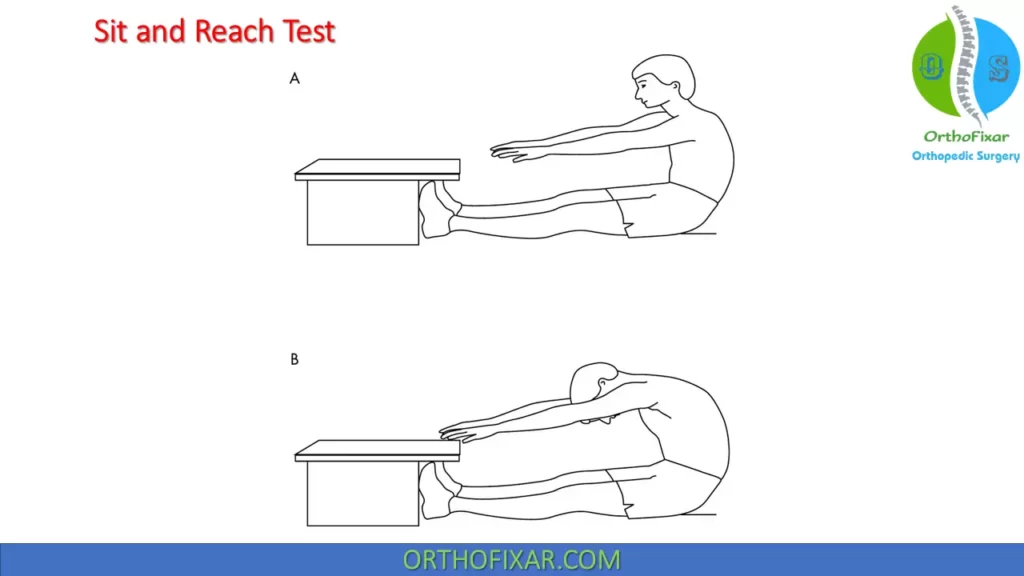
The Sit and Reach Test is a widely used assessment intended to evaluate flexibility of the hamstrings and lower back. It involves reaching forward from a seated position with knees extended, with scoring based on how far the fingertips reach toward or beyond the toes. While touching the toes is generally considered normal for most adults and young children, reaching beyond them is often interpreted as superior flexibility.
See Also: Sit and Reach Test
References
- Mayorga-Vega D, Merino-Marban R, Viciana J. Criterion-related validity of sit-and-reach tests for estimating hamstring and lumbar extensibility: A meta-analysis. Journal of sports science & medicine. 2014 Jan;13(1):1. Link
- Muscles: Testing and Function with Posture and Pain. Book by F. P. Kendall, 5th Edition.