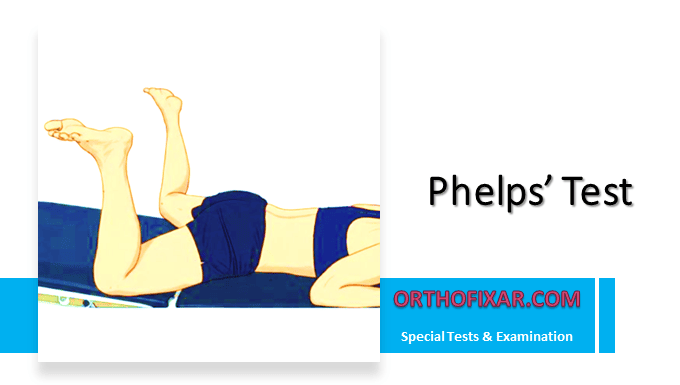
Phelps Test helps differentiate whether limited hip abduction is caused by muscular tightness rather than joint pathology. Phelps Test is designed to assess contracture of the gracilis muscle, one of the medial thigh muscles responsible for hip adduction and knee flexion. Tightness of this muscle can contribute to gait abnormalities, hip mobility limitations, and problems such as crouched gait in children with neuromuscular conditions.
The gracilis is a long, thin muscle that runs along the inner thigh. It originates from the pubic bone and inserts on the medial aspect of the proximal tibia. The gracilis serves dual functions: it adducts the hip (brings the leg toward the midline) and assists in knee flexion. When the knee is extended, the gracilis functions primarily as a hip adductor, but when the knee is flexed, its tension across the hip joint is reduced.
See Also: Gracilis Muscle Anatomy
How to Perform the Phelps Test?
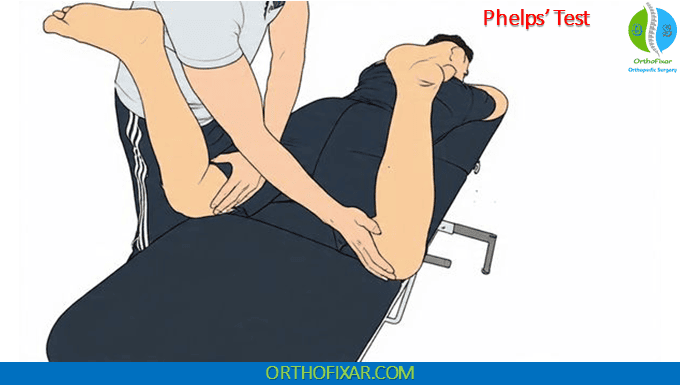
- The patient lies prone on the examination table. The knees remain fully extended.
- The examiner first passively abducts both legs as far as possible while the knees are extended.
- Next, the examiner flexes both knees to 90°.
- With the knees flexed, the examiner again attempts to abduct the hips further.
This change in knee position places slack on the two-joint muscles of the medial thigh, specifically the gracilis.
What does a Positive Phelps Test Mean?
Positive Phelps Test: If hip abduction increases after the knees are flexed to 90°, the test is positive.
This indicates a contracture of the gracilis muscle, as flexing the knees relaxes the gracilis and allows greater abduction.
Negative Test: If hip abduction does not improve, the limitation is likely due to other structures—possibly the adductor longus, adductor brevis, joint pathology, or capsular tightness.
A positive Phelps Test is clinically valuable in:
- Children with spasticity (e.g., cerebral palsy)
- Patients with gait abnormalities due to medial thigh tightness
- Pre-operative planning for adductor lengthening procedures
- Differentiating between multi-joint and single-joint adductor contractures
Early identification helps guide appropriate stretching programs, physical therapy, bracing strategies, or surgical decision-making.
References & More
- Evans RC. Illustrated Essentials in Orthopedic Physical Assessment. St Louis: CV Mosby; 1994.
- Orthopedic Physical Assessment by David J. Magee, 7th Edition.
- Khan IA, Bordoni B, Varacallo MA. Anatomy, Bony Pelvis and Lower Limb: Thigh Gracilis Muscle. [Updated 2023 Apr 4]. In: StatPearls [Internet]. Treasure Island (FL): StatPearls Publishing; 2025 Jan-. Available from: PubMed